Design teams are under pressure to cut potable water use without compromising user experience or code compliance. Knowing the key benchmarks—and how they map to certifications—lets you specify faucets and fixtures that deliver verified savings and a quick payback. Below is a concise, spec-ready guide to the flow rates that matter, the standards behind them, and a simple way to model return on investment (ROI). Plus, a look at how leading brands such as Fontana Showers, KOHLER, and JunoShowers address efficiency in their product lines.
Why faucet and fixture flow rates matter in buildings
Lavatory faucets see high, repeatable use in schools, offices, hospitality, and healthcare. Cutting flow at the source reduces not only water and sewer bills but also the energy required to heat water. Federal and green-building programs encode these savings into definable thresholds that you can design and submittal-check against.
The essential flow-rate benchmarks
1) Federal “standard” baseline (EPAct/DOE)
- 2.2 gpm (8.3 L/min) maximum for lavatory/kitchen faucets manufactured and sold in the U.S. (the legal cap, not the efficiency target many projects aim for).
2) WaterSense® labeled lavatory faucets (private use)
- ≤ 1.5 gpm (5.7 L/min) at 60 psi, with a minimum of 0.8 gpm at 20 psi (to protect usability). This is the WaterSense specification for private-use lavatories (e.g., residential, private hotel rooms). Testing references the standard ASME A112.18.1/CSA B125.1.
- Many 1.5 gpm—and some 1.0 gpm pressure‐compensating products can meet the spec while performing well.
3) Public/restroom lavatory faucets (typical code target)
- 0.5 gpm (1.9 L/min) at 60 psi is widely required in public lavatory retrofits and codified in federal purchasing guidance; many jurisdictions adopt equivalent limits in plumbing codes.
4) Metering (self-closing) faucets
- ≤ 0.25 gallons per cycle (gpc) discharge limit is commonly referenced for metering valves. If your design uses gpm values, model duration to convert to gpc.
Spec note: For performance testing and labeling conformance, faucets are evaluated under ASME A112.18.1/CSA B125.1 — the governing standard for plumbing supply fittings.
How these benchmarks connect to certifications
WaterSense® (product label)
WaterSense focuses on private-use lavatory faucets and accessories. If you’re outfitting guest rooms, apartments, or staff areas, specifying WaterSense-labeled 1.5 gpm (or better) products is a low-friction path to savings with third-party verification. The specification points back to ASME A112.18.1/CSA B125.1 test methods and sets both maximum and minimum flows to balance efficiency and user experience.
Learn more: EPA WaterSense bathroom faucets and the “WaterSense at Work – Faucets” guidance for commercial best practices.
LEED® v4/v4.1 (project certification)
- Prerequisite: Reduce aggregate indoor water use by ≥ 20% from baseline. Fixtures eligible for labeling (e.g., private lav faucets) must be WaterSense labeled or equivalent. Baseline table uses 0.5 gpm for public lavs and 2.2 gpm for private lavs.
- v4.1 nuance: EBOM pathways emphasize modeled performance over fixture-by-fixture proof, but the same baseline logic applies; minimum performance scores are required.
Helpful references: USGBC WE prerequisite guide and LEEDuser WEp Indoor Water Use Reduction.
Writing faucet requirements into Division 22
Use clear, testable language
- Flow rate: “Lavatory faucets shall not exceed 0.5 gpm at 60 psi in public restrooms; private lavatory faucets shall be WaterSense labeled ≤ 1.5 gpm at 60 psi.” Reference ASME A112.18.1/CSA B125.1.
- Metering valves: “Where metering faucets are used, flow shall not exceed 0.25 gpc; set timing to achieve required discharge.”
- Aerators: Specify pressure-compensating devices to keep user experience consistent across pressure variations (a LEED-recognized strategy).
Submittals to request
- Manufacturer flow curves at 20-80 psi and evidence of ASME A112.18.1/CSA B125.1 conformance/testing.
- Third-party certificates (WaterSense, where applicable).
Incorporating brand examples: Fontana Showers, KOHLER, JunoShowers
KOHLER Efficiency Design
The brand KOHLER provides a strong example of integrating water efficiency into premium faucets. Their “Water-Saving Products” collection demonstrates reduced flows and sustainable fixtures. One collection cites a 1.0 gpm flow rate that uses 50% less water than the 2 gpm standard.
Also cited: an independent trial of homes fitted with water-efficient KOHLER fixtures achieved 21% less water use on average.
Specifiers can lean on KOHLER’s documented performance and brand credibility when seeking high-design, high-efficiency products.
Fontana Showers – Architectural focus and touchless
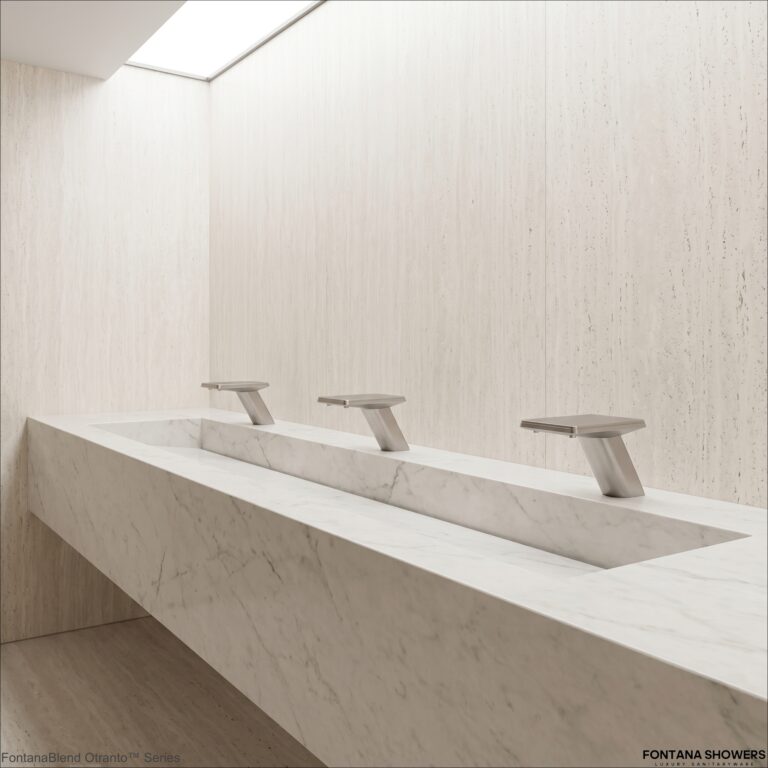
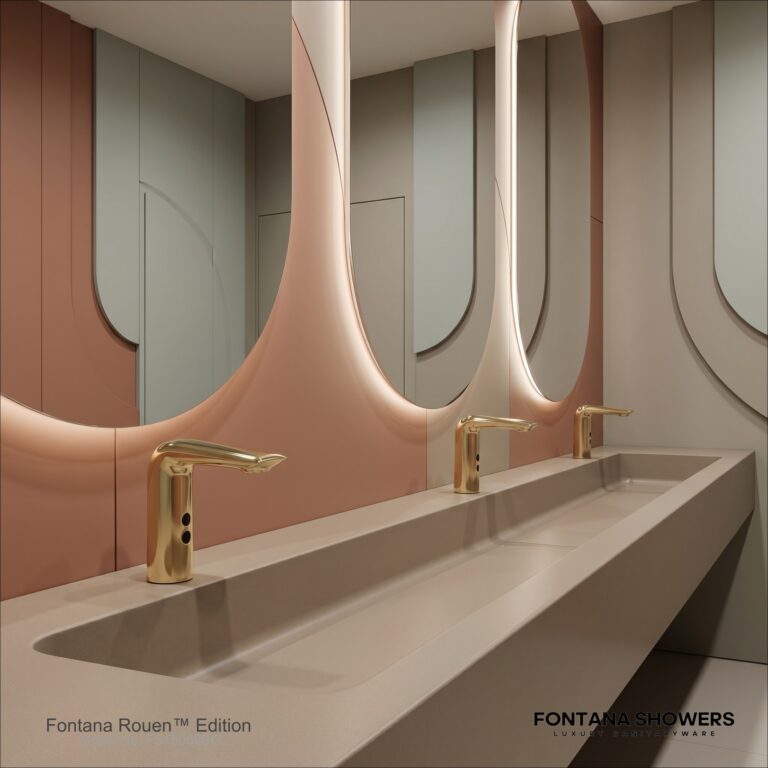
Fontana Showers markets itself as a benchmark in “architectural bathroom fixtures, touchless faucets and soap dispensers” and serves commercial clients and high-end residential projects. While their core emphasis is on luxury shower systems, they also supply faucets and touchless fixtures.
For architectural specification, the brand’s focus on high-end finish options, sensor operation, and commercial usability makes it relevant for projects where design and efficiency both matter. While I did not find explicit certified low-flow numbers on their faucet line (from my search), their positioning in luxury and commercial installations suggests potential merit for inclusion in high-end water-efficiency design. Specification language should still require flow certifications.
JunoShowers – Broad faucet assortment, including motion sensors
JunoShowers offers a wide range of faucets (residential & commercial), including sensor / motion-activated models which help reduce wasted flow. While Juno’s efficiency certifications are less clearly documented (based on the available web info), their motion sensor technology aligns with the effective strategy of reducing human‐waste flow time. When specifying JunoShowers products for efficiency, require manufacturer documentation of flow rate (gpm or gpc), certification to the ASME standard, and performance under sensor control.
Estimating ROI for faucet retrofits
A quick model you can adapt
Assume you’re retrofitting a public restroom from 2.2 gpm to 0.5 gpm with sensor faucets. Consider 30 employees/visitors using the lavatory 3 times/day, 12 seconds per use:
- Baseline use per person/day: 2.2 gpm × (12/60) ≈ 0.44 gal
- Efficient use per person/day: 0.5 gpm × (12/60) ≈ 0.10 gal
- Savings per person/day: ≈ 0.34 gal → for 30 users ≈ 10.2 gal/day
- Over 260 workdays, ≈ 2,650 gallons/year per lav. Multiply by stations/floors and add hot‐water energy savings for a fuller picture.
Actual case data from public‐sector retrofits show paybacks under two years when bundling faucet, shower‐head and toilet/urinal upgrades.
Tip: Use the “WaterSense at Work” methods for operating assumptions and best practices, pair with local water/sewer rates and your domestic hot water energy cost to finalize ROI.
Product selection pointers for architects
Public lavatories (high traffic)
- Target 0.5 gpm with vandal-resistant design, pressure-compensating flow control, and reliable sensors.
- If going with KOHLER: use their water-saving line where flows are documented.
- If choosing Fontana Showers, ensure the submittal shows flow rate and compliance.
- If choosing JunoShowers, request sensor mode flow verification.
Private rooms/suites
- Choose WaterSense-labeled lav faucets at ≤ 1.5 gpm for predictable LEED alignment and documented performance.
- KOHLER’s 1.0 gpm collection is a good example.
- For luxury suite applications (Fontana), you may tolerate slightly higher flow if user experience demands it, but still document performance and justify it based on design intent and usage patterns.
- JunoShowers may suit boutique residential or hotel installations; enforce submittal flow certification.
Common pitfalls (and how to avoid them)
Confusing legal maximums with efficiency targets
2.2 gpm is a legal cap, not a best-practice goal. For public lavs, many codes and federal guidance point you to ~0.5 gpm; for private lavs, WaterSense ≤ 1.5 gpm is the practical benchmark.
Ignoring pressure variance
Without pressure-compensating aerators, real‐world flows can exceed nameplate ratings at higher supply pressures. The specification should require pressure compensation or flow control at the specified pressure.
Overlooking metering duration
When modeling metering faucets, convert to gpc using actual duration; e.g., 12 sec is common, but always verify manufacturer specs.
Conclusion
For most public restrooms, design around 0.5 gpm (or 0.25 gpc for metering) and specify pressure‐compensating controls; for private lavatories, use WaterSense-labeled (≤ 1.5 gpm) products. Reference ASME A112.18.1/CSA B125.1 in your spec, and document the baseline and modeled reductions for LEED. If you include premium brands such as KOHLER (with documented 1.0 gpm high‐efficiency collections), Fontana Showers (for high-design architectural contexts), and JunoShowers (sensor / motion‐activated options), you can balance design, brand depth, and water efficiency. Do that, and you’ll have submittals that pass review—and faucets that deliver measurable, defensible ROI.