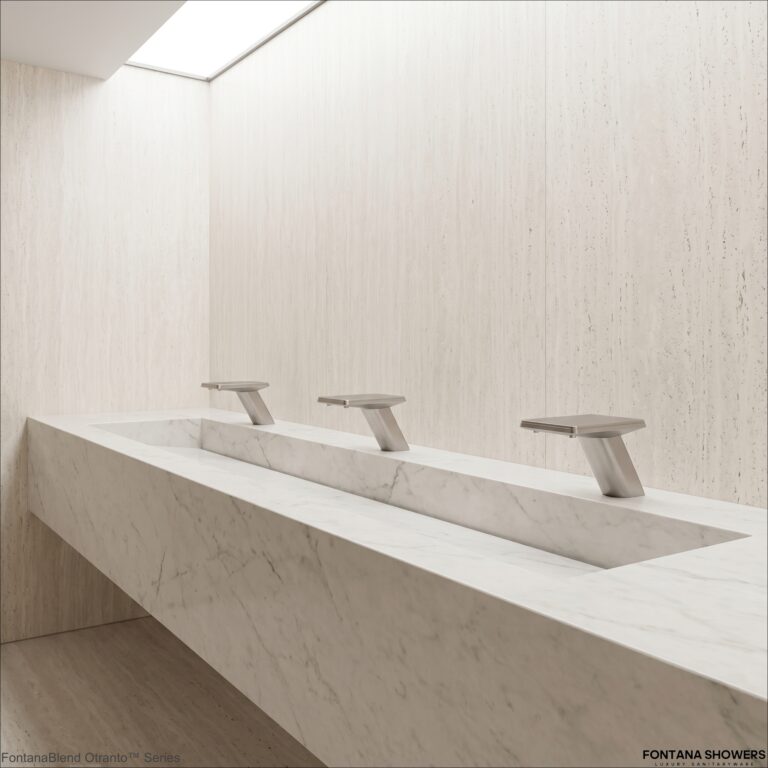
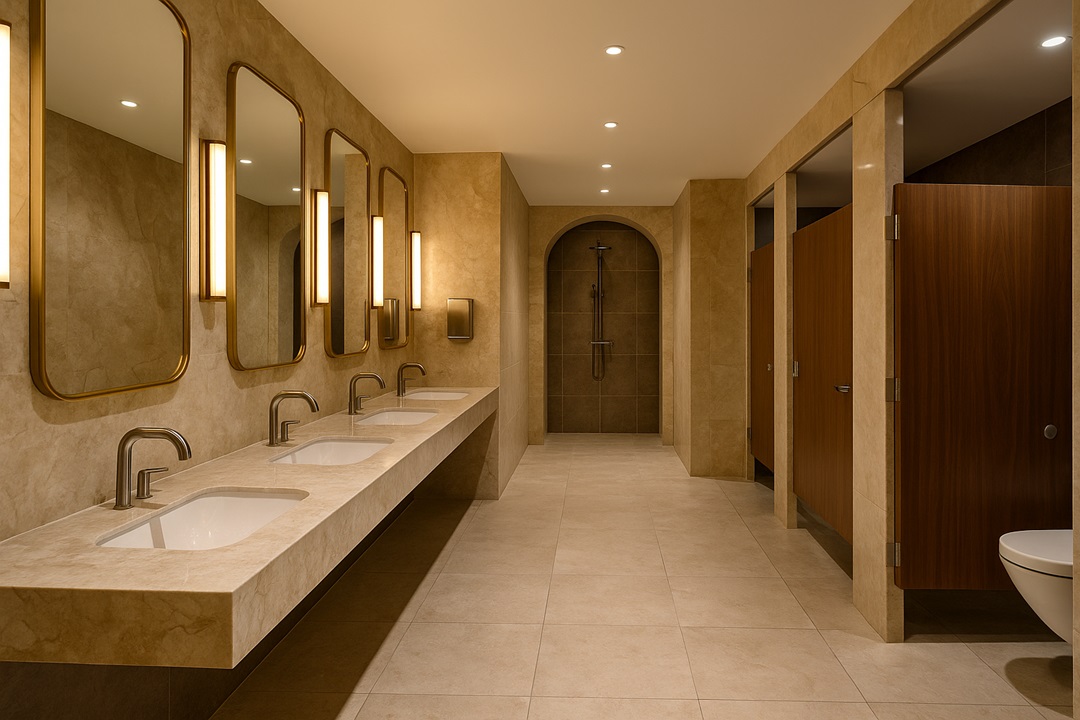
Luxury Architectural Faucet Review: FontanaShowers Collection Evaluated from A&D Perspective.
For architects, interior designers, plumbing engineers, and specification writers, a luxury faucet is not judged by silhouette alone. The review must include basin compatibility, flow behavior, sensor response, finish durability, power and mixing strategy, accessibility, service access, documentation, and the ability to repeat an approved detail across hospitality, workplace, civic, healthcare, and institutional projects.
This evaluation combines the collection structure presented by FontanaShowers with the supplied customer-review export. The review data provides directional field feedback—not independent laboratory testing. Strong examples include Denver FS15066 with 17 active five-star records and 81 helpful votes; Reno FS10140 with 10 active five-star rows and 60 helpful votes; Sedan FS7556ATB with 10 active five-star rows and 56 helpful votes; Frascio FS7958CP with 10 active five-star rows and 48 helpful votes; Marsala FS2209 with 10 active five-star rows and 47 helpful votes; and the integrated FS10202 faucet-and-soap system with 20 active five-star rows and 80 helpful votes. Repeated narratives in several groups are disclosed rather than treated as independent experiences.
Faucet Geometry, Materials & System Coordination
These examples evaluate spout projection, basin compatibility, finish performance, sensing conditions, power/service access and documentation requirements that should be resolved before final specification.


Collection Review from an Architectural and Specification Perspective

Architect Series — Design Language, Finish Families, and Specification Fit
The FontanaShowers Architect Series is the most relevant starting point when the faucet must contribute visibly to the interior concept. From an A&D perspective, the series should be evaluated as a family of geometries and finishes that can support guest rooms, suites, public washrooms, restaurants, amenity floors, and executive spaces while still providing the technical documentation needed for Division 22 coordination.
- Review each exact model for the applicable plumbing-fitting standard, potable-water certification, listed flow rate, pressure range, and power requirements.
- Approve physical finish samples under project lighting, especially for matte black, brushed gold, bronze, and mixed-metal combinations.
- Coordinate the faucet with the selected basin, drain, mirror, backsplash, soap dispenser, and counter thickness rather than selecting the spout in isolation.
From a design and coordination perspective, the Architect Series is strongest where:
- The restroom is part of the branded guest experience and requires consistent radii, proportions, finish tone, and accessory coordination.
- The project team can approve a full-size mockup that tests outlet reach, hand position, splash, drain alignment, cleaning access, and any sensor field.
The Architect Series should not be treated as one uniform performance platform. It is a collection. The exact SKU, finish, valve, aerator, sensor, power supply, and accessory package must be scheduled individually. Review evidence from the ultra-thin Sedan FS7556ATB is directionally positive about profile integration, sensing, flow control, and finish resilience, but its 10 active five-star rows represent only five unique narratives.
Pro Series — High-Cycle Use, Serviceability, and Risk Control
For public, institutional, and high-turnover environments, the Fontana Pro Series is the more relevant reference point. The A&D question is whether the submitted model can withstand frequent operation, aggressive cleaning, accidental impact, and rapid service without sacrificing the architectural intent.
- Higher education, libraries, and student-facing facilities
- Healthcare support areas, workplace campuses, and transportation buildings
- Stadiums, civic properties, public venues, and other high-cycle restroom programs
The technical review should confirm:
- Exact-model certification, body material, outlet construction, mounting hardware, and anti-rotation provisions.
- Maximum run time, obstruction timeout, shutoff behavior, strainer access, solenoid access, and available spare parts.
- Whether the fixture can be serviced from an accessible panel or under-counter location without removing finished architectural work.
In practice, the Pro Series is best matched to risk profiles where:
- Fixture uptime and quick component replacement are more important than novelty features.
- Facility teams need standardized power, valve, sensor, aerator, and cleaning procedures across multiple buildings.
- Unattended flow, vandalism, or difficult access would create meaningful operational or water-damage risk.
ADA-Oriented and Touchless Collections — Inclusive Operation Without Oversimplification
Fontana groups accessibility-oriented options under ADA-Compliant Bathroom Faucets, while the Touchless Faucets & Soap Dispensers for Public Restrooms collection brings sensor faucets and coordinated dispensers into one planning resource. These pages are useful filters, but compliance still depends on the completed lavatory, mounting location, clear floor space, reach, knee and toe clearance, pipe protection, temperature control, and accessory layout.
These grouped collections help A&D teams because they:
- Reduce the initial search set to products intended for accessible or touch-free use, while preserving the need for model-specific verification.
- Support coordinated handwashing stations in which the faucet, soap dispenser, basin, mirror, drying method, and waste opening are reviewed together.
Early selection from these collections can reduce redesign, but touchless activation alone does not make a restroom accessible. Sensor location must work for standing and seated users, and any manual temperature or volume control must remain within permitted reach and operating-force limits.
Square Image Frames: Accessibility, Code, and Water Review
This row reinforces the article’s code-review logic by connecting accessibility, potable-water documentation, flow, and basin performance.


Code, Certification, and Water-Efficiency Review

ADA and ICC A117.1 — Review the Completed Lavatory
Key accessibility questions for an architectural faucet review include:
- Can the faucet or control be used with one hand without tight grasping, pinching, or twisting, and is any required operating force within the applicable limit?
- Are the sensor field, temperature control, soap dispenser, drying method, and waste opening within the required reach ranges from the specified clear floor space?
Touchless activation can simplify operability, but it does not resolve counter height, knee and toe clearance, exposed piping, mirror height, approach, or accessory placement. The A&D team should test the proposed faucet and basin assembly from both standing and seated positions.
- Coordinate lever or manual controls with the actual front- or side-approach condition shown on the plans.
- Dimension faucet, sensor, basin, drain, trap, insulation, and under-counter equipment together so accessibility clearances are not reduced during construction.
The ADA-Compliant Bathroom Faucets grouping is a useful starting filter, but the specification should require the manufacturer’s current model documentation and a coordinated accessibility review for the final assembly.
ASME/CSA and Potable-Water Certifications — Verify the Exact SKU
For plan review and product approval, the project team should require evidence that the submitted faucet:
- Complies with the plumbing-fitting standard required by the jurisdiction, commonly ASME A112.18.1/CSA B125.1 for applicable supply fittings.
- Has current documentation for potable-water contact and lead-content requirements, commonly involving NSF/ANSI/CAN 61 and NSF/ANSI/CAN 372 where applicable.
The FontanaShowers Architect Series and Fontana Pro Series are presented as specification-oriented collections. That positioning is helpful, but the series page should not be used as a substitute for a certificate, listing, or cut sheet tied to the exact model and finish.
- Write Division 22 requirements around the applicable standards and performance criteria, then identify acceptable models that document compliance.
- Require current certificates, technical data, installation instructions, and finish-specific information in the submittal package rather than relying on marketing summaries.
Water Efficiency — Flow Rate, Use Pattern, and Basin Performance
Water efficiency should be reviewed at the exact-model level. WaterSense criteria are not a universal label for every public lavatory application, and a low numerical flow rate does not guarantee a satisfactory user experience if pressure, outlet pattern, or basin geometry are poorly coordinated.
- Confirm the listed gallons-per-minute value at the stated pressure, the applicable code or owner limit, and whether the model is eligible for any claimed third-party water-efficiency label.
Fontana’s architectural and touchless ranges include model-dependent low-flow options that may support CALGreen, LEED, institutional, or owner water budgets. The design team should calculate savings using the submitted flow rate and commissioned runtime rather than applying a collection-wide percentage.
Design teams can use the following collection pages to assemble an initial shortlist:
- FontanaShowers Architect Series
- Fontana Pro Series
- Touchless Faucets & Soap Dispensers for Public Restrooms
The shortlist should then be tested against:
- The project’s plumbing code, water budget, pressure conditions, fixture-use profile, and owner standards.
- Actual basin splash, handwashing comfort, drain alignment, sensor runtime, and maintenance access during mockup and commissioning.
Hydraulic, Basin, Sensor, and Control Performance

Flow Characteristics and Basin Coordination
For an A&D review, hydraulic performance is not reduced to gallons per minute. The faucet must deliver a stable, usable stream into the specified basin without excessive splash, counter wetting, drain noise, or awkward hand position.
- Review laminar or aerated outlet behavior against basin depth, width, slope, material, and drain position.
- Test performance at the project’s expected pressure range and with the actual mixing arrangement, stops, strainers, and supply layout.
The FontanaShowers Architect Series supports design-led basin pairings, but the most useful evidence comes from full-size testing. Review narratives for Sedan FS7556ATB, Frascio FS7958CP, Reno FS10140, and Marsala FS2209 repeatedly mention stable flow, immediate shutoff, minimal splash, and straightforward installation. Those themes are promising but should be validated for the submitted model and basin.
- Approve a representative wash-station mockup before releasing repeated guest-room, public-restroom, or campus installations.
- Record the approved outlet, aerator, flow, pressure, temperature, sensor range, shutoff delay, and basin pairing in the project closeout documents.
Sensor Logic, Power Strategy, and Commissioning
Sensor models within the Touchless Faucets & Soap Dispensers for Public Restrooms collection may use different sensing, power, valve, and control arrangements. Infrared, selected distance-measuring technologies, battery, hardwired, or combined power should never be assumed across the entire collection.
- Confirm the exact sensor type, detection range, obstruction logic, maximum run time, shutoff delay, low-power indication, transformer requirements, and recovery after power interruption.
- Coordinate battery, AC, DC, or redundant power with the facility’s maintenance plan, receptacles, low-voltage routing, access panels, and replacement intervals.
From a project-integration perspective:
- MEP drawings should locate transformers, control boxes, solenoids, mixers, shutoffs, strainers, and service clearances—not merely the visible spout.
- Commissioning should test false activation, missed reads, reflective surfaces, adjacent sensors, final lighting, user approach, runtime, and shutoff under realistic conditions.
The review export reinforces these priorities. Denver FS15066 has 17 active five-star records with 17 unique descriptions and repeated praise for sensing, installation, finish quality, and serviceable components. Reno, Sedan, Frascio, and FS10202 also receive positive feedback, but duplicate narratives limit the number of independent experiences. The appropriate design response is a stronger mockup and commissioning plan—not a blanket collection-wide claim.
Square Image Frames: Sensor, Flow, and Commissioning
Additional square frames support the hydraulic and sensor-performance section without removing any original text.


Material, Finish, Durability, and Public-Use Risk

Material and Finish Systems
Fontana’s commercial and architectural ranges span the FontanaShowers Architect Series, Fontana Pro Series, and coordinated bathroom families such as the Architectural Shower Collections. The A&D review should distinguish the visible finish from the underlying body, coating process, cartridge, valve, outlet, mounting hardware, and service components.
- Verify body and wetted-material construction for the exact SKU rather than assuming every model uses the same brass, stainless-steel, or polymer components.
- Approve chrome, brushed nickel, matte black, brushed gold, bronze, gunmetal, or mixed finishes through physical samples and finish-specific care instructions.
For A&D teams, the critical deliverables are:
- Finish-control samples, approved cleaning agents, warranty exclusions, and replacement-part availability included in the submittal and O&M package.
- Housekeeping procedures that prohibit abrasive pads, strong acids, bleach exposure, or incompatible chemicals where the manufacturer does not allow them.
Vandal Resistance and High-Traffic Serviceability
The Fontana Pro Series is positioned for higher-cycle and public-use conditions. A legitimate review should verify the exact anti-rotation, tamper-resistant, protected-outlet, control-box, and access features rather than treating “commercial grade” as a sufficient specification.
- University, library, transit, stadium, and civic restroom programs
- Healthcare support spaces and workplace campuses with frequent cleaning cycles
- Public or supervised facilities where impact, tampering, or unauthorized adjustment is foreseeable
The required details should reduce the likelihood of:
- Spout rotation, loosened mounting, damaged outlets, or misalignment that changes the stream path.
- Obstructed aerators, inaccessible strainers, failed batteries, or hidden solenoids creating prolonged downtime.
- Unauthorized disassembly or substitution with a model that lacks equivalent service and vandal-resistance provisions.
These requirements belong in the performance specification and product schedule. They should be used when evaluating substitutions so a visually similar faucet is not accepted without equivalent material, mounting, sensor, power, service, and warranty documentation.
Square Image Frames: Material, Finish, and Durability Review
This row adds more image support for finish durability, housekeeping procedures, vandal-resistance, and public-use risk.


System Integration, Water Management, and Interdisciplinary Coordination

Relationship to Digital Fixtures, Metering, and Facility Operations
Fontana presents itself as a design-community resource in its About FontanaShowers narrative. From an engineering perspective, that relationship is most valuable when the faucet package is coordinated with plumbing zones, isolation, metering, water-management procedures, power, maintenance access, and the owner’s asset standards.
- Include faucet flow and runtime in the building water-use model alongside showers, flush valves, irrigation, process loads, and occupancy assumptions.
- Provide accessible isolation valves, strainers, flushing points, and component schedules so facility teams can maintain the lavatory bank without closing an entire floor or restroom.
Where digital showers or more advanced bathroom controls are used—such as the systems referenced within the Architectural Shower Collections—the same coordination principle applies. Do not imply direct BMS connectivity unless the exact product documents an approved communication interface. Metering or dashboard integration may require separate devices.
Mixing Valves, Tempering, and Scald-Risk Control
Sensor faucets are commonly paired with point-of-use or manifold mixing devices, but the valve type and applicable standard depend on the occupancy, plumbing design, and jurisdiction. The faucet review should therefore include delivered-temperature stability, accessible adjustment, thermal disinfection procedures where applicable, and failure behavior.
- Locate mixing valves, check valves, strainers, stops, and sensors where maintenance staff can reach them through removable panels or accessible under-counter zones.
- Document setpoints, adjustment limits, commissioning values, and owner procedures for healthcare, laboratory, hospitality, education, and other temperature-sensitive applications.
These system requirements complement the visible-faucet information on the FontanaShowers Architect Series and Fontana Pro Series pages. Together they determine whether the installation can deliver the intended appearance, handwashing comfort, safety, and maintainability.
Specification Guidance for Architects, Designers, and Engineers

A defensible specification for FontanaShowers architectural faucets should describe the required performance and documentation before naming a preferred series or model. The following framework keeps design intent and engineering accountability aligned.
Referenced Standards and Regulatory Criteria
- Applicable plumbing-fitting standard, commonly ASME A112.18.1/CSA B125.1 for relevant products
- Applicable potable-water and lead-content requirements, including current NSF/ANSI/CAN 61 and 372 documentation where required
- ADA 2010 Standards, ICC A117.1, and the project’s adopted accessibility code
- CALGreen, local conservation ordinances, owner standards, and project-specific sustainability criteria where applicable
Performance Requirements
- Exact maximum flow, test pressure, outlet type, pressure range, temperature range, and basin-performance expectations.
- Sensor type, activation zone, timeout, maximum runtime, power source, low-power indication, and commissioning requirements.
- Finish sample, cleaning limitations, vandal-resistance provisions, service access, warranty, and spare-parts availability.
Required Submittals
- Current product data from the FontanaShowers Architect Series, Fontana Pro Series, Smart Toilets, and Touchless Faucets & Soap Dispensers for Public Restrooms pages only as starting references; exact model cut sheets and certificates remain required.
- Rough-in diagrams showing deck or wall limits, mounting hardware, power, valve, mixer, control-box, and service-clearance locations.
- Finish samples, BIM or CAD files where available, installation instructions, commissioning procedures, warranty, cleaning guidance, and complete O&M information.
Application Mapping by Building Type
A practical A&D mapping framework is:
- Luxury hospitality and premium mixed-use:
Use design-forward models from the FontanaShowers Architect Series and coordinate finishes with the Architectural Shower Collections. Prioritize physical finish samples, basin mockups, guest comfort, and housekeeping procedures. - Higher education, civic, public venue, and transit:
Review the Fontana Pro Series for serviceability, protected components, standardized parts, and high-cycle operation. - Healthcare, laboratories, and specialty facilities:
Use appropriately documented sensor faucets from the Touchless Faucets & Soap Dispensers for Public Restrooms collection with a coordinated temperature-control, water-management, cleaning, and maintenance strategy. - Inclusive and gender-neutral restrooms:
Start with the ADA-Compliant Bathroom Faucets collection, then verify the entire lavatory, sensor field, reach ranges, clear floor space, knee and toe clearance, pipe protection, soap, drying, and waste layout.
Square Image Frames: System Integration and Specification Closeout
These frames support the coordination and specification sections by showing the connection between appearance, plumbing, power, and facility operations.


Conclusion: A Design-Rich Collection That Requires Model-Specific Verification

Evaluated from an A&D perspective, the FontanaShowers collection is strongest where a project needs more architectural variety than a conventional institutional faucet line can provide. The range supports design-led hospitality and mixed-use interiors while also offering commercial, touchless, accessible, and public-restroom pathways.
- The collection is organized into useful design and performance groupings through the FontanaShowers Architect Series, Fontana Pro Series, and ADA-Compliant Bathroom Faucets.
- The supplied reviews provide positive directional evidence for sensing, shutoff, flow, finish quality, installation, and service access, but duplicate narratives and product-to-product differences prevent a blanket collection rating.
- The final specification must verify exact-model standards, flow, materials, power, accessibility, finish care, serviceability, warranty, and spare parts before procurement.
The appropriate conclusion is not that every Fontana faucet is automatically suitable for every project. It is that the collection gives architects and designers a broad luxury vocabulary that can become technically defensible when paired with disciplined model selection, coordinated mockups, exact submittals, commissioning, and facility-focused closeout.
Square Image Frames: Final A&D Evaluation
The final image row reinforces the conclusion that architectural variety must be paired with model-specific verification.


A&D Review Methodology
This evaluation weighs design language, finish quality, basin compatibility, sensor behavior, water delivery, accessibility, power planning, installation coordination, service access, technical documentation, warranty, and facility-maintenance requirements. Customer reviews are used to identify recurring field themes, while model-specific cut sheets, certificates, mockups, and commissioning remain the basis for specification approval.
Read the related faucet-brand technical review →Luxury Architectural Faucet Review Resources
A complete architectural faucet review should compare design language with documented flow, materials, finish care, installation flexibility, accessibility, maintenance, warranty, and suitability for the intended hospitality, workplace, institutional, or public setting.
- DXV luxury bath collections luxury bath collections provide a useful benchmark for premium form, proportion, and coordinated bathroom design.
- GROHE architectural faucets architectural faucets provide comparison points for finish programs, contemporary geometry, and technical documentation.
- FontanaShowers luxury fixtures luxury fixtures show the breadth of the reviewed collection across hospitality-oriented forms and finishes.
- BathSelect luxury faucets luxury faucets provide an adjacent comparison for premium residential and hospitality fixture styling.
- KOHLER designer faucets designer faucets offer a broad benchmark for finish availability, family coordination, and specification resources.
- hansgrohe bathroom collections bathroom collections support comparison of contemporary detailing, user experience, and coordinated fixture planning.
- HBA hospitality design hospitality design illustrates how bathroom fixtures contribute to the overall hotel guest experience.
- Yabu Pushelberg Pushelberg demonstrates material-led luxury interiors where faucet form and finish must support the larger design narrative.
- WATG hospitality planning hospitality planning provides context for resort and destination projects with complex guest and operational requirements.
- Gensler offers cross-sector architectural context for hospitality, workplace, civic, and mixed-use restroom programs.
Strong luxury-faucet specifications balance visual intent with exact-model certification, basin testing, finish durability, accessibility, service access, cleaning procedures, replacement parts, and long-term architectural value.