Healthcare Faucet Specification for Architects: Hygiene, Stagnation, Purge & Water Management
Healthcare faucet specification requires more than selecting a touchless sensor. Hospitals, outpatient facilities, medical offices and healthcare campuses must consider hand-contact reduction, stagnant-water management, automatic purge functions, temperature control, filtration, service isolation, sensing reliability and the ability to maintain fixtures without disrupting adjacent clinical operations.
This guide examines five commercial touchless faucet platforms as AEC case studies and outlines what architects and plumbing engineers should evaluate before approving healthcare lavatory fixtures.
Six Issues Beyond “Touchless”
Automatic activation removes routine faucet-handle contact during handwashing.
Flush programming and purge capability can support local stagnation-management strategies.
Accessible upstream strainers help protect electronic valve components from debris.
Pre-tempered water, manual mixers and thermostatic limiting devices are different strategies.
Technicians should be able to isolate and repair one faucet without disrupting nearby fixtures.
Sensor, purge, temperature, timeout and power behavior should be verified before turnover.
| Product | Healthcare Strength | AEC Lesson |
|---|---|---|
| Fontana Hospital Style Commercial Sensor Faucet | Hospital-oriented hands-free platform | Sensor + power + shutoff coordination |
| BathSelect Hospital Style Sensor Faucet | Clinical/public facility application | Touchless faucet + dispenser coordination |
| Sloan BASYS EFX-600 | Line Purge + diagnostics | Stagnation-management support |
| Zurn Serio ZG6950 | Programmable automatic flushing | Connected water-management controls |
| American Standard NextGen Selectronic | Auto Purge + integrated electronics | Compact service architecture |
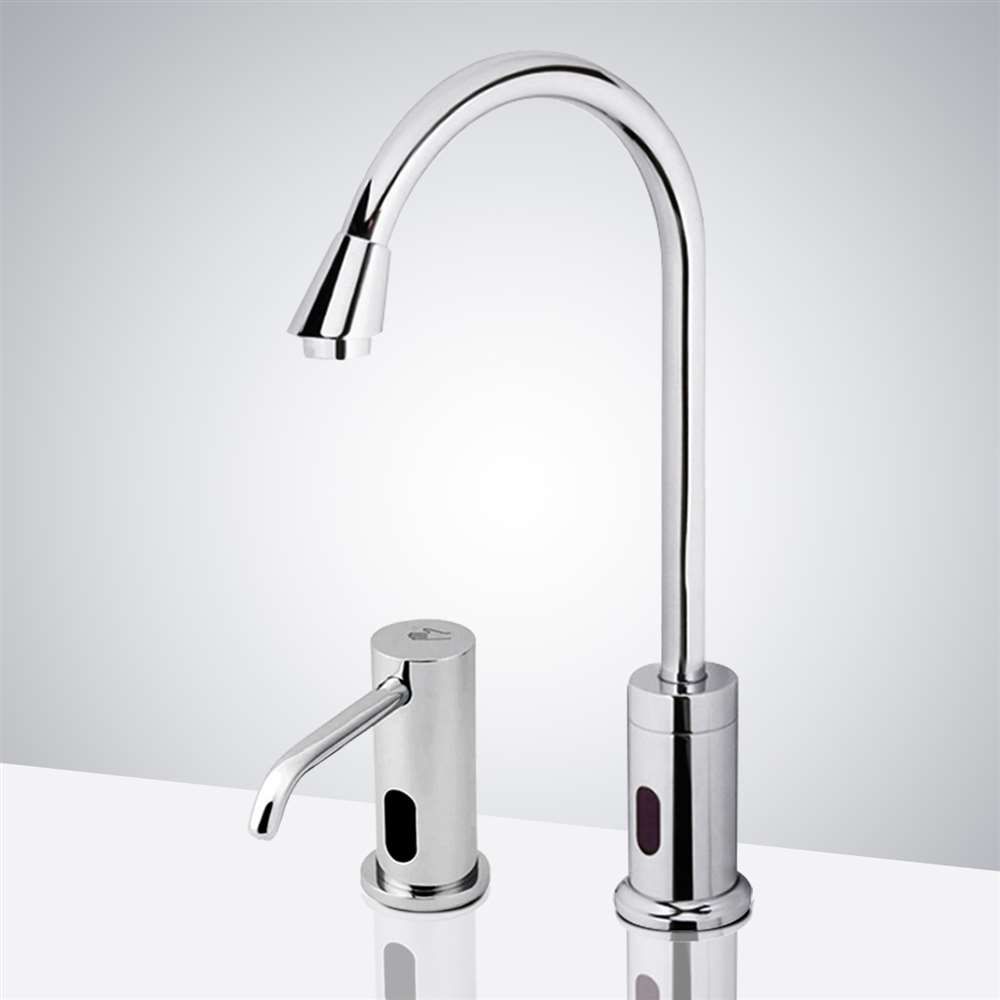
Fontana Hospital Style Adjustable Commercial Automatic Touchless Sensor Faucet
The Fontana Hospital Style Adjustable Commercial Automatic Touchless Sensor Faucet is specifically positioned for hospitals, medical/public facilities and other high-traffic commercial environments.
Fontana publishes a microcomputer-controlled infrared system, automatic detection adjustment, solid-brass construction, AC 110V/DC 6V power and a factory-set 30-second automatic shutoff.
Healthcare-oriented commercial sensing with flexible power and automatic shutoff.
How will the faucet’s power, temperature control and filtration strategy integrate with the facility’s water-management plan?
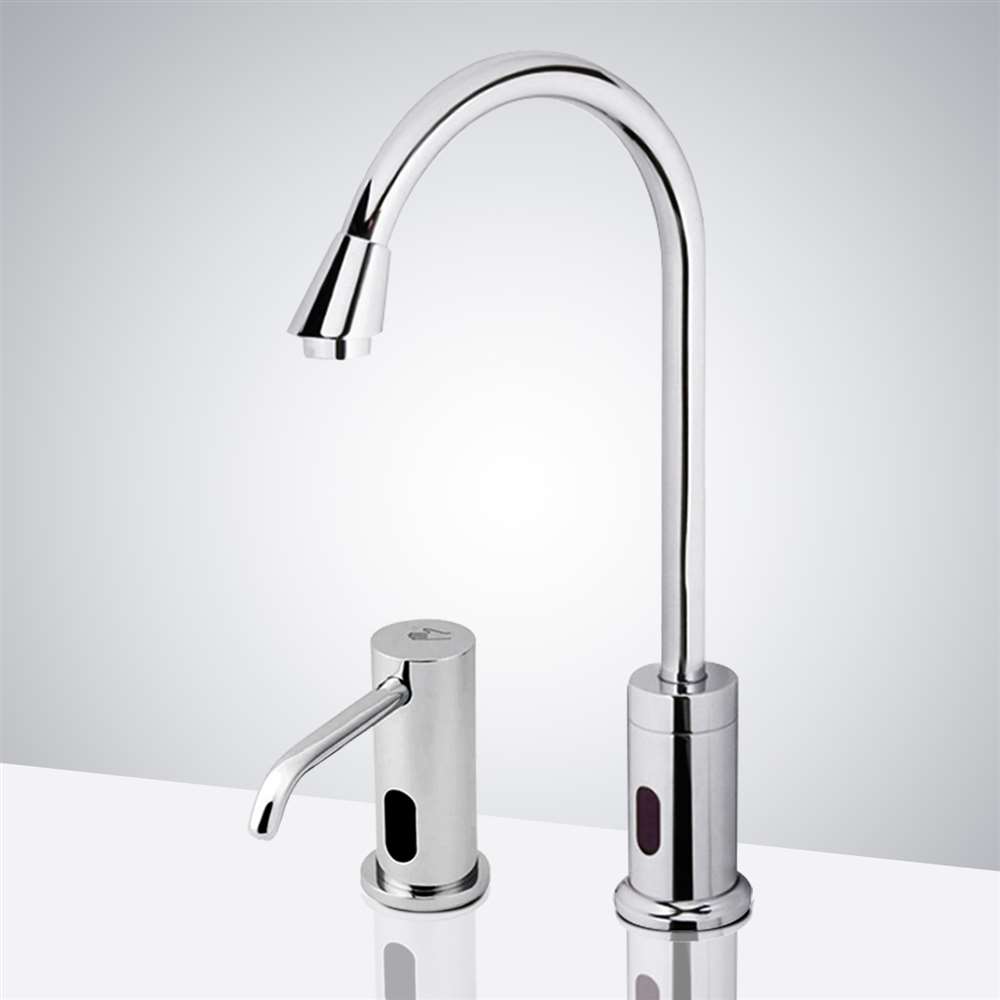
BathSelect™ Hospital Style Adjustable Commercial Touchless Sensor Faucet
BathSelect’s hospital-style commercial platform combines automatic faucet activation with a matching touchless soap-dispenser option, allowing architects to coordinate the entire handwashing station rather than specifying unrelated pieces of equipment.
The current system is positioned for hospitals, public facilities and commercial restrooms and uses automatic shutoff to limit unattended water flow.
A coordinated faucet and soap system can simplify visual and functional handwashing-station planning.
Are soap delivery, faucet sensing and basin placement coordinated to avoid crossing user hand paths?

Sloan BASYS® EFX-600 Commercial Sensor Faucet
BASYS EFX-600 is particularly relevant to healthcare specifications because Sloan includes a Line Purge mode intended to eliminate stagnant water at the fixture.
The platform also provides double infrared sensing, sealed IP67 electronics, above-deck diagnostic indicators and a removable solenoid carrier with an accessible strainer.
Stagnation-management functionality is paired with mature institutional service architecture.
What purge frequency and duration will be commissioned under the facility’s approved water-management strategy?

Zurn Serio Series® ZG6950 Gear-Driven Sensor Faucet
Zurn’s ZG6950 offers a different healthcare water-management strategy: automatic or on-demand line flushing can be programmed through its Bluetooth control platform.
The faucet also replaces the conventional solenoid with a gear-driven ceramic cartridge designed to be less susceptible to debris and buildup.
Programmable flushing and alternative valve architecture support sophisticated facility-management programs.
Who owns the Bluetooth configuration and documents final flush, timeout and sensing settings after commissioning?
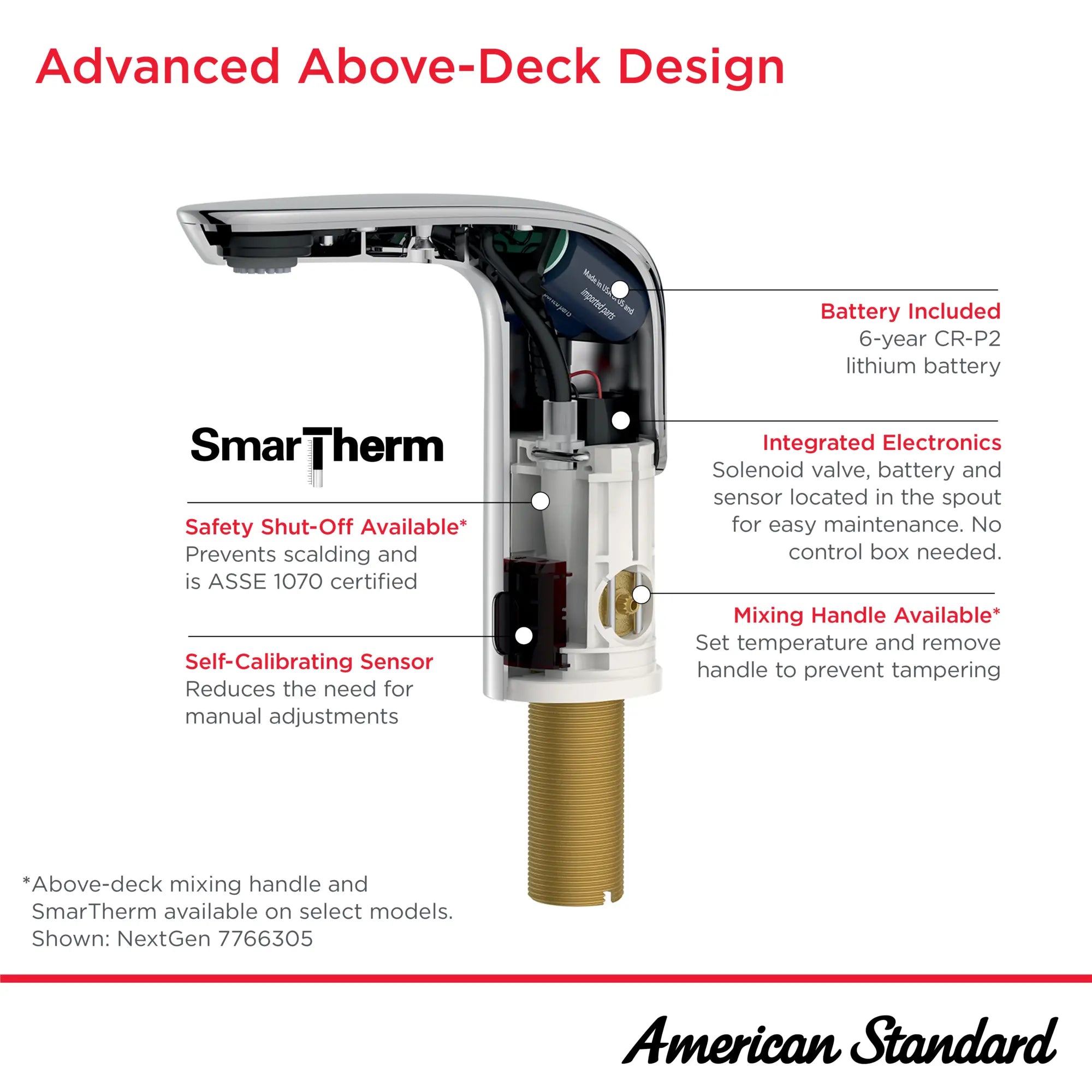
American Standard NextGen® Selectronic® 0.35 GPM Touchless Faucet
NextGen combines periodic Auto Purge functionality with integrated electronics, allowing the sensor, power and water-control components to remain concentrated in the faucet assembly instead of dispersed across a larger below-counter control system.
Compact component architecture can simplify clinical vanity coordination and servicing.
Is the selected auto-purge schedule appropriate to the facility’s documented plumbing and water-management strategy?
Product-image standard: all five product images are configured for an uncropped 500+ px desktop display, and each image links directly to the selected manufacturer product or specification page.
Automatic Purge Is a Tool—not a Complete Water-Safety Program
Periodic faucet operation can help move stagnant water through a local fixture and its nearby branch piping. This may be useful where fixtures experience irregular use.
However, healthcare water management also involves hot-water distribution, temperature, disinfectant residual, occupancy, dead legs and other building-specific conditions.
Reduce Contact Without Overstating the Claim
Automatic faucets remove routine faucet-handle contact from normal use. This can support lower-contact handwashing stations in public and clinical environments.
The correct architectural claim is contact reduction—not that the faucet independently prevents infection.
The Basin Remains Part of the Healthcare Fixture
Spout position, basin depth, drain location and water-stream landing affect splash behavior. In healthcare settings, unnecessary splash may be especially undesirable around handwashing stations.
| Design Condition | AEC Review |
|---|---|
| Shallow basin | Review stream impact and splash |
| Outlet directly over drain | Check rebound and noise |
| High faucet outlet | Evaluate water-drop distance |
| Reflective sink | Validate optical sensor behavior |
| Integrated backsplash | Confirm cleaning access and sensing environment |
Define How Tempered Water Reaches the Faucet
Healthcare specifications should clearly identify whether the faucet receives pre-tempered water or whether hot and cold supplies feed a point-of-use mixer or thermostatic valve.
Sloan’s current EFX-600 documentation specifically notes that a thermostatic mixer may be ordered separately where ASSE 1070 temperature control is required.
Strainers Should Be Accessible Without Major Disassembly
Electronic valves contain comparatively small flow paths. Supply debris can reduce flow or interfere with the water-control mechanism.
Healthcare facilities should favor strainers that maintenance staff can inspect and clean without removing the entire faucet or disturbing adjacent casework.
Healthcare Faucet Acceptance Tests
| Sensor | Verify natural activation and reliable shutoff. |
| Flow | Confirm the exact project GPM. |
| Temperature | Verify tempered-water delivery and limiting device. |
| Purge | Record interval, duration and responsible facility team. |
| Timeout | Verify maximum continuous run time. |
| Filter | Demonstrate strainer access to maintenance staff. |
| Power | Document battery, AC, hybrid or hydropower configuration. |
| Service isolation | Confirm one faucet can be maintained independently. |
What Architects Should Require
| Exact model | Including flow, power and mixing suffixes |
| Sensor technology | Detection type and operating range |
| Automatic purge | Availability, timing and adjustment method |
| Valve architecture | Solenoid, ceramic, gear-driven or other |
| Filtration | Strainer location and service method |
| Temperature control | Pre-tempered, manual mixer or thermostatic device |
| Diagnostics | Power, sensor and valve fault indication |
| Replacement parts | Sensor, valve, filter, battery and controller references |
Healthcare Commercial Faucet Brands
Healthcare Faucet Specification FAQ
Do touchless faucets prevent healthcare-associated infections?
No. They reduce routine contact with faucet controls but should be treated as one element of the overall hand-hygiene and environmental-control strategy.
What is Line Purge?
It periodically operates the faucet to move water through the local fixture and nearby branch connection.
Should every healthcare faucet use automatic purge?
No. The facility water-management team should determine whether, when and how purge functions are used.
Why are accessible strainers important?
They allow maintenance teams to remove supply debris before it causes valve or flow problems.
Should the faucet use thermostatic mixing?
Where point-of-use temperature limiting is required, specify the appropriate certified thermostatic device rather than assuming a basic mixer provides equivalent protection.
Should sensor faucets be commissioned after finishes are installed?
Yes. Basin reflectivity, lighting, backsplash and surrounding materials can affect installed sensing behavior.
Professional References
CDC — Water in Healthcare Facilities
Healthcare environmental-control and water-system guidance.
CDC — Water Management Program Toolkit
Framework for building water-management planning.
WHO — WASH FIT
Risk-based framework for water, sanitation, hygiene and environmental cleaning in healthcare facilities.
American Society of Plumbing Engineers
Healthcare and commercial plumbing-engineering resources.
NSF/ANSI/CAN 61
Health-effects requirements for components in contact with drinking water.
Specify the Faucet as Part of the Water-Management System
Healthcare touchless faucets should be judged by more than sensor convenience. Fontana provides a hospital-oriented commercial sensor platform; BathSelect supports coordinated touchless wash stations; Sloan adds explicit line-purge and diagnostic architecture; Zurn provides programmable flushing and a gear-driven valve; and American Standard combines auto-purge with compact service components.
For architects and plumbing engineers, the strongest healthcare specification clearly defines sensing, flow, temperature control, filtration, purge behavior, maintenance access and commissioning responsibilities before the fixture is approved.
Review Fontana Hospital Style Commercial Faucet →Independent editorial disclosure: ArchFaucets.com provides independent architecture and specification-oriented analysis. Touchless operation, purge functions and automatic flushing do not independently prevent infection or waterborne disease. Verify project-specific healthcare requirements, current manufacturer documentation and facility water-management protocols before approval.