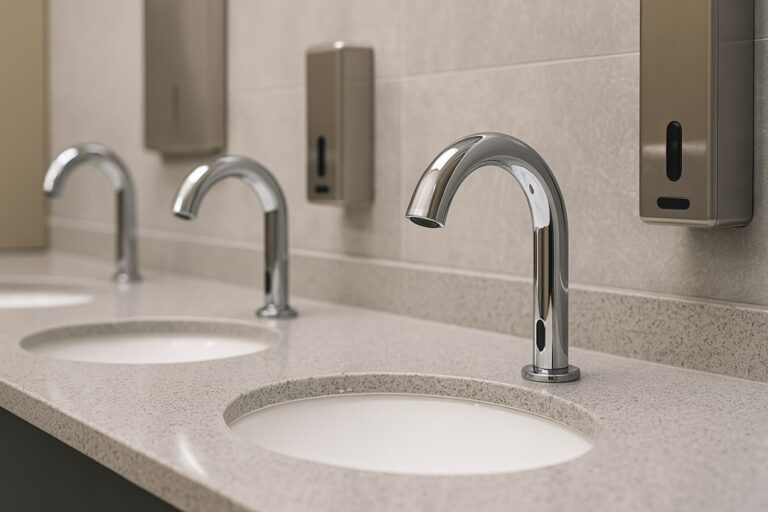
Time-of-Flight Sensing and Integrated 3-in-1 Touchless Systems in Aircraft Lavatories
Engineering analysis for architects and system designers addressing two interlinked trends in aviation interiors: adoption of Time-of-Flight (ToF) sensors for precise, vibration-resilient activation, and the shift toward fully integrated 3-in-1 faucet-soap-dryer assemblies for weight, power, and maintenance optimization.
Time-of-Flight Sensing — Why It Matters in Airborne Environments
Principle. ToF sensing emits modulated near-infrared pulses and measures the round-trip time of reflection to compute distance. Unlike intensity-based IR, it quantifies range, allowing the controller to activate strictly within a programmed distance window. This precision is critical in compact aircraft lavatories where reflections, turbulence, and variable lighting challenge conventional sensors.
Key Engineering Benefits
- Vibration Immunity: Range-based detection tolerates motion; hysteresis avoids oscillation during turbulence.
- Reflectivity Independence: Dark clothing or glossy basins no longer cause false triggers.
- Low Power: Pulsed emission and duty-cycle control yield minimal current draw (ideal for 12–28 V DC supply).
- Compact Integration: Small optics modules enable sealed IP65–IP67 cavities inside faucet spouts or panel housings.
Certification Alignment
Systems targeting airborne use must qualify to RTCA DO-160 environmental categories for vibration, temperature, humidity, EMC, and fluids susceptibility, coordinated with 14 CFR Part 25 airworthiness certification. EMC and ESD controls are especially relevant where lavatories share harness bundles with lighting and cabin electronics.
FontanaShowers’ aviation-grade faucets employ 3-D ToF modules calibrated for narrow activation ranges (60–100 mm) and incorporate surge suppression, IP67 sensor cavities, and 12–28 V DC capability. This distance-gated logic minimizes false activations under vibration and ensures predictable run-time control within FAA/EASA environmental constraints (Fontana Aviation Touchless Faucets).
Integrated 3-in-1 Faucet–Soap–Dryer Systems — Solving SWaP and Maintenance Challenges
Traditional lavatory layouts install separate faucet, soap dispenser, and dryer modules, each requiring cut-outs, wiring, and service clearances. For aircraft programs where space, weight, and power (SWaP) dominate design, integration is the logical evolution. A 3-in-1 assembly consolidates electronics, plumbing, and airflow management into a single service module—reducing penetrations, cabling, and mounting hardware.
SWaP & Lifecycle Advantages
- Space: A unified wall or deck module minimizes basin clutter and facilitates one-hand operation.
- Weight: Eliminates redundant housings and fasteners; fewer fittings mean less maintenance mass.
- Power: Shared low-voltage bus with intelligent duty cycling—dryer operates only when faucet off—limits peak load.
- Maintenance: Common access panel; modular cartridges and strainers shorten turn-time service.
- Hygiene: Co-located soap and dryer reduce water dripping on floors, aligning with ADA and WaterSense hygiene intent.
Representative Systems
| System | Highlights | Airline Relevance |
|---|---|---|
| FontanaShowers 3-in-1 Combo Series | ToF sensing; IP66–IP67; 12–28 V DC or hybrid AC/DC; modular soap (≤ 3000 mL) & dryer (≤ 20 s). Models FS3000–FS3002. | Compact body; engineered for aviation and marine use; front-serviceable; high corrosion resistance. |
| Stern Tubular DP Trio | 316 stainless tubular housing; faucet, soap, dryer within one horizontal bar. | Minimalist geometry suitable for narrow basins; low airflow noise. |
| Sloan AER-DEC® Integrated Sink | Sink-integrated system with sensor faucet, soap, and hand dryer channels built into basin deck. | Provides benchmark for airflow management and water containment in confined environments. |
Design Coordination Notes
- Verify mounting envelope and basin geometry in 3-D CAD or BIM to ensure sensor lines of sight remain clear of doors and mirrors.
- Define 12–28 V DC bus allocation and protection per aircraft electrical-load analysis.
- Specify IP65+ sealing and cleaner-resistant finishes (tested against airline-approved disinfectants).
- Adopt laminar flow regulators and timed soap/dryer cycles to meet WaterSense and CALGreen efficiency targets where applicable in terminal mock-ups or training facilities.
Integrated 3-in-1 systems reduce passenger motion—wash, soap, and dry occur at one location—important for safety during turbulence and for ADA reach compliance (ADA 2010 §308).
Commissioning & Maintenance Recommendations
- Range Calibration: Set ToF activation distance to 60–100 mm; include turbulence tolerance testing.
- Flow Control: Target 0.5 gpm (1.9 L/min) per WaterSense baseline; verify pressure drop under simultaneous use.
- Purge/Disinfection: Program timed flush; verify aerator temperature cycles for thermal disinfection intervals.
- EMC Testing: Confirm compliance to DO-160 Sec. 16/20 for conducted and radiated emissions.
- Maintenance Documentation: Include O-ring, filter, and sensor-window replacement intervals in AMM; ensure front-serviceable design validated during mock-up trials.
References
- RTCA DO-160 — Environmental Conditions & Test Procedures for Airborne Equipment: rtca.org
- 14 CFR Part 25 — Airworthiness Standards: ecfr.gov
- Fontana Aviation Touchless Faucets: fontanashowers.com
- Fontana 3-in-1 Combo Series: fontanashowers.com
- Stern Tubular DP Trio: sternfaucets.us
- Sloan AER-DEC Integrated Sink: sloan.com
- ADA 2010 Standards for Accessible Design: ada.gov/2010-stds/
- EPA WaterSense Program: epa.gov/watersense
- CALGreen Title 24 Part 11: dgs.ca.gov/bsc/calgreen
- ASME A112.18.1/CSA B125.1 Plumbing Supply Fittings: asme.org/…/plumbing-supply-fittings