

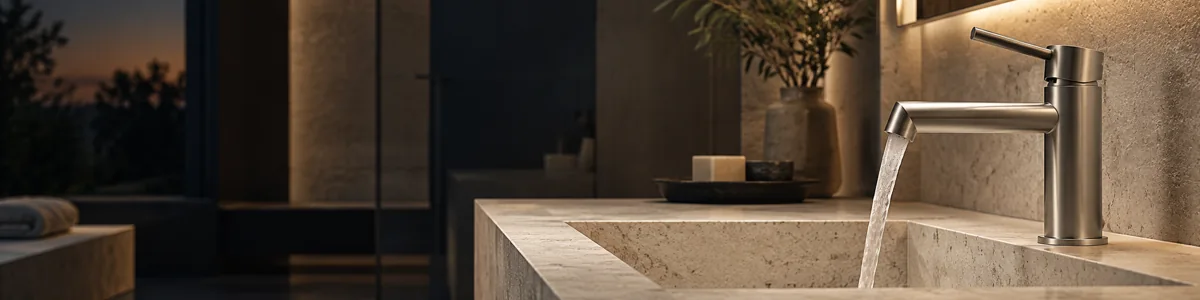

Mixed metal finishes hold up through construction only if the schedule names the finish process, not just the color. “Matte black” from one manufacturer is a PVD finish rated for years of abrasion resistance; “matte black” from another is a powder-coat or electroplated finish that will wear differently at the lever and aerator contact points. Specify the pairing by finish code and manufacturer, lock it with substitution language, and the contrast stays intentional instead of reading as a field error.
Why mixed finishes drift during substitution
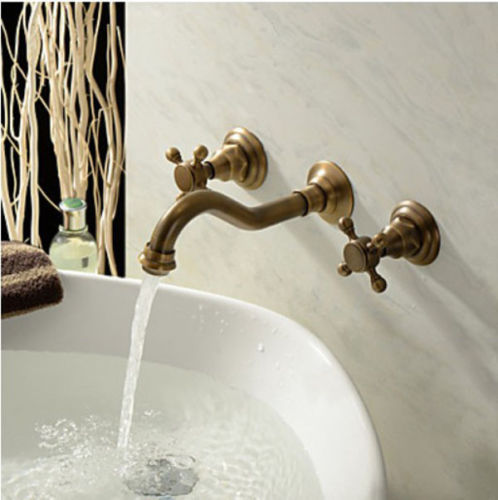
Finish mismatches rarely happen at design intent. They happen during value engineering, when a contractor submits an “equal” faucet in the same nominal finish name but from a different manufacturer’s line. Two finishes labeled “brushed gold” or “oil-rubbed bronze” can differ in base alloy, clear-coat thickness, and sheen angle. Under site lighting, a substituted tub filler next to a spec’d lavatory faucet will visibly disagree even though both submittals used the same English-language finish name.
This is a documentation problem before it is a visual one. If the schedule only lists “finish: matte black” without a manufacturer finish code or process spec, the GC’s substitution request has no technical basis to reject. The architect ends up relitigating the finish match at punch list, which is the most expensive place to catch it.
PVD vs electroplate: finish codes differ
Write PVD and electroplated finishes as separate specification lines, not as options under one finish heading. Physical vapor deposition bonds a metal-ceramic layer under vacuum; electroplating deposits metal ions in a plating bath. They produce different wear curves, different cost tiers, and different available colors from the same manufacturer’s catalog. A finish schedule that treats them interchangeably invites a sub to quote whichever is cheaper to source that quarter.
ASME A112.18.1 governs finish durability testing for plumbing fixture fittings, including the abrasion and corrosion resistance thresholds a finish must meet to be labeled for residential or commercial duty. Citing the standard in the spec section does two things: it gives you a technical basis to reject a submittal that meets the color but not the durability class, and it forces the submittal reviewer to actually pull the manufacturer’s test data instead of eyeballing a finish chip.
- PVD finishes: typically carry the manufacturer’s longest finish warranty tier, resist scratching at a harder Mohs-equivalent surface, and are priced as a premium line item separate from standard chrome or brushed nickel.
- Electroplated finishes: lower cost, wider color range in some catalogs, but more prone to visible wear at high-touch points like faucet handles and shower trim over the life of the installation.
- Powder-coat or painted finishes: common on matte black kitchen faucets at the budget tier, acceptable for some scopes but not equivalent to PVD black for abrasion resistance, and should never be substituted into a PVD-specified line item without a formal change.
Writing schedule notes for intentional contrast
The fixture schedule should state the finish pairing as a single locked line item, not as two independent fixture selections that happen to land in the same room. If the design intent is a matte black kitchen faucet against brushed brass cabinet hardware, write both into the same schedule note with a cross-reference, so a sub cannot swap one without triggering a review of the pair.
A workable note format:
| Fixture | Manufacturer | Finish Code | Process | Paired With |
|---|---|---|---|---|
| Kitchen faucet, FX-04 | Manufacturer A | MB-PVD-02 | PVD | Cabinet pulls, HW-11 |
| Cabinet pulls, HW-11 | Manufacturer B | BB-EP-07 | Electroplated | Kitchen faucet, FX-04 |
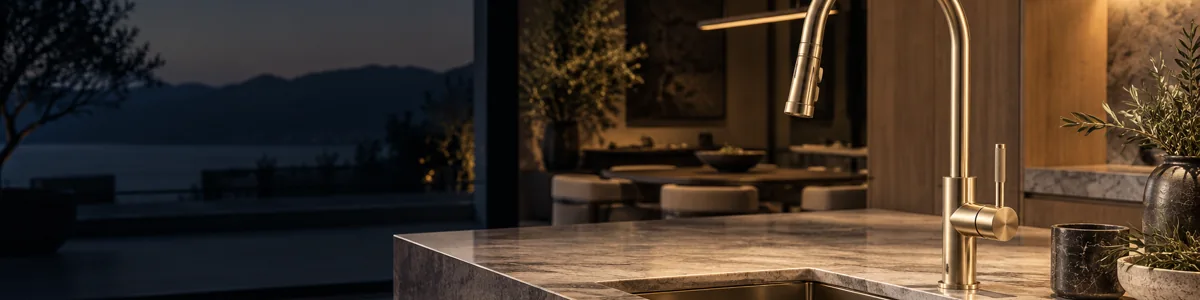
This table format does the coordination work for the GC and the submittal reviewer. It also gives you language to point to when a substitution request shows up with only one half of the pair changed. Readers specifying a dark kitchen fixture against lighter hardware can review a current line of black kitchen faucets to confirm which finish process the manufacturer uses before locking the schedule, since “black” alone is not a specification.
Coordinating lead times across finish families
PVD finishes commonly run longer lead times than standard chrome or brushed nickel from the same manufacturer, often by two to six weeks depending on the finish color and whether it is a stocked or made-to-order line. When a schedule pairs a PVD fixture with an electroplated fixture from a different manufacturer, those lead times rarely line up on their own. If the GC orders both fixtures at the same time without checking finish-specific lead times, one half of the pair arrives for rough-in and the other shows up weeks later, forcing a choice between delaying the install or temporarily running a mismatched fixture that someone forgets to swap.
Build the lead-time check into the submittal schedule itself, not into field coordination. Require the submittal to state the finish-specific lead time, not just the fixture lead time, since many manufacturers quote a base lead time for standard finishes and a separate, longer one for PVD or custom colors.
Submittal language that prevents finish swaps
Standard “or equal” substitution language is the mechanism that lets finish mismatches into a project. It evaluates function and nominal finish name, not finish process or wear class. Tighten the substitution clause specifically for paired finishes:
- Require substitution requests for any fixture in a locked finish pairing to include ASME A112.18.1 test data for the proposed finish, not just the originally specified one.
- State explicitly that PVD-specified line items cannot be substituted with electroplated or powder-coat finishes regardless of color match, and vice versa.
- Require that a substitution on one half of a paired finish note triggers automatic resubmission of the paired fixture for architect review, even if the paired fixture itself is unchanged.
- Name the finish code, not just the color name, in every submittal transmittal so the reviewer is comparing manufacturer specification sheets, not color photographs.
This language adds a line or two to a standard submittal section but removes the ambiguity that lets a sub quote a cheaper finish and call it equal. It also gives the architect a documented basis to reject the submittal outright rather than negotiating a finish match after the fixtures are on site.
Before issuing the schedule for bid, confirm three things: every finish line item names a process (PVD, electroplated, or powder-coat), every intentional pairing is written as a single cross-referenced schedule entry, and the submittal section requires finish-specific lead times and test data rather than nominal fixture lead times. If a GC comes back with a substitution request that only addresses color and price, that is the signal to send it back for the missing finish-process documentation before it goes any further.