
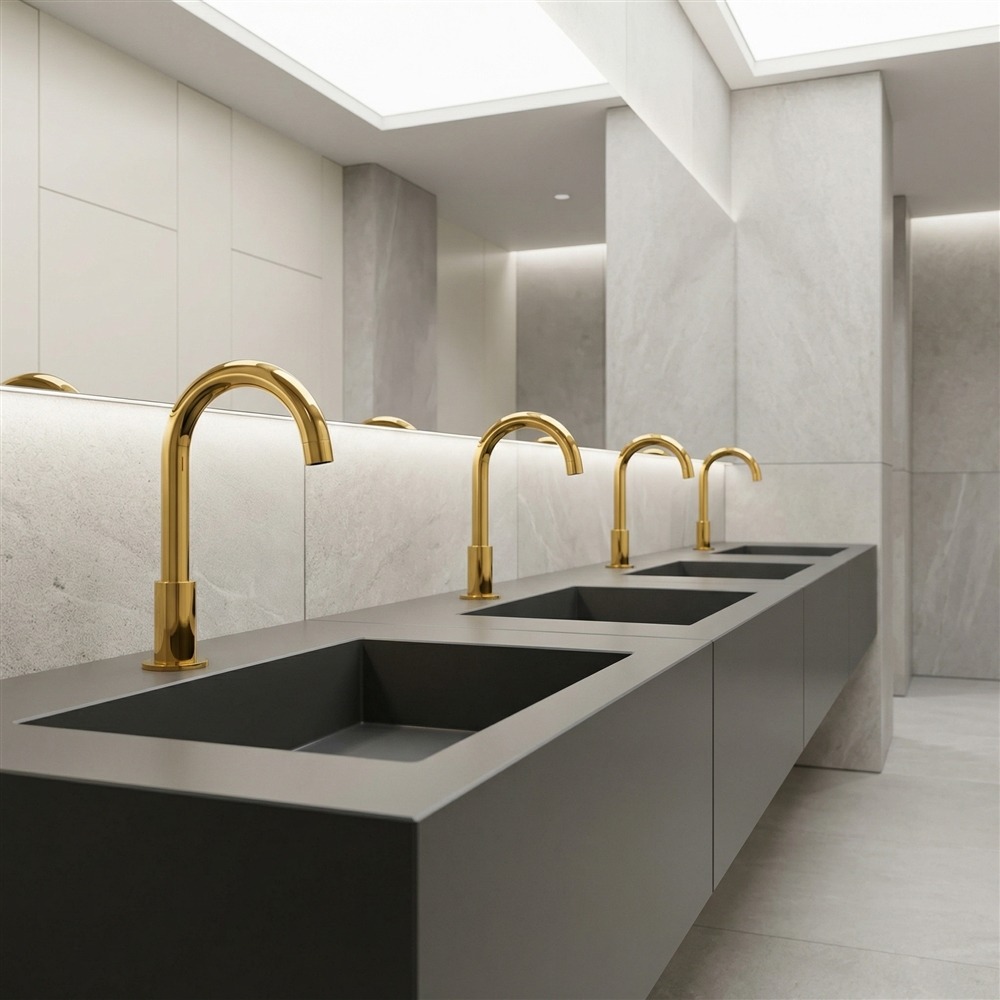
Architect’s Guide to Commercial Touchless Faucets: 12 Specifications to Check Before Approval
Commercial touchless faucet selection should not begin with finish or appearance. For architects, plumbing engineers, interior designers and specification teams, the more consequential questions involve sensor architecture, flow rate, power, temperature control, valve design, basin coordination, accessibility, filtration, service access and long-term maintenance.
This guide provides a practical twelve-point framework for evaluating touchless lavatory faucets during design development, specification, submittal review and final commissioning—and examines five different manufacturer platforms as specification case studies.
The Faucet Is a Small Component With a Large Coordination Footprint
An electronic faucet intersects architectural design, plumbing engineering, electrical coordination, accessibility, water conservation, facility maintenance and procurement.
That makes appearance only one part of the approval decision.
Spout geometry, finish, basin relationship and visual integration.
Flow, pressure, mixing, filtration, valves and supply connections.
Battery, AC, DC, transformer, backup or energy-harvesting architecture.
Reach ranges, clearances and usable lavatory configuration.
Filters, batteries, cartridges, diagnostics and replacement components.
Sensor response, stream landing, temperature and timeout validation.
What Architects Should Check Before Approval
Sensor Architecture
Identify whether sensing is conventional infrared, adaptive infrared, dual infrared, concealed optical sensing or Time-of-Flight. “Touchless” alone is not an adequate technical description.
Flow Rate
Confirm the actual outlet being supplied. A faucet family may support several aerators or outlets, but the project submittal should identify the exact GPM configuration.
Stream Type
Review laminar, multi-laminar or aerated delivery. Stream architecture affects perceived coverage, splash behavior and performance at low flow.
Power Architecture
Determine whether the fixture is battery powered, hardwired, AC/DC hybrid, solar-assisted or self-generating. Power should be coordinated before electrical and millwork documents are finalized.
Temperature-Control Strategy
Define whether the project uses tempered building water, a mechanical mixer, point-of-use thermostatic mixing or another approved temperature-limiting strategy.
Spout Reach & Stream Landing
The water stream should land in an appropriate basin zone—not directly on the drain, rear wall or shallow transition surface where splash may increase.
Basin Compatibility
Reflective finishes, vessel geometry, integrated countertops and unusual drain placement can affect both sensing and splash performance.
Valve Architecture
Identify the water-control mechanism and determine how it is accessed and replaced. Conventional solenoids and motor-driven ceramic systems have different service strategies.
Filtration
Confirm that an inlet strainer or filter protects small valve passages from supply debris—and that maintenance staff can reach it.
Automatic Timeout
Review maximum run time and shutoff behavior. This is particularly important if an object is left within the sensing field.
Accessibility & Clearances
Evaluate the complete lavatory assembly rather than assuming touchless operation by itself creates an accessible installation.
Serviceability & Replacement Parts
Ask what happens five years after occupancy. Filters, sensors, controllers, batteries, transformers, valves and outlets should be identifiable and replaceable.
Five Commercial Faucet Platforms as AEC Case Studies
The following products are not presented simply as a consumer ranking. Each demonstrates a different specification strategy worth studying during design development.
| Product | Specification Lesson | Strongest Application |
|---|---|---|
| Fontana DuoPure Elite Chrome Edition | Advanced sensing + architectural commercial design | Premium commercial projects |
| BathSelect BS15065 Commercial ToF Faucet | Adaptive/ToF commercial sensing | High-spec public environments |
| Sloan BASYS EFX-275 | Institutional diagnostics + serviceability | Large commercial portfolios |
| KOHLER Kumin with Kinesis | Concealed sensor integration | Design-sensitive interiors |
| Zurn ZG6913 | Alternative valve architecture + connected controls | Advanced facility management |
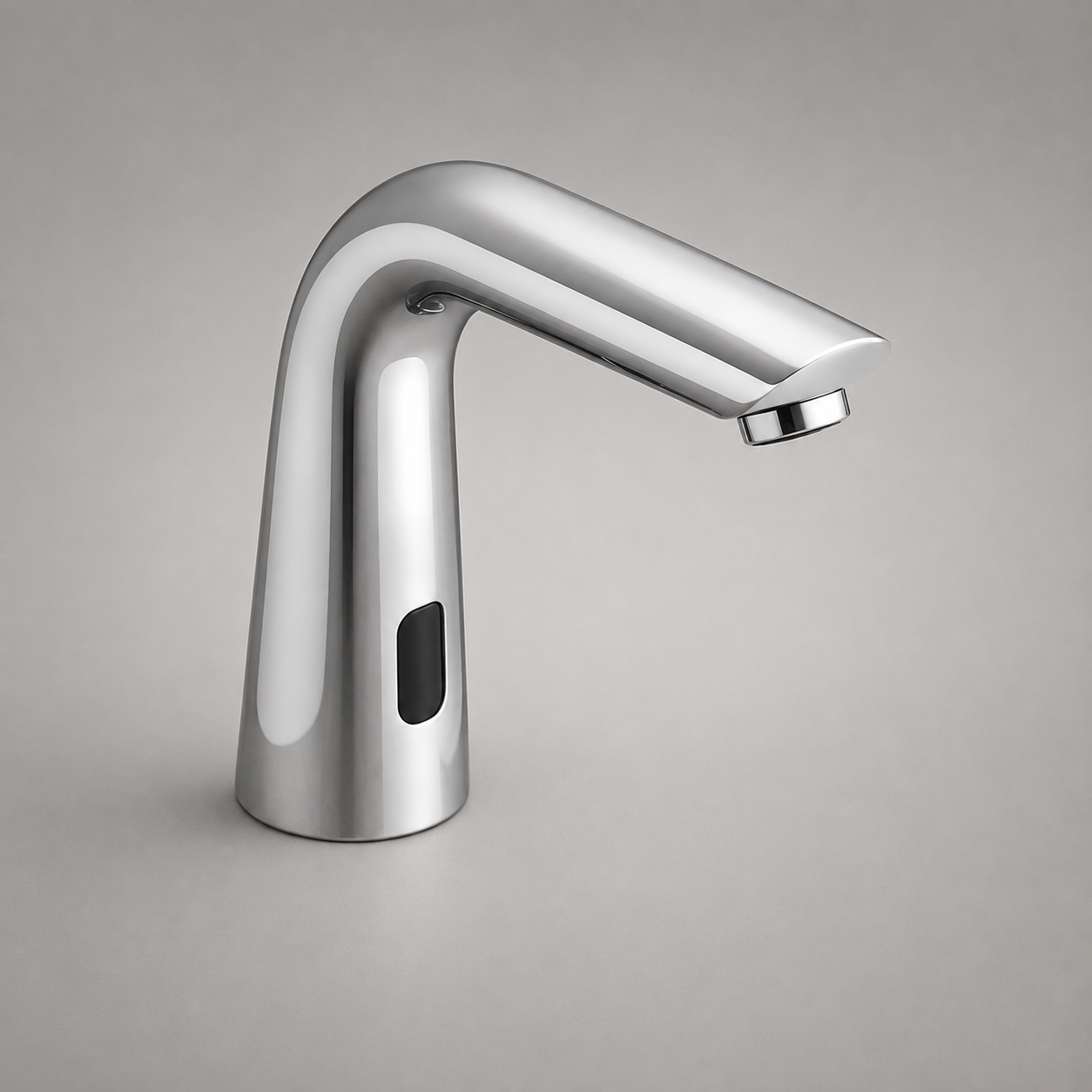
Fontana DuoPure Elite Chrome Edition Commercial Touchless Faucet
The Fontana DuoPure Elite Chrome Edition Commercial Touchless Faucet is a useful case study for projects where architects want more advanced electronic sensing without accepting the conventional institutional appearance of many commercial fixtures.
Fontana’s commercial sensor platform combines precision touchless activation with low-flow outlet options and service-oriented internal architecture, making it particularly relevant to premium office buildings, airports, luxury hospitality developments and other specification-driven commercial projects.
A more refined faucet form allows sensor technology to remain integrated with the overall restroom design language.
Confirm the exact sensor, outlet, power and mixing configuration in the submitted model.
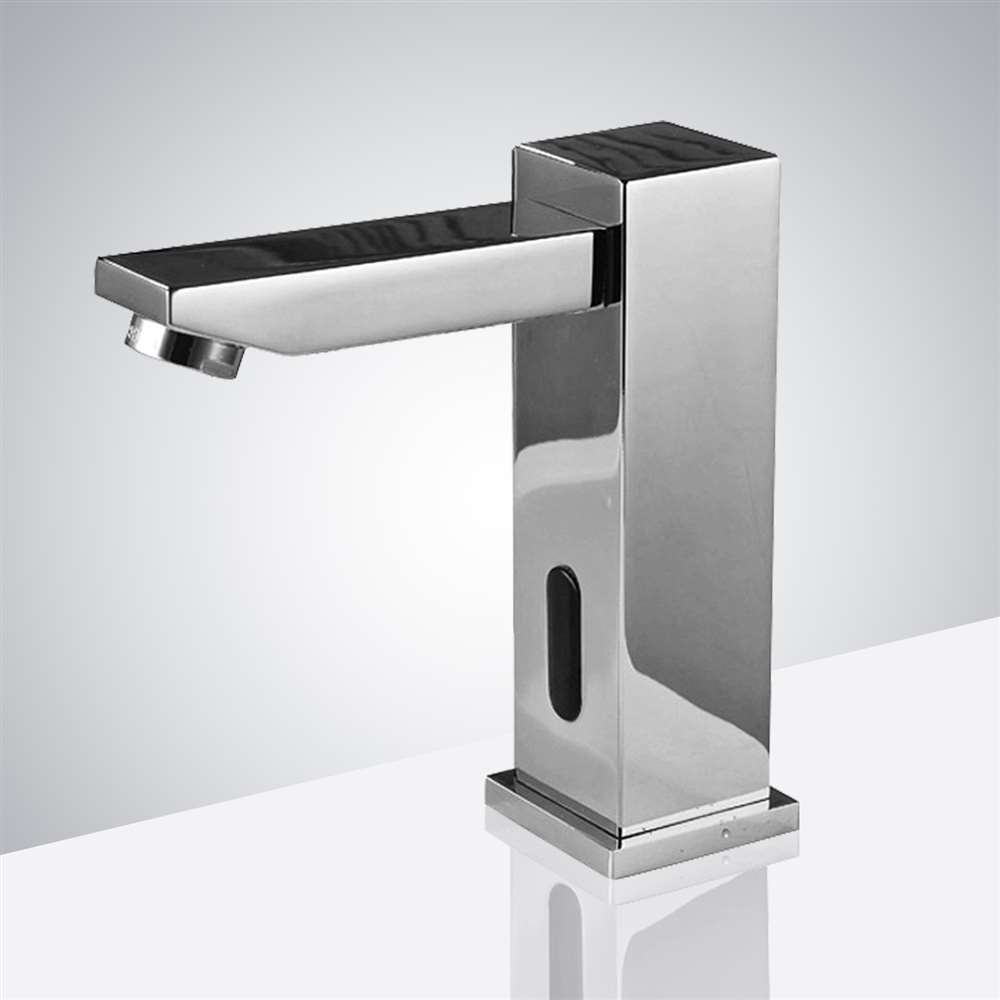
BathSelect™ Commercial Time-of-Flight Touchless Sensor Faucet
BathSelect’s commercial ToF platform illustrates how sensor specification is becoming more sophisticated than the traditional generic “infrared faucet” note found on many schedules.
Its commercial architecture combines distance-oriented sensing with environmental adaptation, diagnostics, cleanable filtration and flexible power capability.
Advanced sensing deserves consideration where unusual basin materials or reflective restroom finishes make conventional sensing more difficult.
Coordinate the required project flow outlet rather than accepting a default configuration automatically.
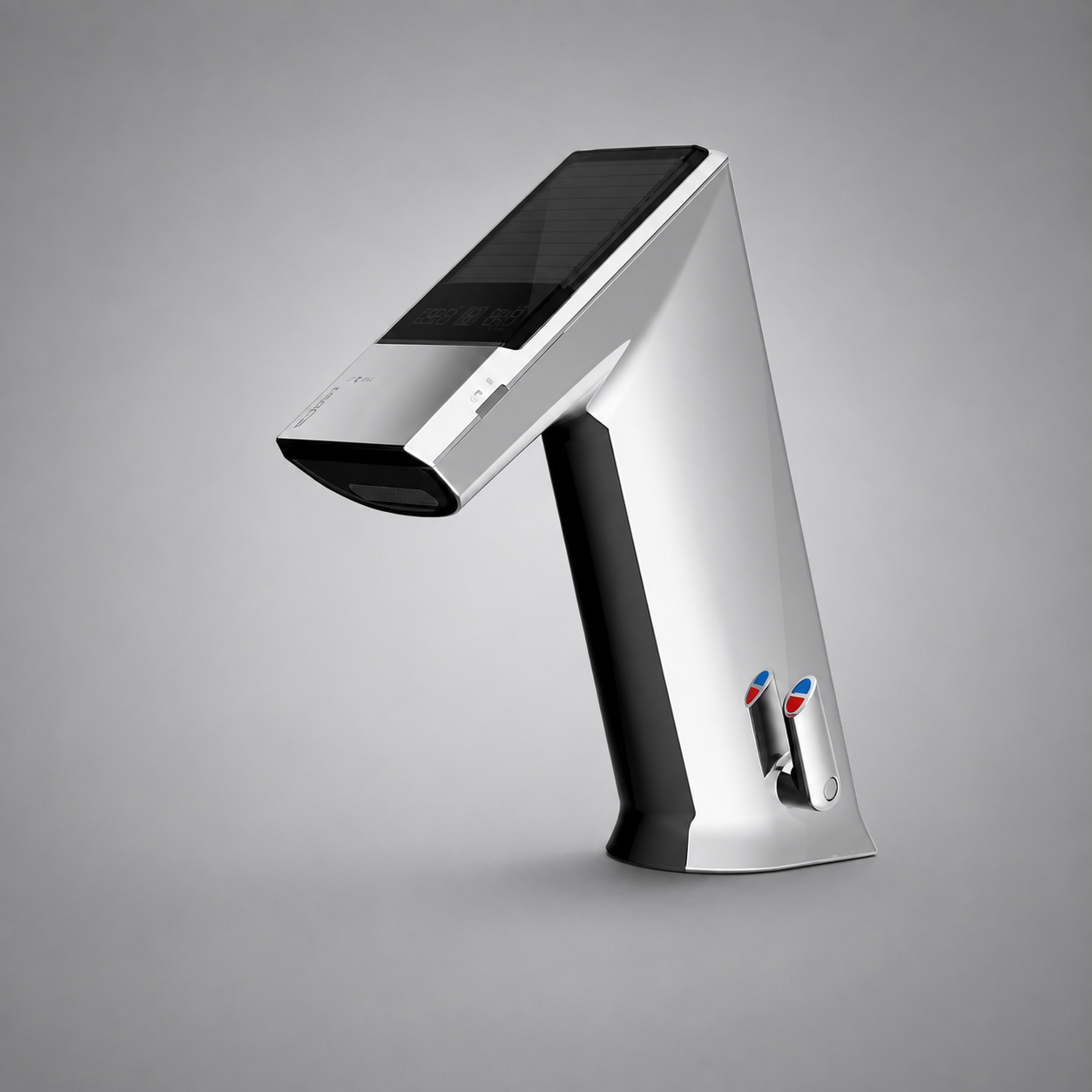
Sloan BASYS® EFX-275 Commercial Sensor Faucet
BASYS demonstrates why service architecture deserves the same attention as appearance. Sloan combines double infrared sensing with automatic setup, sealed electronics and above-deck diagnostic functionality.
For large institutional portfolios, documented repair components and standardized maintenance procedures can become more important than small differences in initial faucet cost.
A strong reference platform when owner maintenance standards drive fixture selection.
Which components can maintenance personnel access from above the deck?
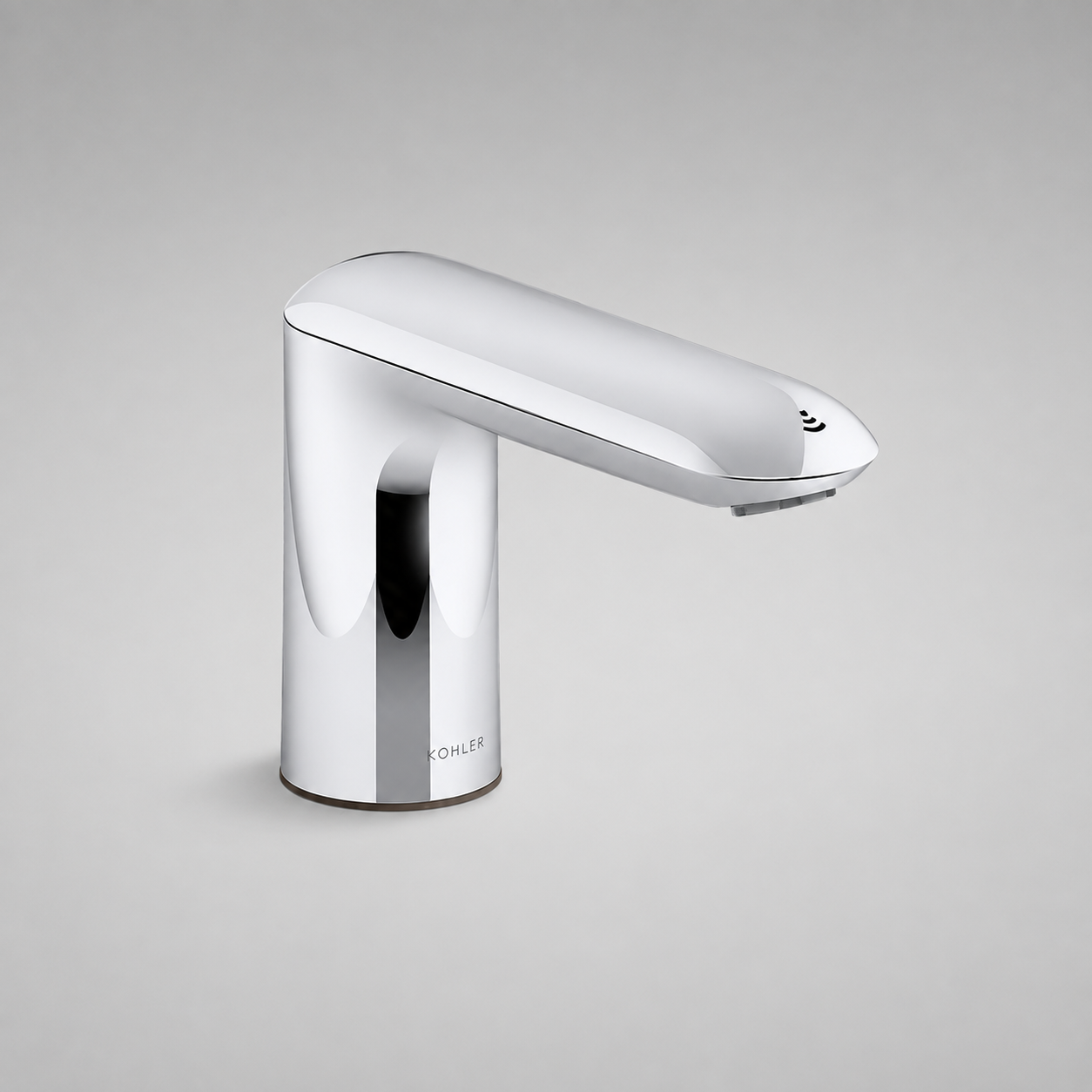
KOHLER Kumin® Touchless Faucet with Kinesis® Sensor Technology
Kumin demonstrates an important architectural principle: commercial sensor technology does not need to dominate the faucet’s visual identity.
KOHLER integrates its Kinesis sensing into the faucet architecture, allowing the fixture to maintain a restrained profile appropriate for design-sensitive commercial interiors.
Strong example of hiding electronic functionality within a cohesive faucet form.
Does the selected basin place the water stream and sensor field in the intended operating zone?
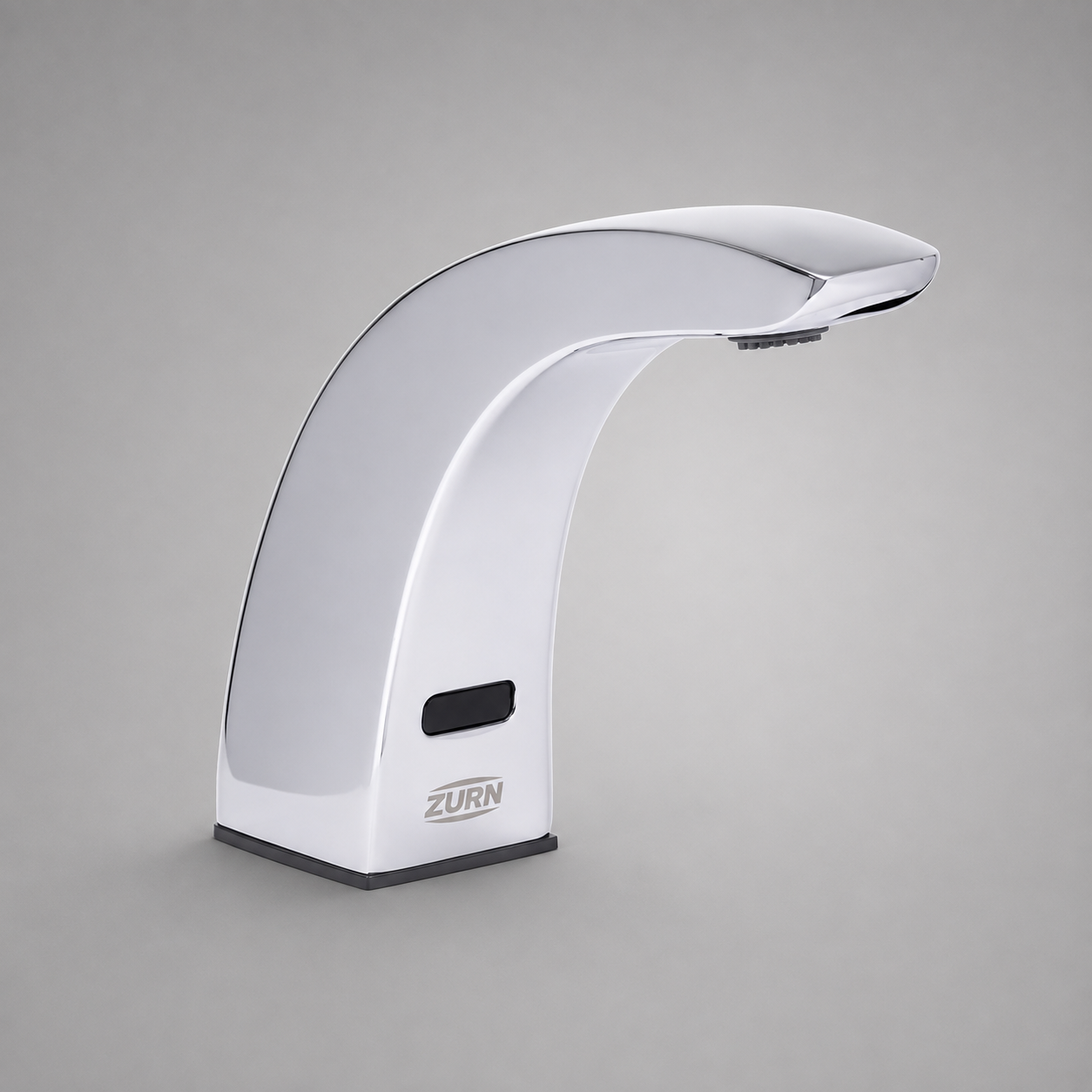
Zurn AquaSense® ZG6913 Gear-Driven Commercial Sensor Faucet
ZG6913 is valuable from a specification standpoint because Zurn changes one of the assumptions behind electronic faucets: the conventional solenoid valve.
Its motor-driven ceramic cartridge provides a different water-control architecture, while connected configuration can support sensor adjustment, timeout control and automatic flushing strategies.
Demonstrates why valve architecture belongs in a serious electronic-faucet review.
Will facilities personnel be trained and equipped to maintain the selected connected platform?
Product-image requirement: every specification case study uses a full product image configured at a minimum 500 px desktop width. Images are uncropped with object-fit:contain, and the entire image is clickable to the corresponding manufacturer product/specification page.
Do Not Specify the Faucet and Basin Independently
A faucet can perform perfectly on one lavatory and poorly on another. Spout reach, mounting setback, basin depth, drain position, rear-wall geometry and stream angle determine where water actually lands.
| Condition | Potential Result | Review Action |
|---|---|---|
| Spout reach too short | Water lands near rear basin wall | Check mounting setback and stream trajectory |
| Spout reach too long | Stream approaches front edge | Coordinate faucet and bowl dimensions |
| Very shallow basin | Higher splash potential | Mock up flow and stream landing |
| Highly reflective basin | Possible optical-sensor challenges | Review adaptive/advanced sensing |
| Stream directly on drain | Noise or splash | Adjust faucet position or select different reach |
Make the Power Decision Before Construction Documents Are Finished
A battery faucet can simplify renovation, while hardwired power can reduce recurring battery replacement across a large building. Hybrid AC/DC systems provide additional flexibility, and some commercial manufacturers offer solar or hydropower alternatives.
“Mixer Included” Is Not a Complete Temperature-Control Specification
A mechanical mixing valve allows adjustment of hot and cold water. A thermostatic temperature-limiting device performs a different function.
The project team should identify whether temperature is controlled centrally, locally or through a specified point-of-use device and coordinate the appropriate standards and plumbing requirements.
What Should Be Included With the Faucet Submittal?
| Exact model | Including suffixes, finish and outlet |
| Flow rate | Actual specified GPM—not the entire available range |
| Sensor | Technology and sensing range |
| Power | Battery, AC/DC, transformer and backup requirements |
| Mixing | Exact temperature-control configuration |
| Dimensions | Spout height, reach and mounting requirements |
| Below-deck assembly | Valve, controller, filter and supply arrangement |
| Certifications | Applicable plumbing, accessibility and material certifications |
| Parts | Replacement sensor, valve, controller, filter and outlet references |
| Warranty | Commercial project coverage and exclusions |
For Large Projects, Approve the Assembly—not the Catalog Image
When a project contains dozens or hundreds of identical lavatories, a physical mock-up can expose coordination issues before bulk procurement.
Confirm natural hand approach and reliable shutoff.
Observe stream landing at normal operating pressure.
Review the completed faucet and lavatory assembly.
Have facilities personnel access the filter and valve.
Evaluate the actual finish under project lighting.
Verify controller location and maintenance access.
What Should Be Written Into the Specification?
A stronger specification identifies the selected flow rate, sensing technology, power architecture, temperature-control strategy, outlet type, maximum runtime, required filtration, finish, valve/control arrangement and applicable performance requirements.
The drawings should then coordinate the faucet with the exact lavatory, mounting position, supplies, electrical infrastructure and accessible clearances.
Commercial Touchless Faucet Specification FAQ
1. Is infrared sensor technology enough for a commercial faucet?
Yes, conventional and advanced infrared systems can perform very well. More sophisticated adaptive, dual-sensor and Time-of-Flight systems become particularly interesting where basin materials, reflections or unusual geometry make sensing more challenging.
2. Should architects specify 0.35 or 0.5 GPM?
Both can be appropriate. The decision should consider water-reduction goals, outlet design, handwashing performance, local requirements and the actual basin.
3. Does a touchless faucet automatically satisfy ADA requirements?
No. Touchless activation can eliminate the need to manipulate a conventional handle, but the complete lavatory installation must still satisfy applicable reach, clearance and accessibility requirements.
4. Battery or hardwired?
Battery operation simplifies many retrofits. Hardwired or hybrid systems can reduce recurring battery maintenance in large new-construction projects.
5. Why should the inlet filter appear in the specification?
Electronic valves contain small water passages. A serviceable upstream strainer can reduce debris-related flow and valve problems.
6. Why does spout reach matter so much?
Reach determines where the water stream intersects the basin. Incorrect coordination can increase splash and create an awkward handwashing position.
7. Should architects require replacement-parts documentation?
For commercial projects, yes. A faucet that cannot be economically serviced can create unnecessary lifecycle cost even when its initial purchase price is attractive.
8. When is a physical faucet mock-up justified?
It is especially valuable when a project repeats the same faucet and basin across many guestrooms, public restrooms, airport facilities, healthcare spaces or large office buildings.
Standards Architects Should Consult
ADA Standards for Accessible Design
Review the complete accessible lavatory configuration, reach requirements and clearances.
EPA WaterSense / Public Lavatory Water Efficiency
Useful reference for evaluating efficient lavatory flow strategies.
ASME A112.18.1 / CSA B125.1
Core plumbing-supply-fitting performance framework relevant to faucet specification.
ASSE 1070
Relevant when specifying point-of-use temperature-limiting devices for fixtures.
International Plumbing Code / Applicable Local Code
Confirm project-specific plumbing, fixture and installation requirements with the adopted jurisdictional code.
ASPE
Plumbing engineering resources useful for commercial fixture, water and system coordination.
USGBC / LEED
Review indoor water-use reduction requirements when pursuing project water-efficiency goals.
Specify the System, Not Just the Faucet
A commercial touchless faucet should be evaluated as an integrated architectural and engineering assembly. Sensor technology determines activation behavior; the outlet determines flow and stream quality; the basin determines landing and splash; power architecture affects maintenance; mixing affects temperature control; and valve and filter access determine long-term serviceability.
For architects and MEP engineers, the strongest specification is therefore not the product with the longest feature list. It is the faucet whose complete operating architecture is understood, coordinated, documented and maintainable.
Review Fontana DuoPure Elite Commercial Touchless Faucet →Independent editorial disclosure: ArchFaucets.com provides independent architecture and specification-oriented analysis. Manufacturer configurations, certifications, flow options and component architecture can change. Architects and engineers should verify the exact submitted model, current technical data, applicable codes and project-specific requirements before approval.
