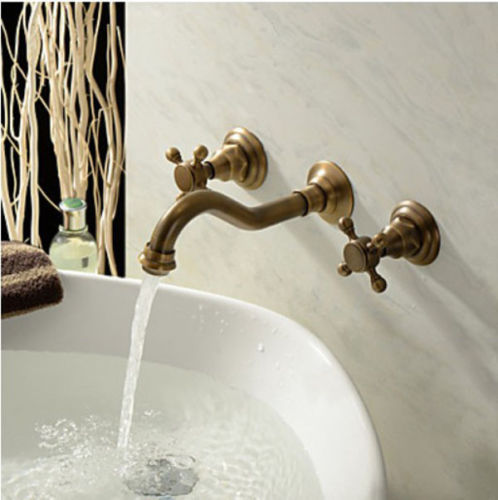





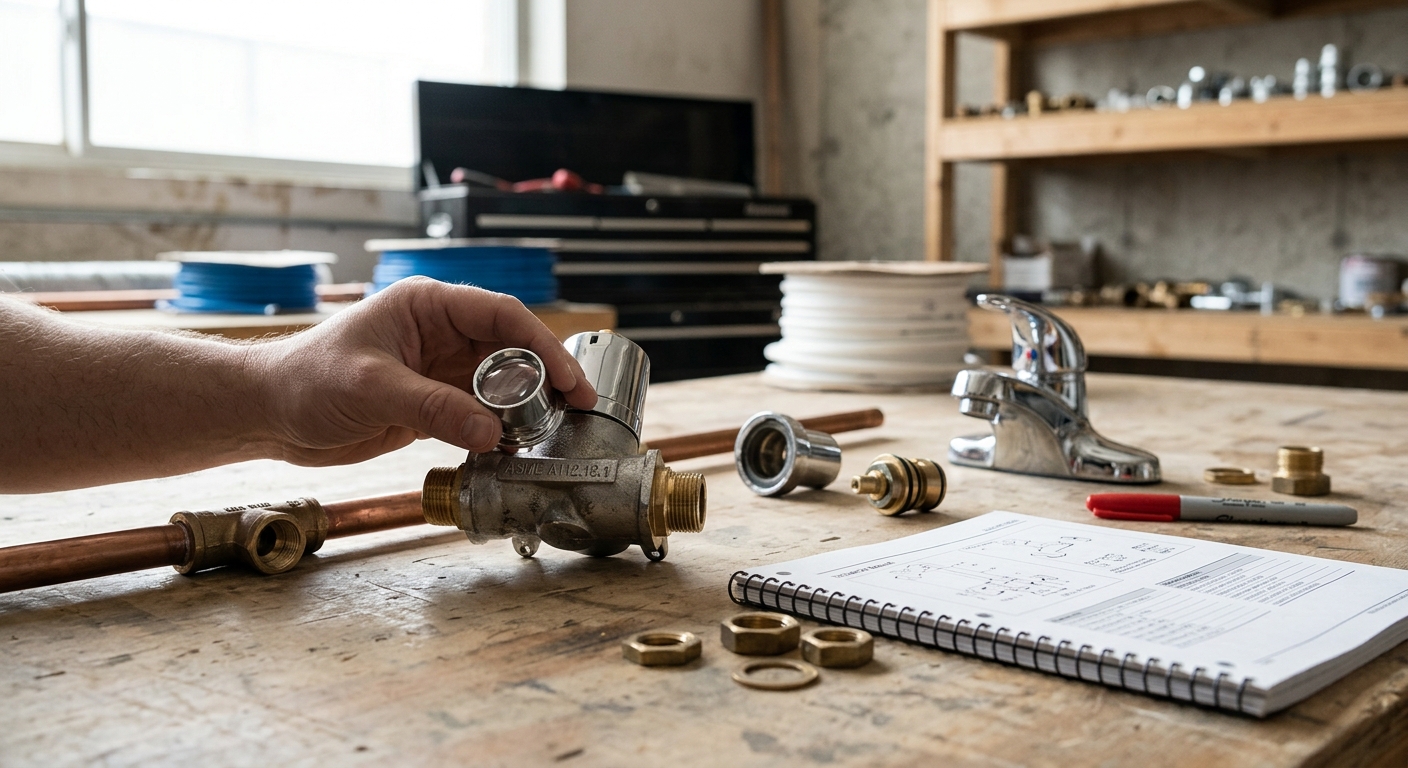
ASME A112.18.1 certifies that a faucet or supply fitting has passed third-party testing for mechanical performance: flow rate, backflow prevention where applicable, hot-limit safety, endurance cycling, and material integrity under pressure. The mark on a cut sheet tells you a lab verified the claim, not that the manufacturer self-reported it. For submittal review, that distinction is the whole job.
What ASME A112.18.1 Actually Certifies
ASME A112.18.1 is the US standard for plumbing supply fittings, which in practice means faucets, fittings, and the components that connect them to supply lines. It is frequently harmonized with CSA B125.1, and most manufacturers test to both simultaneously and list the dual standard on their documentation. A product carrying only one or the other is not automatically noncompliant, but it is worth asking why, especially on a project with both US and Canadian distribution or a client with cross-border facilities standards.
The standard covers mechanical and hydraulic performance. It does not certify lead content (that falls under NSF/ANSI 372 and the Safe Drinking Water Act’s low-lead requirements) and it does not certify WaterSense efficiency claims. Reviewers sometimes conflate these marks because they appear clustered on the same spec sheet. They verify different things, tested by different protocols, and a submittal can legitimately carry one without the others.
Reading the Mark on a Cut Sheet
The mark itself is usually a small certification logo near the product’s technical data, issued by an accredited third-party lab, not by ASME directly. ASME sets the standard; it does not test products. The actual certification comes from bodies like IAPMO (the UPC mark family) or CSA Group, both accredited to test against A112.18.1. You’ll see the lab’s logo, not ASME’s, printed on the cut sheet or stamped on the fitting body itself.
What to check on the document:
- The certifying body’s logo is present and legible, not a generic “complies with” statement in text
- The standard number matches current revision language (manufacturers update cut sheets when standards revise; stale references suggest the sheet wasn’t updated post-certification)
- The certification applies to the specific model and finish being submitted, not a parent product line
- Any listed exceptions or conditions, such as minimum supply pressure or flow restrictor requirements tied to the certification
A cut sheet that says “meets ASME A112.18.1” without a lab mark is a manufacturer’s claim, not a certification. That language shows up more often than it should, usually on lower-volume or import lines where third-party testing is pending or was never completed for that specific configuration.
Cross-Checking Marks in Listing Databases
A mark on a cut sheet is a starting point, not a verification. Cut sheets get reused across product revisions, and a finish or trim change can occur without a corresponding new certification test. Before approving, check the model number against the certifying body’s public listing database. IAPMO maintains a searchable product listing directory, as does CSA. Both let you search by manufacturer and model number and will show the actual certification scope and date.
This step matters most on high-volume multi-family or commercial jobs where the same faucet model might ship in several trim variants, only some of which were actually submitted for testing. A database search takes a few minutes. Catching a mismatch after fixtures are delivered costs considerably more than that.
Document the database check in your submittal log, not just the approval. If a certification question comes up later, during a inspection or a warranty dispute, having a timestamped record that you verified the listing (versus just reviewing the cut sheet) matters for your liability position.
When a Substitution Request Lacks Certification
Substitution requests are where this issue surfaces most often. A contractor proposes an equal product, often at a lower cost or shorter lead time, and the cut sheet included with the substitution request is missing a clear certification mark or shows a standard reference that doesn’t match the specified fitting. Do not approve on the promise that certification is “in process.”
Ask the contractor to provide one of the following before substitution approval:
- A copy of the current listing record from the certifying lab’s database, not just the manufacturer’s cut sheet
- Written confirmation from the lab (IAPMO, CSA, or equivalent) of certification status, including scope and expiration if applicable
- If certification is pending, a documented timeline with the lab’s file number and expected completion date
This is particularly relevant for commercial kitchen applications, where fittings see continuous-duty cycles well beyond residential use and the certification testing protocol accounts for that duty cycle. If a proposed substitute for commercial kitchen faucets doesn’t carry current certification matched to the commercial-duty rating specified, the substitution should be rejected or held pending verification, not approved with a note to follow up.
Lead-Time Risk From Pending Certification
A product without current ASME A112.18.1 certification is not necessarily defective or unsuitable. It may be new to market, awaiting lab scheduling, or mid-revision after a design change. But “pending” is not a basis for submittal approval on most projects, and treating it as a formality creates downstream risk.
If you accept a substitution on the basis of pending certification, build in the actual lab timeline, not an optimistic one. Third-party testing queues at IAPMO and CSA can run several weeks depending on current volume and whether the product requires full testing or an abbreviated re-test for a minor variant. A contractor’s assurance that certification is “almost done” is not a schedule input. Get the lab’s file number and ask for their stated turnaround.
The practical risk is that fixtures ship, get installed, and then certification comes back with required changes, at which point you’re dealing with removal and replacement on a completed scope of work instead of a submittal rejection. The few weeks spent waiting for certification before approval are nearly always cheaper than the alternative.
Noting Compliance in the Fixture Schedule
Once a fixture is verified, note the certification status directly in the fixture schedule, not just in the submittal log. Include the certifying body, the standard reference (A112.18.1, CSA B125.1, or both), and the date you verified the listing. This gives anyone reviewing the schedule later, during a change order, a value-engineering pass, or a close-out review, a record that doesn’t require re-opening the original submittal file.
| Schedule field | What to enter |
|---|---|
| Standard | ASME A112.18.1 / CSA B125.1 (note both if dual-listed) |
| Certifying body | IAPMO, CSA, or other accredited lab |
| Verification date | Date you confirmed via listing database, not cut sheet date |
| Model/finish scope | Confirm certification covers the exact SKU, not the product family |
This habit pays off most on projects with phased fixture ordering, where early-approved models get substituted mid-project due to availability. The schedule becomes the reference point instead of someone hunting through old email threads for the original cut sheet.
Before signing off on any faucet submittal, pull the model number and run it through the certifying lab’s database yourself. Don’t rely solely on the manufacturer’s printed claim. If a substitution request shows a gap in certification, put the burden on the contractor to produce lab documentation and a real timeline, and build that timeline into your approval schedule rather than treating it as a footnote. On commercial and high-duty-cycle applications, confirm the certification scope matches the actual duty rating specified, not just the base model.