Introduction
In modern architectural design, precision and data hold importance no less than aesthetics. Building Information Modeling has become the cornerstone for this, whereby all professionals can coordinate everything in a project in a digital way. Simple faucets become intelligent components of these models, carrying essential metadata that supports design accuracy, sustainability, and facility management.
This article explores how BIM-ready faucets can help you enable more efficient workflows through download-and-go families, organized metadata, and integration methods from these valued manufacturer sources: BathSelect, FontanaShowers, Delta, Chicago Faucets, and BIMobject.
Why BIM-Ready Faucets Matter
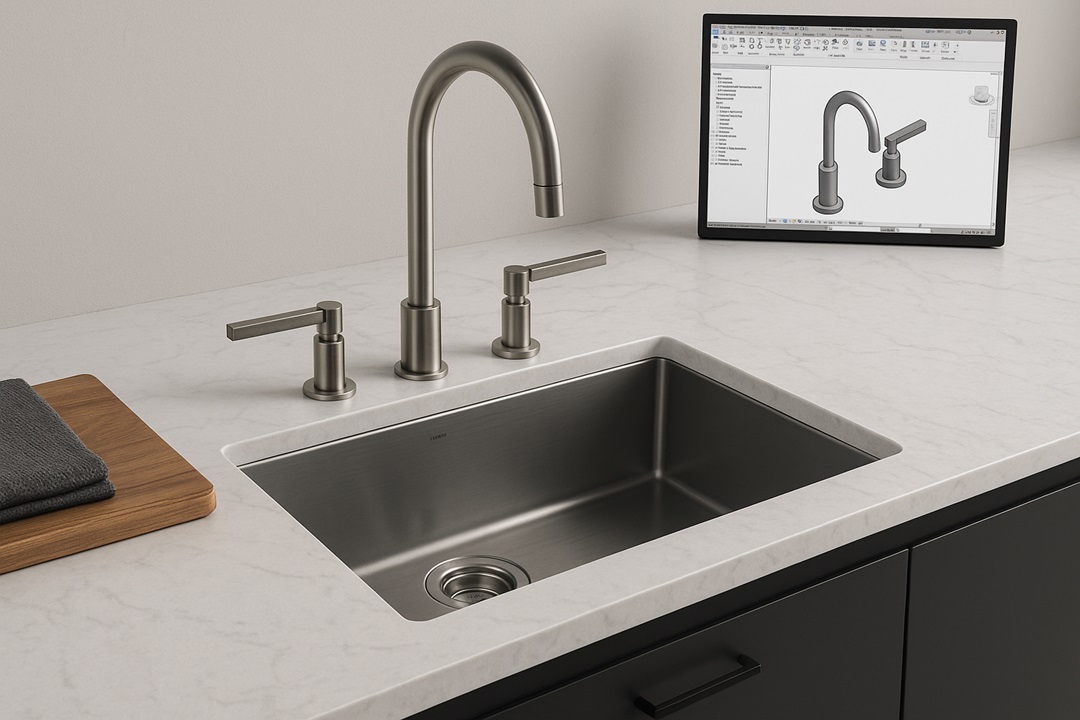
A BIM-ready faucet is not merely a 3D model, but an intelligent object interacting with the building’s mechanical and plumbing systems. Embed such a family in your Revit or ArchiCAD model, and each component will start to play an active role in spatial coordination, compliance, and specification control.
In such a closely integrated environment, for architects and engineers:
- Accurate coordination between plumbing, casework, and architectural finishes.
- Reduced design conflicts to minimize field adjustments.
- Automatically populate the schedule and align specifications correspondingly.
- Other types of compliance for sustainable buildings include ADA and LEED.
Leading manufacturers such as BathSelect and FontanaShowers now offer downloadable Revit families that embed performance and certification data directly into the model.
Understanding Downloadable Families
Downloadable faucet families are usually available in .rfa, .gsm, or .skp file formats. They are models that combine geometry and parameters so that design professionals can insert accurate product data into the BIM environment.
When choosing faucet families, consider the following:
- Geometry accuracy: The 3D model should include the correct type of mount, reach, and point of connection for the faucet.
- Level of Detail: Depending on the design phase required, it can be everything from a simple model for coordination to a detailed model for visualization.
- Include in the submittals data such as, but not limited to, model numbers, flow rates, finishes, and certification information.
- Compatibility: Please ensure that the file versions are compatible with your software release.
- Naming Convention: Use consistent file naming so that version tracking will be easier among teams.
Manufacturing companies like BathSelect provide Revit families for commercial, hospitality, and residential projects, both for touchless and manual faucets.
Metadata: What Is It?
Metadata in BIM turns geometry into actionable information. In fact, it provides the foundation for scheduling, compliance checking, and FM long into the future. Without metadata, a faucet family will be no more than a shape; with it, that is an intelligent object linking design and construction with the maintenance phase.
The critical metadata parameters for faucet families are:
- Manufacturer, Product Model
- Mounting configuration
- Flow rate vs. pressure data
- Material and finish codes
- Various certifications and standards include ADA, WaterSense, and NSF
- Warranty or maintenance intervals
For example, both BathSelect and FontanaShowers construct their BIM families with editable fields that allow the architect to edit parameters to suit particular project specifications and sustainability goals.
Integration Workflow
For maximum benefit, structured integration will ensure that consistency and coordination are sustained across multi-disciplines in BIM-ready faucets.
- Select manufacturer families based on design intent and specification requirements.
- Please download the relevant Revit or ArchiCAD file, and then load it into your project library.
- Properly set the faucet on either sink or countertop to confirm mounting height and spatial clearance.
- Adjust parameters to meet the chosen model finish or water efficiency requirement.
- Coordinate with the MEP engineers on verification of rough-in connections and plumbing layout.
- Link the metadata directly to project schedules so that the documentation and quantity take-off are automated.
- Include BIM data at FM handover, making sure that maintenance and warranty information can be accessed directly from the model for the facility team.
This workflow minimizes duplication and reinforces standardization and interoperability between Architectural and Engineering teams.
Common Challenges
Even with increased manufacturer support, there are a number of integration pitfalls for faucet families:
- Too much detail in geometry will bog down the coordination in BIM, so use lightweight models.
- Incomplete metadata reduces long-term value. Always check for fields that are editable including finish or certification.
- Files created in different releases of Revit also constitute a version mismatch; confirm compatibility early.
- Inconsistent naming makes collaboration more difficult; establish internal BIM standards.
- Neglecting updates may lead to the use of models that have become outdated; check periodically with the manufacturer for their latest BIM content.
Such challenges are addressed by manufacturers like BathSelect, which provide regularly updated BIM files that balance detail with efficiency.
Benefits for Architects and Engineers
Smooth Coordination
With intelligent faucet families, teams can identify spatial and plumbing clashes much earlier so they can avoid expensive revisions.
Automated Documentation
Because key data is embedded in the model, generation of schedules, legends, and specifications is increasingly done automatically.
Improved Visualization
A well-defined geometry and materials enable realistic renderings and presentations to clients.
Sustainability Alignment
Flow rate parameters assist in the assessment of water efficiency during the design phase in support of submissions for green certification.
Lifecycle Asset Management
Facility managers maintain their access to all maintenance and product info, which very much contributes positively to the effective operating of the building even after the handover date. The availability of ready-to-use BIM libraries from the manufacturers assures integrity in the data chain from concept to occupancy.
Conclusion
In fact, the detailing of plumbing fixtures must keep pace with the accelerating pace of BIM adoption. With BIM-ready faucets, what had been a static fixture is transformed into an information-rich, dynamic asset that carries value through each phase of a project, from design coordination to facility maintenance.
The architects who refer to the manufacturer libraries of BathSelect, FontanaShowers, Delta, Chicago Faucets, and BIMobject see advantages that can be measured in terms of accuracy, output, and life-span knowledge gained. The companies by indicating the products with thick geometry and metadata, can provide not only intelligent but also eco-friendly buildings, proving that even a faucet, when connected through BIM, is a vital part of the future architecture.