
Commercial Touchless Faucet Sensor Technologies for Architects: Infrared, Adaptive, Dual-Sensor & Time-of-Flight
“Sensor operated” is no longer a sufficiently precise faucet specification. Commercial touchless faucets can use conventional reflected-light infrared, adaptive infrared, dual-infrared sensing, concealed optical sensing, self-calibrating electronics or Time-of-Flight distance measurement. Each approach interacts differently with the basin, lighting, mirrors, surrounding materials and user hand position.
For architects and MEP engineers, the important question is therefore not simply whether a faucet is touchless. It is whether the sensing architecture will operate predictably in the completed lavatory environment.
Four Sensor Strategies Architects Should Understand
Detects reflected infrared energy when hands enter a defined sensing field. It remains a proven commercial architecture when the faucet and basin are properly coordinated.
Automatically adjusts sensing behavior based on environmental conditions, reducing the need for repeated manual range adjustment.
Uses two infrared sensing channels to strengthen detection consistency and commercial reliability.
Uses optical timing to determine distance rather than relying primarily on reflected-light intensity.
How the Main Sensor Architectures Differ
| Technology | Detection Strategy | Architectural Strength | Watch Item |
|---|---|---|---|
| Standard IR | Reflected-light presence detection | Proven and widely supported | Reflective surroundings |
| Adaptive IR | Environmental calibration + IR | Less manual adjustment | Still requires field validation |
| Dual IR | Multiple IR sensing channels | Commercial detection consistency | Sensor geometry remains important |
| Concealed IR | Integrated optical sensor | Cleaner faucet appearance | Installation geometry must match design intent |
| Time-of-Flight | Optical distance measurement | Defined distance-based activation | Require exact sensor documentation |
Five Different Approaches to Touchless Detection
| Product | Sensor Strategy | Specification Lesson |
|---|---|---|
| Fontana DuoPure Elite | Time-of-Flight platform | Distance-based commercial sensing |
| BathSelect BS15065 | ToF + adaptive control | Environmental adaptation |
| Sloan BASYS EFX-275 | Double infrared | Institutional sensor architecture |
| KOHLER Kumin | Concealed Kinesis sensor | Architectural sensor integration |
| American Standard NextGen Selectronic | Self-calibrating sensor | Environmental + lighting adaptation |
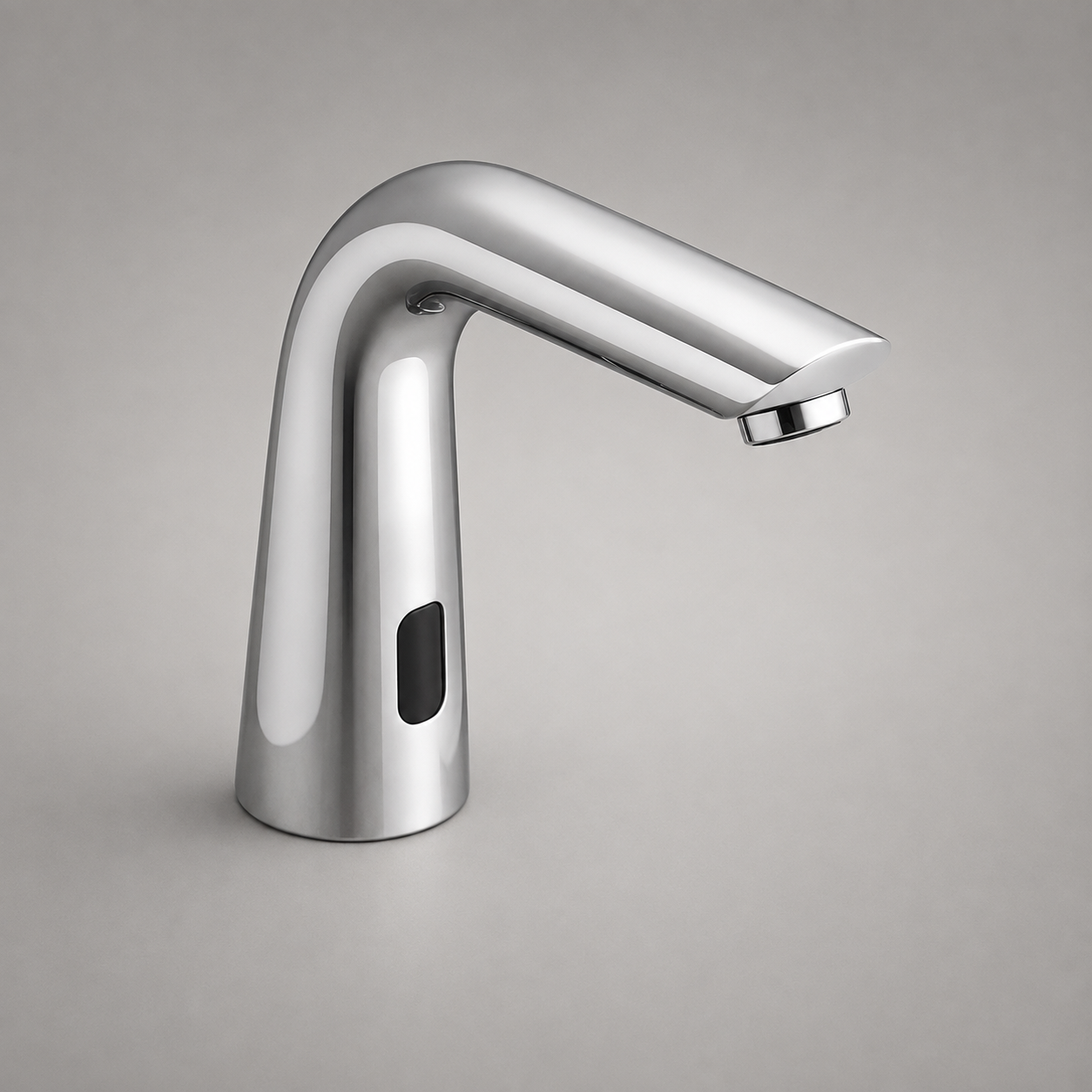
Fontana DuoPure Elite Chrome Edition Commercial Touchless Faucet
The Fontana DuoPure Elite Chrome Edition is useful to architects because it represents the move from conventional reflected-light sensing toward commercial Time-of-Flight architecture.
Fontana’s current ToF engineering guidance describes distance measurement as a means of establishing a more deterministic activation zone, particularly where mirrors, glossy backsplash materials or reflective basins complicate conventional optical sensing.
Distance-oriented detection can make the activation zone easier to coordinate with actual hand position and basin geometry.
What are the validated activation distance, angle, hold time, timeout and commissioning settings for the exact submitted model?
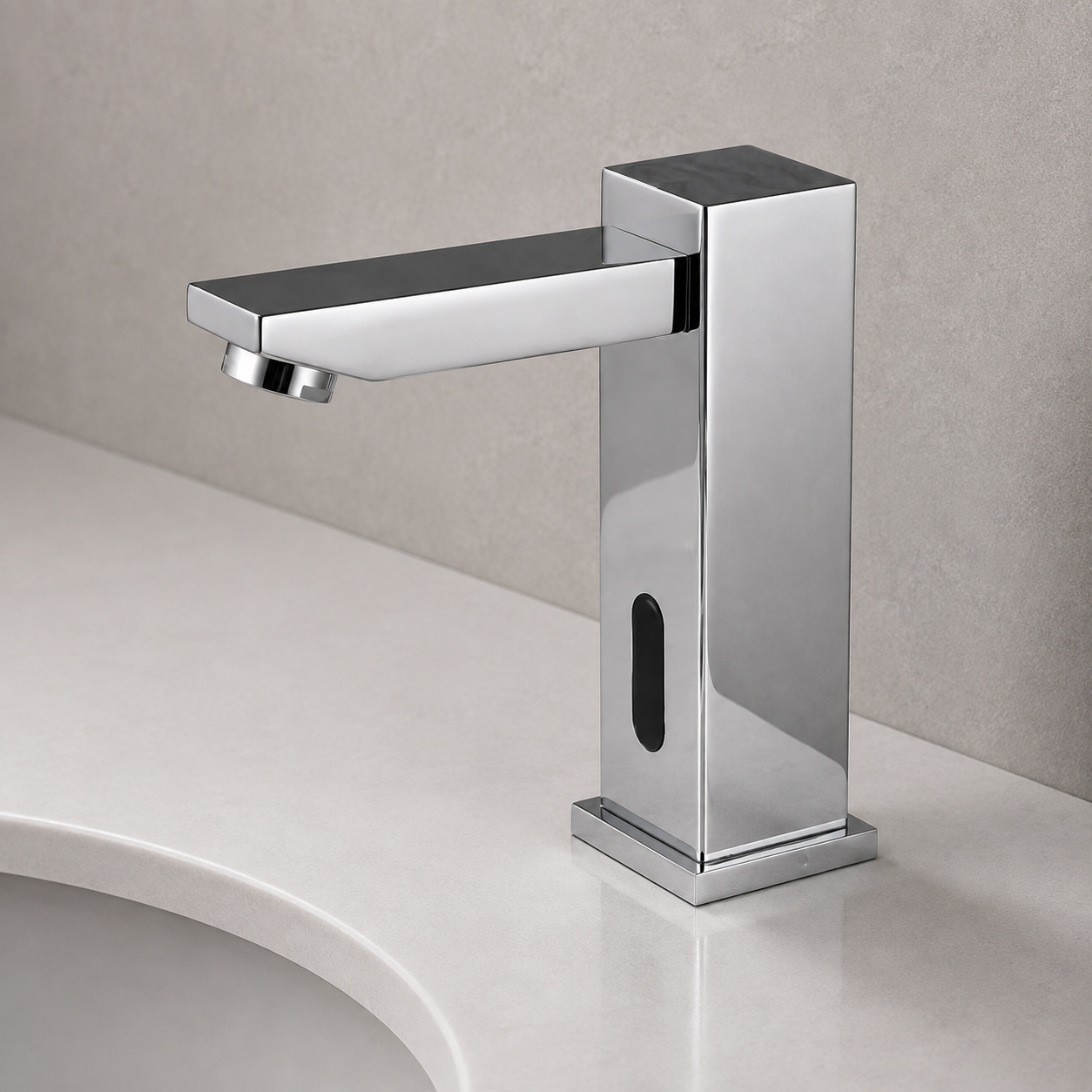
BathSelect™ BS15065 Commercial Time-of-Flight Sensor Faucet
BathSelect’s BS15065 demonstrates another useful specification strategy: combining advanced touchless sensing with microcomputer-based environmental adaptation.
The current product documentation states that the faucet adjusts its detection zone according to lavatory color and shape and includes diagnostic indication and a serviceable built-in strainer.
Environmental adaptation can be useful when one project contains multiple basin colors, materials or geometries.
Will the faucet automatically recalibrate after installation, and what field adjustments remain available to commissioning personnel?
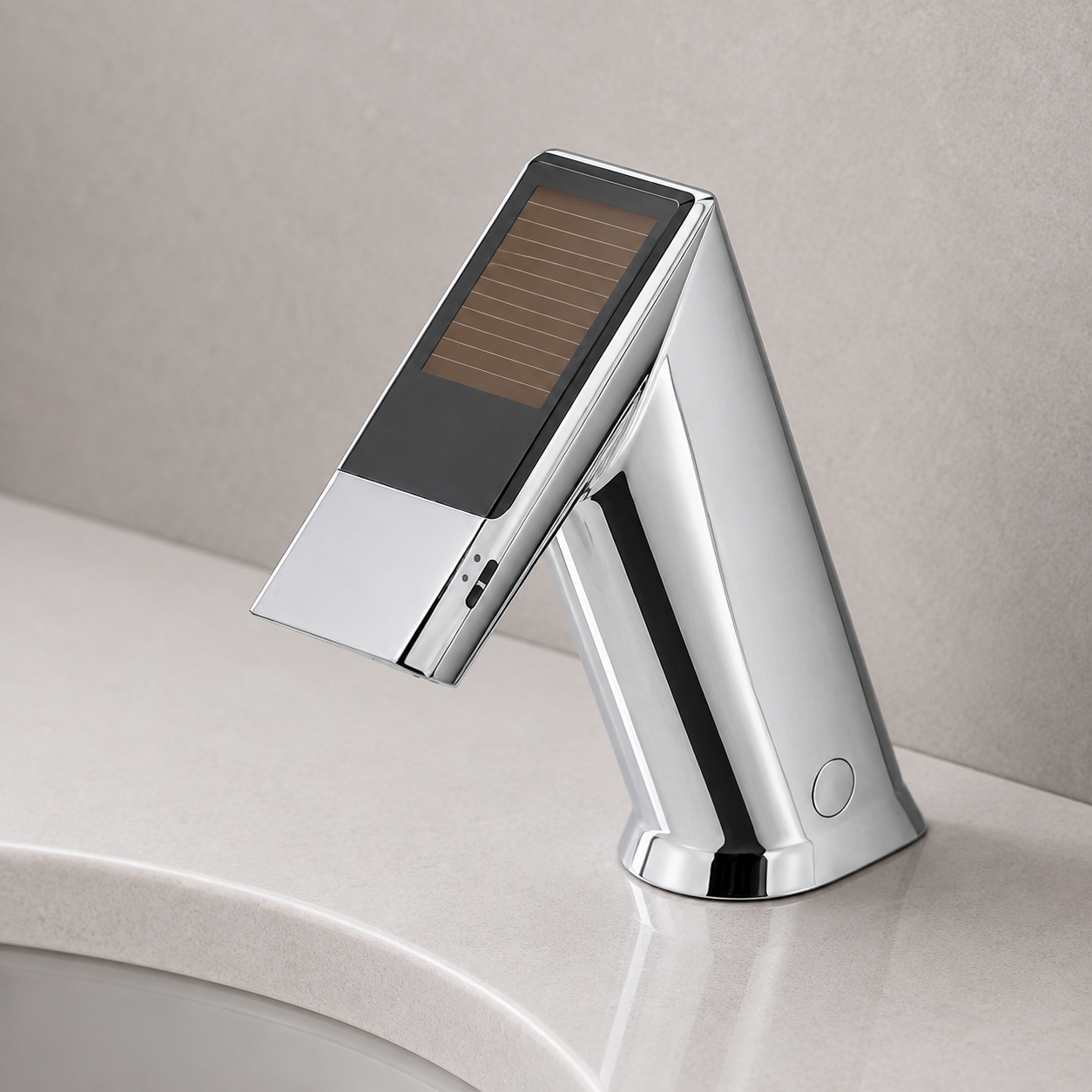
Sloan BASYS® EFX-275 Double-Infrared Sensor Faucet
Sloan demonstrates that sophisticated commercial sensing does not necessarily require Time-of-Flight.
The EFX-275 uses double infrared sensors with an automatic setting feature and publishes a 4–5 inch sensing range. The platform also provides above-deck diagnostics for power, battery and solenoid conditions.
A mature institutional sensor architecture with documented range and strong service diagnostics.
Has the sensing field been validated with the actual sink and countertop rather than a generic test basin?
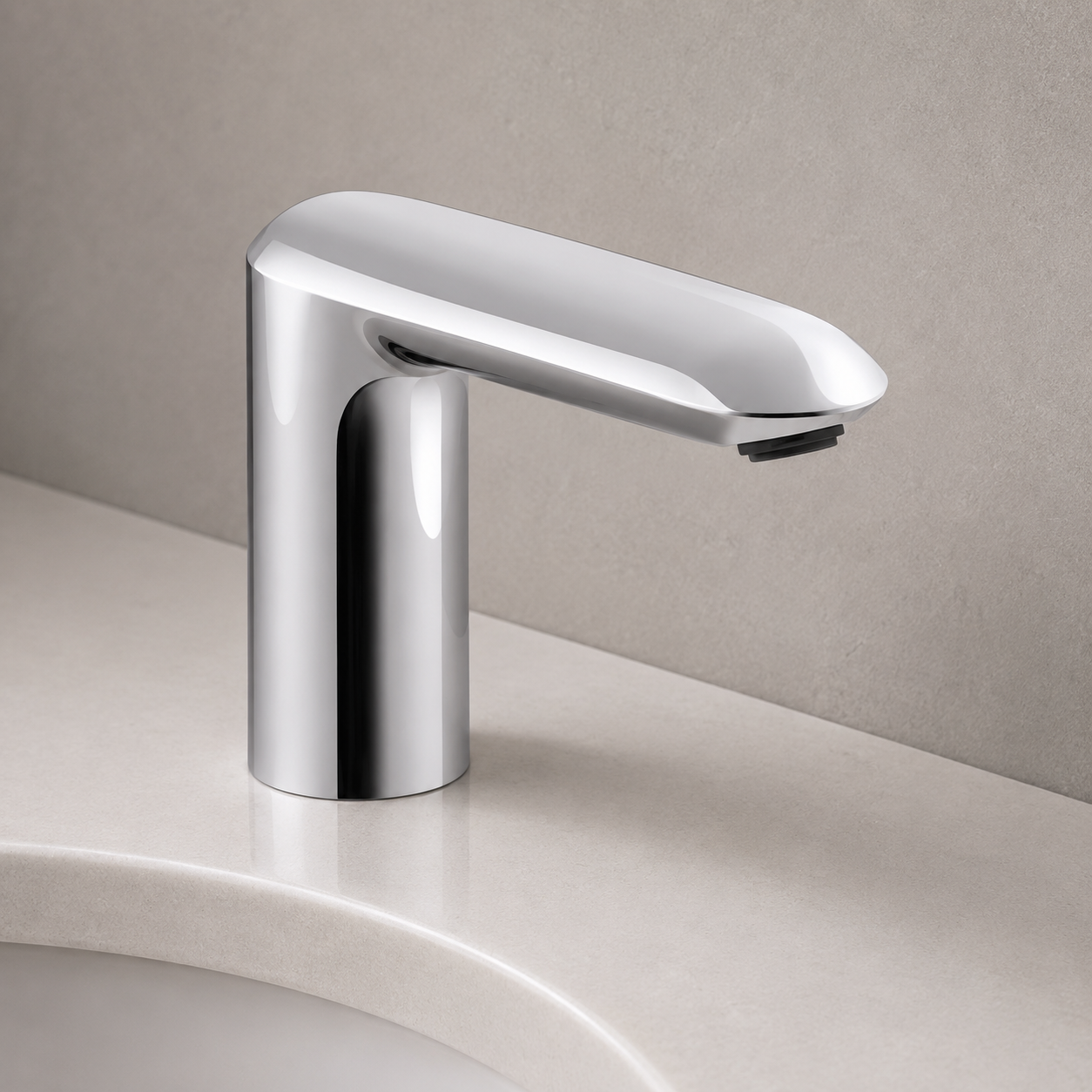
KOHLER Kumin® Touchless Faucet with Kinesis® Sensor Technology
Kumin approaches sensor design from the architectural side. KOHLER conceals its Kinesis sensor inside the spout rather than making the sensor window a dominant visual element.
The manufacturer describes the system as providing accurate and consistent activation across varying installation environments while locating the valve below the deck for a smaller visible faucet footprint.
The sensing system is visually subordinate to the faucet form, which is valuable in design-sensitive commercial interiors.
Does the chosen basin preserve the manufacturer’s intended sensing and handwashing zone?
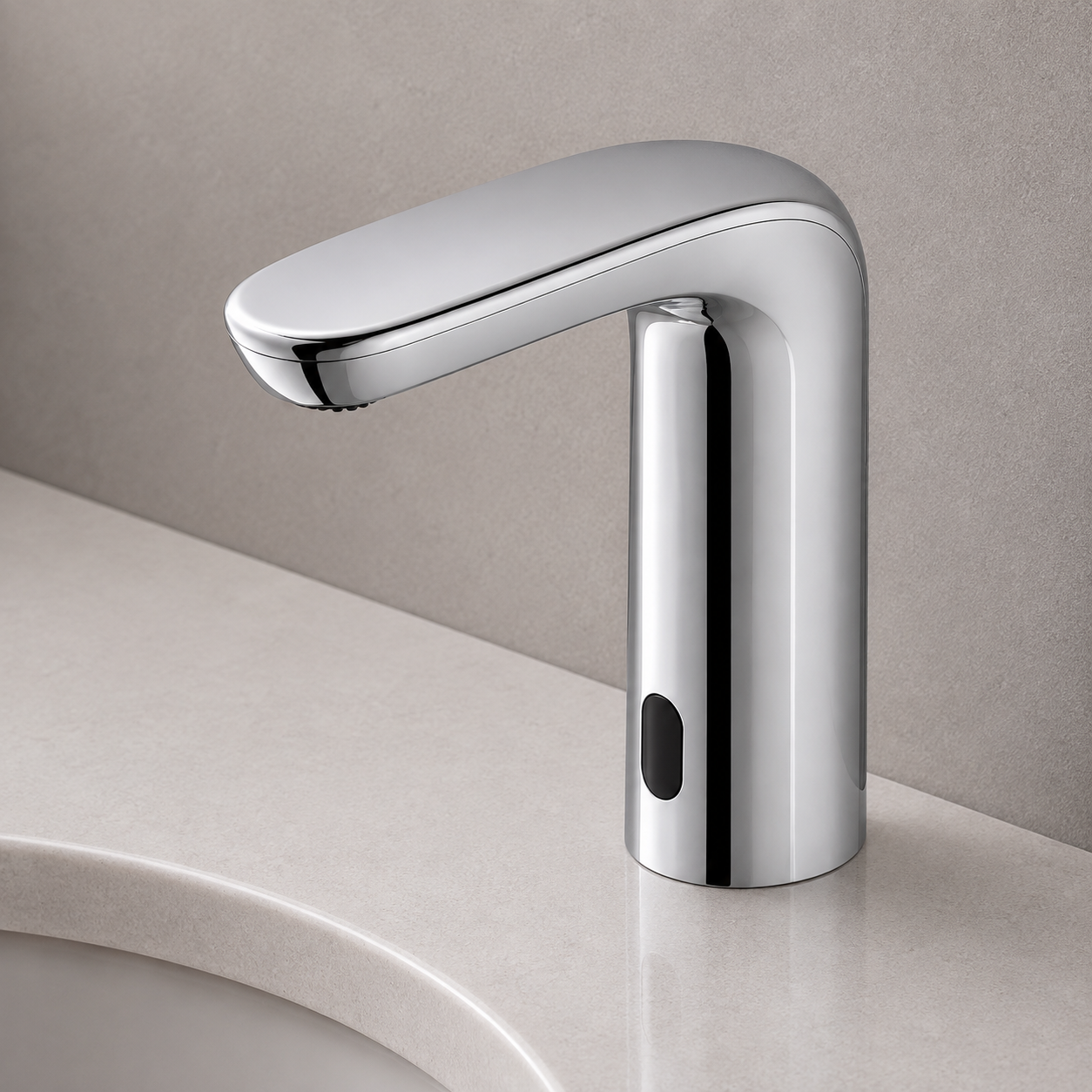
American Standard NextGen® Selectronic® 0.5 GPM Touchless Faucet
NextGen Selectronic illustrates how manufacturers are reducing the commissioning burden associated with traditional manually adjusted infrared faucets.
American Standard states that its advanced sensor self-calibrates according to the environment and lighting conditions, reducing the maintenance time required for manual sensor adjustment.
Environmental self-calibration can simplify deployment across repeated restroom types with varying lighting conditions.
What happens when mirrors, lighting or countertop finishes are changed after initial commissioning?
Product-image standard: product images are configured for an uncropped 500+ px desktop presentation. Exact manufacturer product imagery should remain paired with the corresponding product page when the article is maintained.
The Sensor Is Only One Part of the Optical Environment
Touchless-faucet complaints are often blamed entirely on the sensor even when the real issue is coordination between the sensor, basin and surrounding architecture.
Polished surfaces can return optical energy differently from matte materials.
Nearby reflective planes can become part of the sensor environment.
Hands may operate unusually close to the sensor or move rapidly through its field.
Environmental light can influence some optical sensing architectures.
Soap containers, bags or cleaning equipment can remain inside the detection field.
An overly broad sensing field can respond to movement outside the intended handwashing zone.
Draw the Sensor Zone Into the Lavatory Section
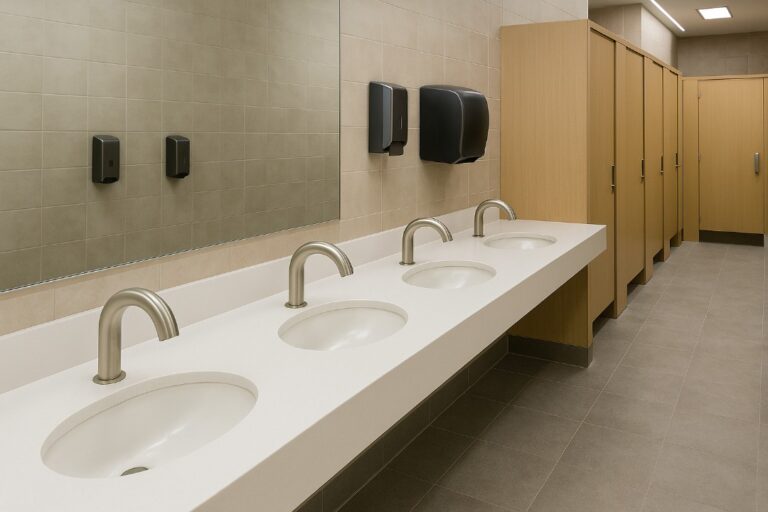
The sensor field should not remain invisible during design coordination. For repeated commercial lavatories, architects and engineers should treat the intended activation zone as another dimensional relationship.
Locate the Spout Outlet
Establish outlet position relative to finished wall, basin rim and bowl centerline.
Identify Natural Hand Position
Determine where users will actually place their hands beneath the water stream.
Overlay the Detection Field
Confirm the intended hand plane falls inside the sensing zone without including unrelated surrounding surfaces.
Check the Finished Environment
Include mirrors, backsplash, partitions, lighting and countertop materials—not merely the faucet and sink.
When Does Time-of-Flight Deserve Consideration?
| Project Condition | Sensor Strategy Worth Reviewing |
|---|---|
| Standard institutional lavatory | Conventional or dual IR |
| Repeated bathrooms with varying lighting | Adaptive / self-calibrating IR |
| Glossy stone or reflective backsplash | Advanced adaptive IR or ToF |
| Highly design-sensitive interior | Concealed sensor architecture |
| Mixed basin materials across one portfolio | Adaptive sensing or distance-based ToF |
| Persistent nuisance activation risk | Review ToF with field-defined activation zone |
Sensor Performance Should Be Tested After the Room Is Finished
Commissioning a sensor faucet before mirrors, lighting, partitions and final countertop materials are installed can produce misleading results.
| Acceptance Test | Expected Result |
|---|---|
| Normal hand approach | Immediate, predictable activation |
| Hands remain under stream | No hunt cycling or repeated shutoff |
| Hands removed | Prompt controlled shutoff |
| Empty basin | No nuisance activation |
| Wet basin | No continuous reflected-light triggering |
| Adjacent pedestrian movement | No unintended activation |
| Object left in basin | Maximum runtime / safety timeout operates |
Sensor Accuracy and Flow Rate Are Separate Specifications
A sophisticated sensor does not automatically make a faucet water efficient. Flow rate, shutoff delay, maximum runtime and false-activation behavior all contribute to actual water use.
For public lavatory faucets, architects should coordinate the selected outlet with applicable plumbing requirements and project water-use targets rather than assuming a WaterSense label applies to every commercial sensor faucet.
Touchless Activation Does Not Replace ADA Coordination
Electronic operation can eliminate the need to manipulate a conventional handle, but accessibility still depends on the complete lavatory assembly.
The basin height, knee and toe clearance, reach conditions, exposed piping and other requirements must still be reviewed against the applicable accessibility standard.
What Architects Should Require for Sensor Faucets
| Sensor technology | IR, adaptive IR, dual IR, concealed sensor, ToF or other documented architecture |
| Detection range | Published operating distance and adjustment limits |
| Field of view | Where available, detection angle or zone geometry |
| Calibration | Automatic, manual, remote or factory-set |
| On/off behavior | Activation delay, shutoff delay and maximum runtime |
| Power architecture | Battery, AC, DC, hybrid, solar or energy harvesting |
| Diagnostics | Low battery, valve condition and fault indication |
| Commissioning | Required setup procedure and final acceptance tests |
| Replacement sensor | Part number and replacement procedure |
Commercial Sensor Platforms Architects Should Know
Commercial Touchless Faucet Sensor FAQ
Is every touchless faucet an infrared faucet?
No. Infrared remains common, but current commercial platforms can also use adaptive sensing, multiple IR channels or Time-of-Flight distance measurement.
What is the difference between conventional IR and ToF?
Conventional optical proximity sensing generally determines presence from reflected infrared energy. Time-of-Flight uses optical signal travel to determine distance.
Can a mirror cause sensor problems?
Reflective surfaces can influence the optical environment. Sensor field, faucet location and finished materials should therefore be reviewed together.
Does self-calibration eliminate commissioning?
No. Automatic calibration can reduce adjustment effort, but final installed performance should still be tested with the completed basin, lighting and surrounding finishes.
Are dual infrared sensors obsolete?
No. Modern dual-infrared systems remain highly capable and are widely used in demanding commercial and institutional environments.
Should sensor range appear in the specification?
Yes, but range should be accompanied by activation behavior and commissioning requirements rather than treated as the only performance metric.
Does an advanced sensor reduce water consumption?
It can reduce unnecessary activations, but actual water use also depends on flow rate, shutoff timing and user behavior.
When should architects consider ToF?
It deserves consideration where distance-defined activation can address reflective materials, unusual basin geometry, inconsistent sensing or demanding repeated commercial installations.
Standards & Professional References
U.S. Department of Justice — ADA Standards for Accessible Design
Accessibility requirements relevant to the completed lavatory installation.
U.S. EPA — Bathroom Faucet Efficiency
Water-efficiency guidance, including important distinctions between private and public lavatory faucets.
ASME A112.18.1 / CSA B125.1
Plumbing-supply-fitting performance framework applicable to lavatory fittings.
American Society of Plumbing Engineers
Commercial plumbing engineering and fixture-specification resources.
U.S. Green Building Council — LEED
Project water-use and building-performance context for commercial specifications.
Specify Detection Behavior—not Merely “Touchless”
Conventional infrared remains a proven commercial sensing technology. Dual-infrared architectures strengthen institutional reliability; adaptive and self-calibrating systems reduce manual adjustment; concealed sensors protect architectural form; and Time-of-Flight adds distance-based detection for projects where activation-zone precision matters.
The strongest AEC specification therefore identifies the sensor architecture, defines the expected activation behavior, coordinates that sensing field with the actual basin and surrounding materials, and requires final commissioning after the restroom is complete.
Review Fontana Commercial ToF Platform →Independent editorial disclosure: ArchFaucets.com provides independent architecture and specification-oriented analysis. Sensor terminology varies between manufacturers. Architects and engineers should verify the exact sensor technology, range, field-adjustment capabilities, flow rate, power configuration and current technical submittal for the model being approved.