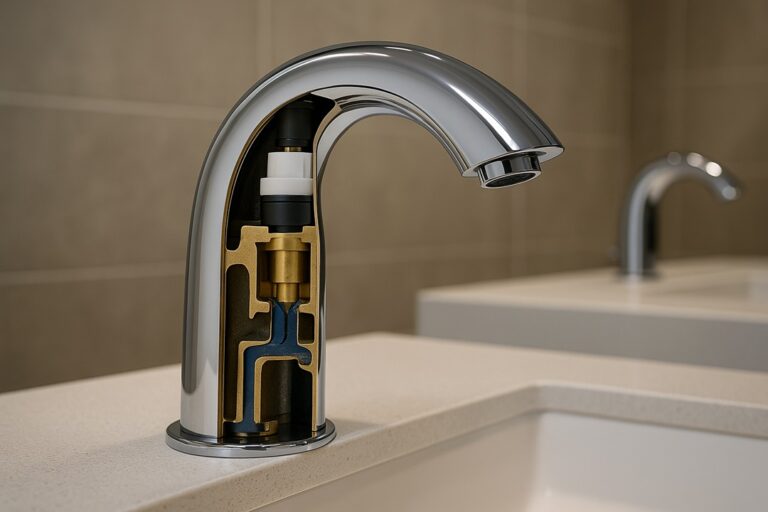

A single finish callout on a fixture schedule does not mean a single supplier, a single lead time, or a single point of failure. Kitchen faucets, lavatory sets, and any bar or prep sink fixtures typically ship from different product lines even within one manufacturer’s catalog, and they rarely hit the jobsite on the same week. Coordinating them across five trades means managing the schedule as a procurement document first and a design document second.
Why one finish code doesn’t guarantee one supplier
Specifying “polished chrome throughout” reads as one decision. It is actually several, because polished chrome on a kitchen faucet, a lav faucet, a tub filler, and a shower trim may come from three different factories even under one brand name. Manufacturers frequently outsource categories, license names, or run separate plating lines for high-volume kitchen faucets versus lower-volume specialty trim. The finish can match on the sample chip and still diverge slightly in sheen or undertone between categories, which is a submittal problem, not a taste problem. Pull actual finish samples per category, not per brand, before locking the schedule.
Matching finish codes across fixture types
ANSI/BHMA A156.18 gives you a common language for this, and it’s worth writing the code into the schedule instead of a marketing name. “Brushed Nickel” means nothing enforceable; BHMA 626 or 630 (for stainless-look brushed finishes) does. Cross-reference every fixture’s submitted finish against the BHMA code, not the manufacturer’s proprietary name, because two products both called “Satin Nickel” can carry different BHMA designations depending on base metal and plating process.
- Require BHMA code citation on every cut sheet submitted, not just the trade name.
- Flag any fixture where the manufacturer cannot map their finish to a BHMA code. That’s usually a sign of a non-standard or proprietary process, which matters for long-term wear matching and future replacement stock.
- Keep a single reference row per finish code at the top of the schedule so reviewers aren’t hunting through cut sheets to confirm consistency.
This matters most on renovation work where existing fixtures stay in place and new ones need to match. A BHMA code gives you a defensible basis for a substitution argument; “it looked close in the showroom” does not.
Lead time mismatches between kitchen and lav fixtures
This is where schedules actually break. Kitchen faucets, especially pull-down or pull-out models with integrated sprayers, commonly run 4 to 10 weeks longer than standard lavatory sets, depending on finish, whether the unit includes a matching soap dispenser or air gap cover, and whether it’s a current or recently updated SKU. Lav faucets in stock finishes often ship in 1 to 3 weeks; the same brand’s kitchen faucet in a specialty finish like matte black or a PVD coating can run 6 to 10 weeks or longer if it’s backordered.
| Fixture category | Typical lead time range | What drives the delay |
|---|---|---|
| Lavatory faucet, standard finish | 1-3 weeks | Usually stock item at distributor |
| Lavatory faucet, specialty finish | 3-6 weeks | Made-to-order plating run |
| Kitchen faucet, standard finish | 2-5 weeks | Assembly complexity, sprayer hose sourcing |
| Kitchen faucet, specialty finish or integrated accessories | 6-10 weeks | Finish backorder, accessory matching, minimum order runs |
These ranges are typical, not guaranteed, and they shift with the manufacturer’s production calendar and whatever else is backordered that quarter. The point for the schedule is structural: if you specify the kitchen faucet and the lav faucet on the same submittal date expecting simultaneous delivery, you are building in a mismatch that plumbing will discover at rough-in, not before.
Sequencing substitution requests before rough-in lock
Rough-in valve bodies get set weeks before finish trim ever arrives on site, and the valve body is often finish-agnostic but not always fixture-agnostic. Some manufacturers pair a specific rough-in valve to a specific trim line; substitute the trim after rough-in is set and you may need to pull tile or drywall to swap the valve. Coordinate substitution requests against the plumbing trade drawings before that lock date, not after.
Practical sequencing:
- Confirm rough-in valve compatibility with the trim SKU at time of initial submittal, not at trim delivery.
- Set your substitution request deadline at least one full submittal review cycle before rough-in, typically 2 to 3 weeks depending on the GC’s review turnaround.
- Route any substitution touching a kitchen faucet’s finish through the same lead-time check described above. A last-minute substitution to a matte black finish, for example, can add weeks if that finish isn’t in the distributor’s regular stock rotation. If you’re evaluating options in that finish, it’s worth reviewing what’s actually stocked versus made-to-order across a supplier’s current line, such as a distributor’s listing of black kitchen faucets, before writing the substitution into the schedule.
- Document substitution approval in writing with the BHMA finish code and lead time confirmed, not just the model number.
A substitution approved on aesthetics alone, without a lead-time check, is the single most common cause of a faucet holding up a punch list.
Building a single fixture schedule tab, not five
Kitchen, powder room, primary bath, secondary baths, and utility or bar sink fixtures often end up on separate schedule tabs because different consultants or subs draft different rooms. That fragmentation is exactly what lets a finish mismatch or a lead time conflict slip through, because no one is looking at all five categories side by side. Consolidate every faucet, valve, and trim item onto one tab with common columns: room, fixture type, manufacturer, model, BHMA finish code, lead time, rough-in valve compatibility, and submittal status. Sort by lead time, not by room, when you’re checking for schedule risk. The room-by-room view is for the GC; the lead-time view is for you.
This single-tab approach also makes it faster to answer the question every reviewer eventually asks: which fixtures are still open, and which finish codes are unconfirmed. If that answer takes more than a few minutes to produce, the schedule is organized for the wrong audience.
Flagging discontinued finishes before bid closes
Finish lines get discontinued or reformulated more often than base fixture models do, particularly PVD and living finishes that depend on a specific plating vendor. A finish that was current when the schedule was drafted can be discontinued by the time bids close, especially on longer projects. Before bid closing, send a written confirmation request to each manufacturer’s rep asking whether every specified finish code is still in active production, not just listed in the current catalog. Catalogs lag discontinuations by a full print or web cycle in some cases. Get the confirmation in writing and keep it in the submittal file, because a discontinued finish discovered after bid close is a change order, not a substitution.
Before the schedule goes final: confirm BHMA codes on every line, verify lead times against the actual rough-in date rather than the overall project completion date, and get written confirmation that every specified finish is still in production. If any of those three checks comes back uncertain, resolve it before the submittal goes out, not during the review cycle.