How Many Automatic Soap Dispensers Does a Commercial Restroom Need? Sink Count, Traffic, ADA & MultiFeed Quantity Calculator
Should every commercial lavatory have its own automatic soap dispenser? Can one sensor dispenser serve two sinks? How many units should be planned for a bank of 4, 8, 12 or 24 lavatories—and what happens when an airport, stadium, hospital, university or office portfolio contains 50, 100, 250 or 500 handwashing positions? This guide separates plumbing-code fixture quantity from soap-dispenser planning and provides a practical design methodology based on sink layout, simultaneous users, accessibility, traffic and maintenance architecture.
First: Plumbing Fixture Count Is Not Soap Dispenser Count
Commercial plumbing codes establish minimum quantities for plumbing fixtures such as water closets and lavatories according to building occupancy and use.
That is a different question from determining how many automatic soap dispensers should be installed at those lavatories.
Best Design Starting Point: One Convenient Soap Position per Lavatory
For many new commercial restroom projects, coordinating one automatic soap position with each lavatory is the clearest starting point.
Sink Count vs Automatic Soap Dispenser Planning
| Lavatories / Wash Positions | Dedicated Strategy | Potential Shared Strategy | Design Direction |
|---|---|---|---|
| 1 | 1 dispenser | Not applicable | Dedicated unit is the normal starting point. |
| 2 | 2 dispensers | 1 shared dispenser may be evaluated | Check reach, counter geometry and simultaneous use. |
| 4 | 4 dispensers | 2 or 3 shared positions may be evaluated | Dedicated usually supports clearer peak flow. |
| 6 | 6 dispensers | Project-specific shared arrangement | Evaluate central soap supply even if dispenser heads remain dedicated. |
| 8 | 8 dispensers | Shared positions only with deliberate layout analysis | Peak throughput becomes increasingly important. |
| 12 | 12 dispensers | Shared arrangement requires careful circulation review | Strong candidate for centralized soap supply. |
| 24+ | One per wash position is a strong baseline | Architect/MEP/facility-engineered | Treat quantity and soap supply as commercial infrastructure. |
The shared quantities above are possible planning scenarios—not code minimums or recommendations applicable to every project.
Can One Automatic Soap Dispenser Serve Two Sinks?
Potentially, yes.
But the important question is not whether one dispenser can physically sit between two basins. The question is whether both users can operate it comfortably and simultaneously without creating conflict.
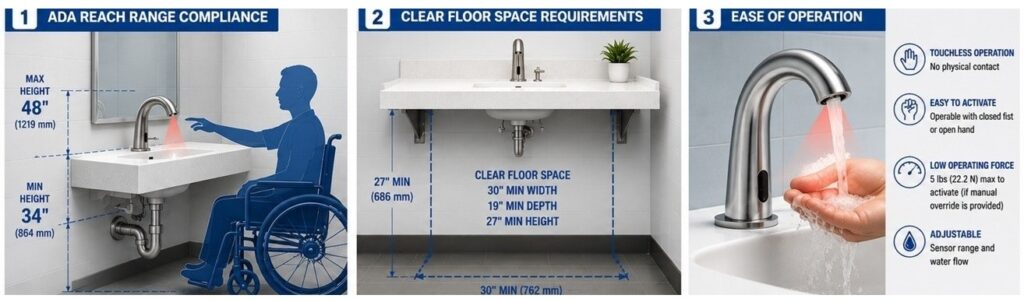
ADA Can Change the Quantity and Placement Decision
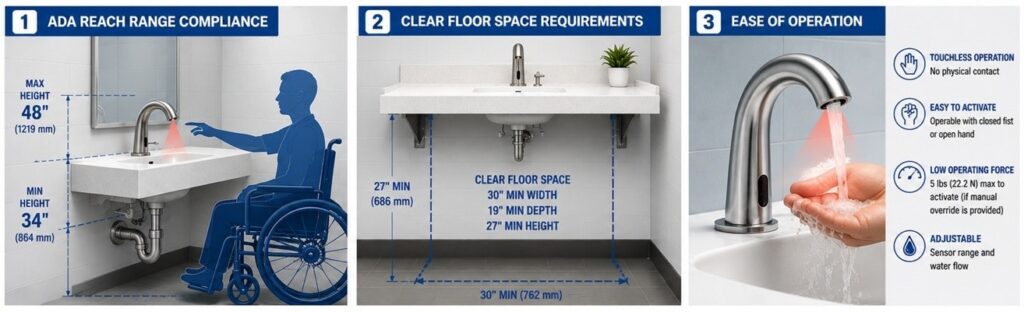
The U.S. Access Board advises that soap dispensers provided at accessible lavatories must be located within applicable reach ranges and conveniently usable from the accessible handwashing position.
It also explains that the knee and toe space beneath a lavatory must be deep enough to support the required reach to faucet controls, soap dispensers and other operable parts.
Therefore, a shared dispenser should not be positioned merely for geometric symmetry if doing so makes it difficult to use from the accessible lavatory.
U.S. Access Board Lavatory GuidePeak Concurrency Is More Useful Than Daily Occupancy
A restroom might have thousands of users per day but never have every sink occupied at once. Another restroom may experience its entire demand within a 15-minute intermission.
Average Number of Simultaneously Occupied Lavatories During Peak Period
÷ Total Lavatories
For example:
| Restroom | Lavatories | Typical Peak Simultaneous Users | Concurrency |
|---|---|---|---|
| Office example | 8 | 3 | 37.5% |
| Airport example | 8 | 6 | 75% |
| Stadium example | 8 | 8 | 100% |
These are illustrative traffic scenarios, not universal facility benchmarks.

Interactive Automatic Soap Dispenser Quantity Calculator
This calculator is a project-planning tool, not a code calculator.
4-Sink Commercial Restroom
For a small low-traffic office restroom, shared positioning may sometimes work. For a theater, school, stadium or transportation facility with frequent peak use, dedicated soap positions generally offer a stronger operational design.
8-Sink Restroom
| Strategy | Soap Dispensers | Primary Benefit | Primary Risk |
|---|---|---|---|
| Dedicated | 8 | Maximum peak throughput | Higher hardware and service-point count |
| 3 per 4 sinks | 6 | Moderate hardware reduction | Requires carefully positioned shared units |
| 1 per 2 sinks | 4 | Minimum dispenser count | User conflict, reach and peak-flow concerns |
12-Sink Restroom: Quantity and Supply Architecture Become Separate Decisions
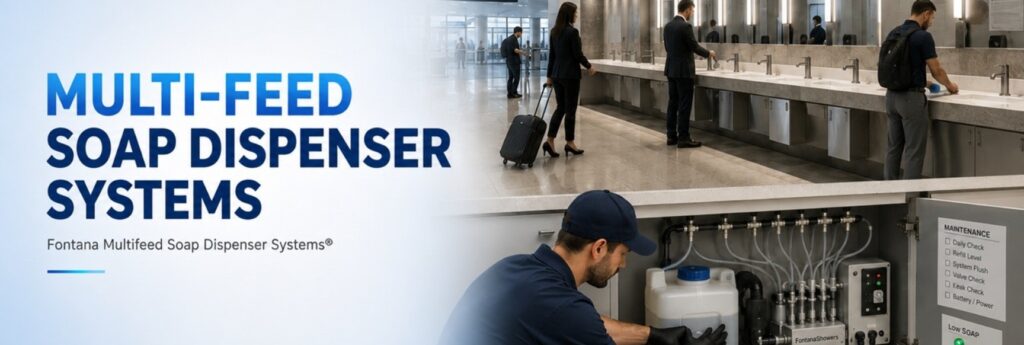
A twelve-lavatory restroom may still use twelve dedicated soap dispensing heads while supplying those heads from fewer central soap reservoirs.
This allows the project to preserve user throughput while improving maintenance architecture.
Verified Fontana MultiFeed™ EngineeringMultiFeed Does Not Determine Dispenser Quantity
Fontana’s current MultiFeed™ engineering page explicitly separates dispenser quantity from reservoir capacity.
The system connects multiple compatible automatic soap dispensers to a centralized soap supply, but reservoir selection must reflect:
Total Connected Dispenser Activations × Actual Dose × Desired Service Days
Large Portfolio Planning: 50, 100, 250 & 500 Sinks
At portfolio scale, reducing dispenser count solely to save hardware can be a false economy if it damages restroom throughput or accessibility.
| Total Sinks | 1:1 Dedicated Layout | 75% Layout Scenario | 50% Shared Layout Scenario |
|---|---|---|---|
| 50 | 50 dispensers | 38 dispensers | 25 dispensers |
| 100 | 100 dispensers | 75 dispensers | 50 dispensers |
| 250 | 250 dispensers | 188 dispensers | 125 dispensers |
| 500 | 500 dispensers | 375 dispensers | 250 dispensers |
Hardware Savings vs Operational Cost
Suppose a 100-sink portfolio evaluates 100 dedicated dispensers versus 50 shared dispensers.
Stadiums & Arenas
Event venues can experience near-simultaneous use of large lavatory banks during halftime and intermission.
This is one of the strongest applications for separating user-facing dispenser quantity from maintenance-facing reservoir quantity.
Airports & Transportation Facilities
The 2024 International Plumbing Code separately recognizes passenger terminals and transportation facilities when calculating minimum plumbing fixtures from occupant load.
Once the required lavatory layout has been established, soap quantity should be evaluated around passenger volume, flight-bank peaks, accessibility and facility maintenance logistics.
Facility-Type Planning
| Facility Type | Soap-Quantity Priority |
|---|---|
| Airport | High concurrency, long hours and large restroom banks favor abundant soap access. |
| Stadium / Arena | Extreme peak demand strongly favors simultaneous user throughput. |
| Hospital Public Restroom | Accessibility, dependable soap availability and maintenance control are priorities. |
| University | Class-change peaks and large distributed fleets require scalable quantity planning. |
| Office Building | Moderate concurrency can make more layout options viable. |
| Luxury Hotel / Resort | User experience, architecture and intuitive fixture placement remain important. |
| Convention Center | Break periods can create event-style peak demand despite lower off-event traffic. |
What Architects & MEP Engineers Should Document
Commercial Soap Dispenser Quantity Worksheet
| Planning Input | Project Value |
|---|---|
| Occupancy classification | ________________________ |
| Design occupant load | ________________________ |
| Code-required lavatories | ________________________ |
| Actual designed wash positions | ________________________ |
| Expected peak simultaneous users | ________________________ |
| Dedicated soap positions | ________________________ |
| Shared soap positions | ________________________ |
| Total automatic dispenser heads | ________________________ |
| Accessible lavatory soap location verified | YES / NO |
| Total daily soap activations | ________________________ |
| Actual soap dose | ________ mL |
| Central MultiFeed considered | YES / NO |
| Number of central service zones | ________________________ |
| Desired refill interval | ________ days |
Verified Fontana Commercial Soap & Project Resources
Current centralized-soap planning guidance covering reservoir, pump, manifold, tubing, traffic, capacity and maintenance access.
MultiFeed™ EngineeringCurrent Fontana commercial automatic soap-dispenser collection.
Automatic Soap SystemsCommercial product, system and touchless-soap technical navigation.
Touchless Soap HubCalculate soap capacity separately from dispenser-head quantity.
Reservoir CapacityCalculate service intervals from actual traffic, dose and working capacity.
Refill PlanningFontana commercial project and specification support for AEC teams.
AEC ResourcesIndependent Code & Accessibility References
Minimum plumbing fixture quantities by occupancy classification and occupant load.
2024 IPC Chapter 4Official guidance for accessible lavatories, reach, knee/toe clearance, faucets and soap dispensers.
ADA Lavatory GuideFacility-management resources for commercial buildings, schools, hospitals, hotels and institutional properties.
Commercial BuildingsCommercial Soap Dispenser Quantity FAQ
How many automatic soap dispensers does a commercial restroom need?
There is no universal dispenser-to-occupant ratio. Quantity should be coordinated with the actual number and layout of lavatories, peak simultaneous use, accessibility and project maintenance strategy.
Does every sink need its own automatic soap dispenser?
Not as a universal code rule. However, one conveniently located dispenser per wash position is a strong starting strategy because it supports simultaneous use and intuitive handwashing flow.
Can one automatic soap dispenser serve two sinks?
Potentially, provided both users can reach it conveniently and the layout does not create accessibility, cross-reach, sensor or peak-throughput problems.
How many soap dispensers should four sinks have?
Four dedicated dispensers provide the clearest one-to-one layout. A smaller number of shared dispensers can be evaluated, but should be justified from actual reach, accessibility and expected traffic rather than used as an automatic ratio.
How many soap dispensers should twelve sinks have?
Twelve dedicated user-facing soap positions are a strong baseline for a high-throughput restroom. Centralized MultiFeed can reduce refill points without necessarily reducing the number of dispensing heads.
Does MultiFeed reduce the number of soap dispensers required?
Not necessarily. MultiFeed centralizes the soap supply. A project can still provide one dispensing head at every lavatory while reducing the number of separate soap reservoirs requiring replenishment.
Does the plumbing code say how many soap dispensers are required?
The plumbing code determines quantities for plumbing fixtures such as lavatories according to occupancy and use. Soap-dispenser quantity and placement require separate project design and accessibility coordination.
Where should the soap dispenser be located at an accessible lavatory?
It should be conveniently usable from the accessible lavatory and within the applicable reach range. Counter depth, clear floor space and knee/toe clearance must be coordinated with the required reach.
Are touchless soap dispensers good for accessibility?
The U.S. Access Board notes that motion-activated or touch-free faucets and dispensers can provide easier access and accommodate a broader range of users.
What matters more in stadiums: sink count or daily traffic?
Both matter, but peak simultaneous use is particularly important. A stadium restroom can have near-total sink occupancy during short intermission periods, which makes abundant user-facing soap access especially valuable.
Final Recommendation
Commercial soap-dispenser quantity should be decided in three stages.
That approach keeps two separate engineering decisions separate: how many people need access to soap at once and how the facility wants to store and replenish that soap.