






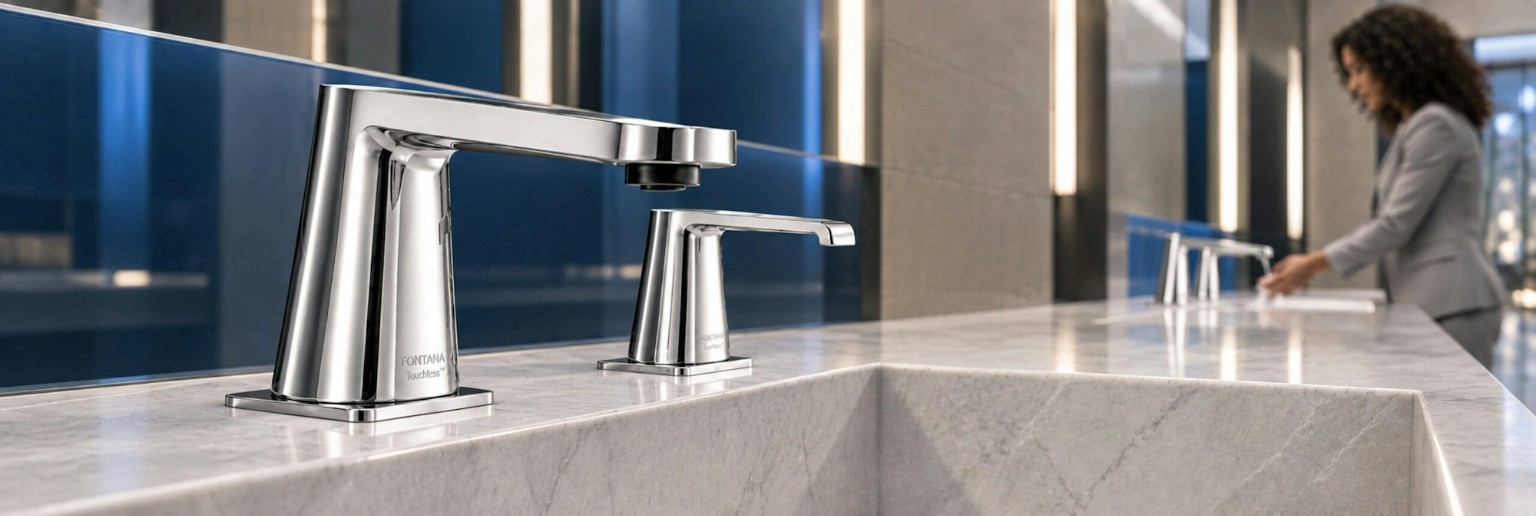


For 2026 ProjectsSpecification · Performance · Service
ArchFaucets · AEC Selection Guide · 2026
Best Archfaucets for 2026 — Ultimate Guide
Searching for the best commercial faucets in 2026? Select by application, basin geometry, control method, flow strategy, power, accessibility and service access. A commercial faucet is a small but highly used part of the restroom system; its performance depends on the faucet, basin, water supply, controls and maintenance plan working together.
This technical guide helps architects, plumbing engineers, contractors and facility teams compare commercial faucet types and evaluate documented examples from Delta, Moen, TOTO, GROHE, FontanaShowers and BathSelect. Brand references are starting points for submittal review, not an independent ranking. Verify every feature against the current model-specific product data.
Scope: commercial lavatory faucets for public, hospitality, education, office and healthcare projects. Confirm local plumbing, accessibility, water-efficiency and procurement requirements with the project team.
How to choose a commercial faucet for a 2026 project
Start with the actual use pattern and basin, then compare complete faucet assemblies. A sensor faucet that looks suitable in a catalog may require a different spout reach, mixing arrangement, power source or controller than the project provides.

Traffic, users and operating hours
Estimate peak concurrent use, daily operating hours, cleaning windows and expected service intervals. A busy airport, a staff washroom and a boutique hotel may require different power planning, vandal resistance and service access.
For multi-basin vanities, document whether all stations operate at once, how users approach them and whether adjacent soap dispensers or dryers can trigger unintended events.

Match the spout to the sink
Check spout reach, outlet height, basin depth, drain location and the intended handwashing area in plan and section. Keep the stream clear of the drain where practical, and review splash against the actual basin form.
Confirm the faucet mounting type, deck thickness, hole spacing and under-counter clearance. A wall-mounted system also needs rough-in dimensions and access to the concealed valve or service box.
Choose manual, sensor or hybrid operation
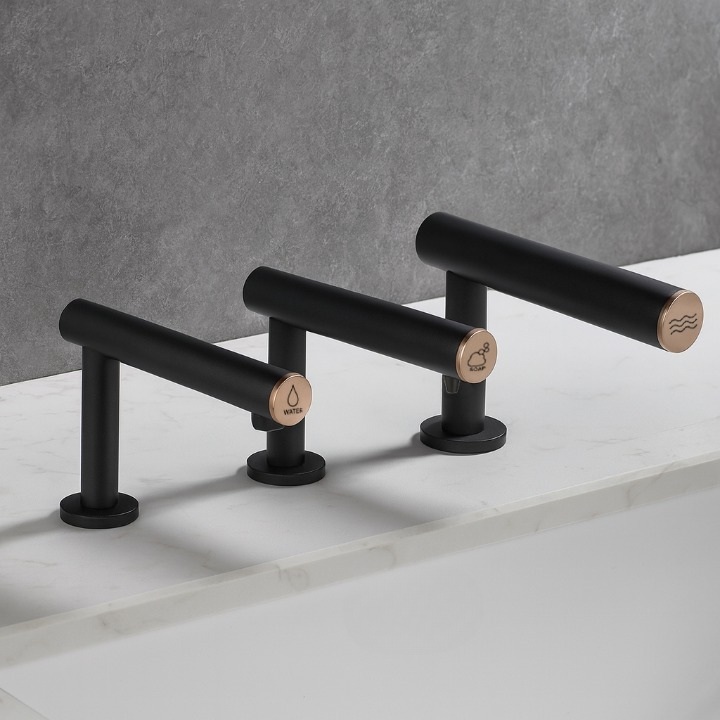
Sensor faucets support hands-free activation; manual faucets provide familiar direct control; hybrid arrangements add a manual temperature or override control. Confirm what the control senses, how the user adjusts temperature and how cleaning mode works.
Do not treat “infrared,” “proximity” or “time-of-flight” as complete performance specifications. Request the model’s activation method, adjustment procedure, startup sequence, timeout behavior and service instructions.
Make maintenance reachable
Locate controllers, batteries, solenoids, filters, mixing valves and isolation stops where a technician can reach them without removing finished millwork. Ask which components are field-replaceable and whether spare parts will remain available.
Standardizing a small number of models across a facility may reduce training and parts complexity. Confirm the trade-offs before finalizing a portfolio-wide standard.
Commercial faucet types and where each can fit
| Faucet type | Typical strengths | Design checks | Good fit when |
|---|---|---|---|
| Deck-mounted manual | Simple control logic; familiar maintenance. | Reach, handle operation, finish durability and accessible control force. | A direct, serviceable fixture is the priority. |
| Deck-mounted sensor | Touch-free activation; configurable modes on some models. | Detection behavior, power, startup, mixing, basin reflections and cleaning mode. | High use or reduced handle contact is desired. |
| Wall-mounted sensor | Open deck and simplified counter cleaning. | Wall backing, rough-in, projection, outlet position and concealed service access. | The architectural design calls for a clear vanity deck. |
| Metering faucet | Controlled dispensing per activation. | Cycle duration, temperature control, code applicability and user needs. | Project criteria call for timed delivery. |
| Hybrid or manual override | Combines sensor use with an additional control method. | Clear operating sequence, temperature limitation and failure-mode behavior. | Operational flexibility is required and the model supports it. |
2026 manufacturer references: Top Commercial Brands to Evaluate
Use these product and category links to begin a submittal review. The examples show different engineering approaches; they are not directly interchangeable and are not ranked by independent testing.

Evaluate the control and power configuration
Delta’s commercial Proximity® material describes activation as hands approach the faucet body. Its commercial range includes battery, hardwire and other power configurations by model. Review the specific product sheet for operating details, flow control, mixing and service parts.
Delta Proximity® technology · Delta commercial sensor faucet example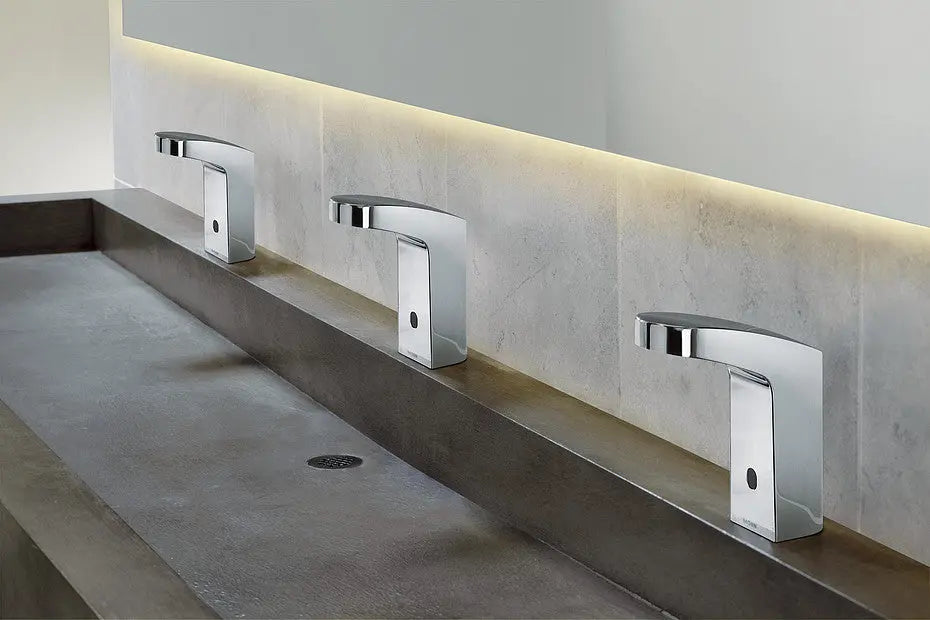
Review programming and service access
Moen’s M-POWER commercial lineup describes tool-free hand-gesture programming for supported settings, front access to batteries and solenoid, and a sentinel flush option on applicable models. Verify the selected model, operating mode, power arrangement and current instructions.
Moen M-POWER sensor products · Product data and downloadsCompare self-generating and AC options
TOTO’s Standard-R example offers a self-generating ECOPOWER or AC power choice, a micro-sensor beneath the spout, and model-specific flow and on-demand options. Check whether the selected package includes a controller, mixing valve and supply lines.
TOTO ECOPOWER overview · TOTO Standard-R product details
Check program and cleaning functions
GROHE’s Bau Cosmopolitan E literature describes sensor switching, cleaning mode and preset programs on specified models. Options vary by model, including battery or mains supply and temperature control. Match the item number to its installation instructions and remote-control availability.
GROHE Bau Cosmopolitan E · GROHE product literature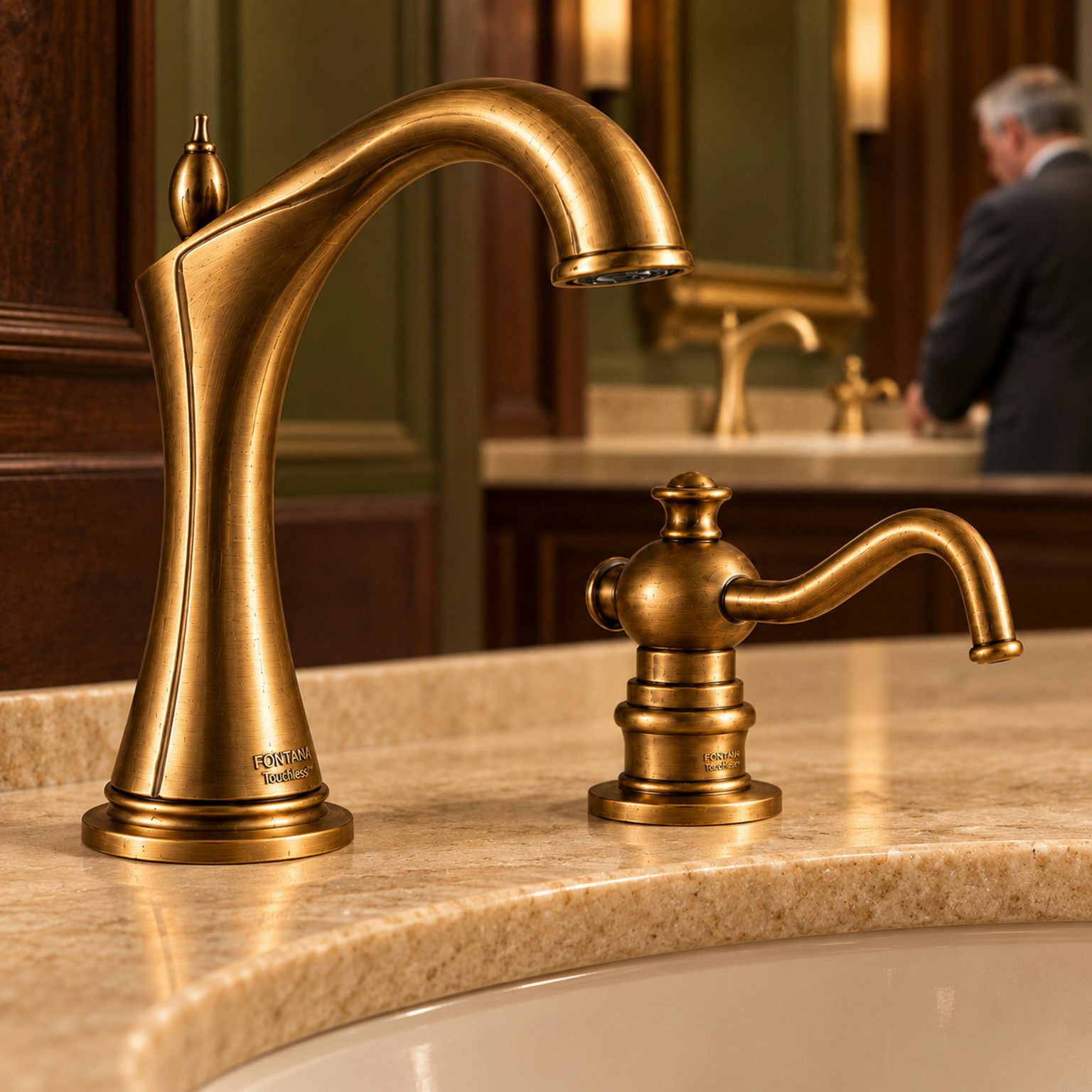
Check configuration by selected model
FontanaShowers’ commercial category includes multiple faucet styles and configurations. Review each model’s sensor type, specified operating range, flow control, power, mixing approach, mounting and documentation before using a product for a scheduled project.
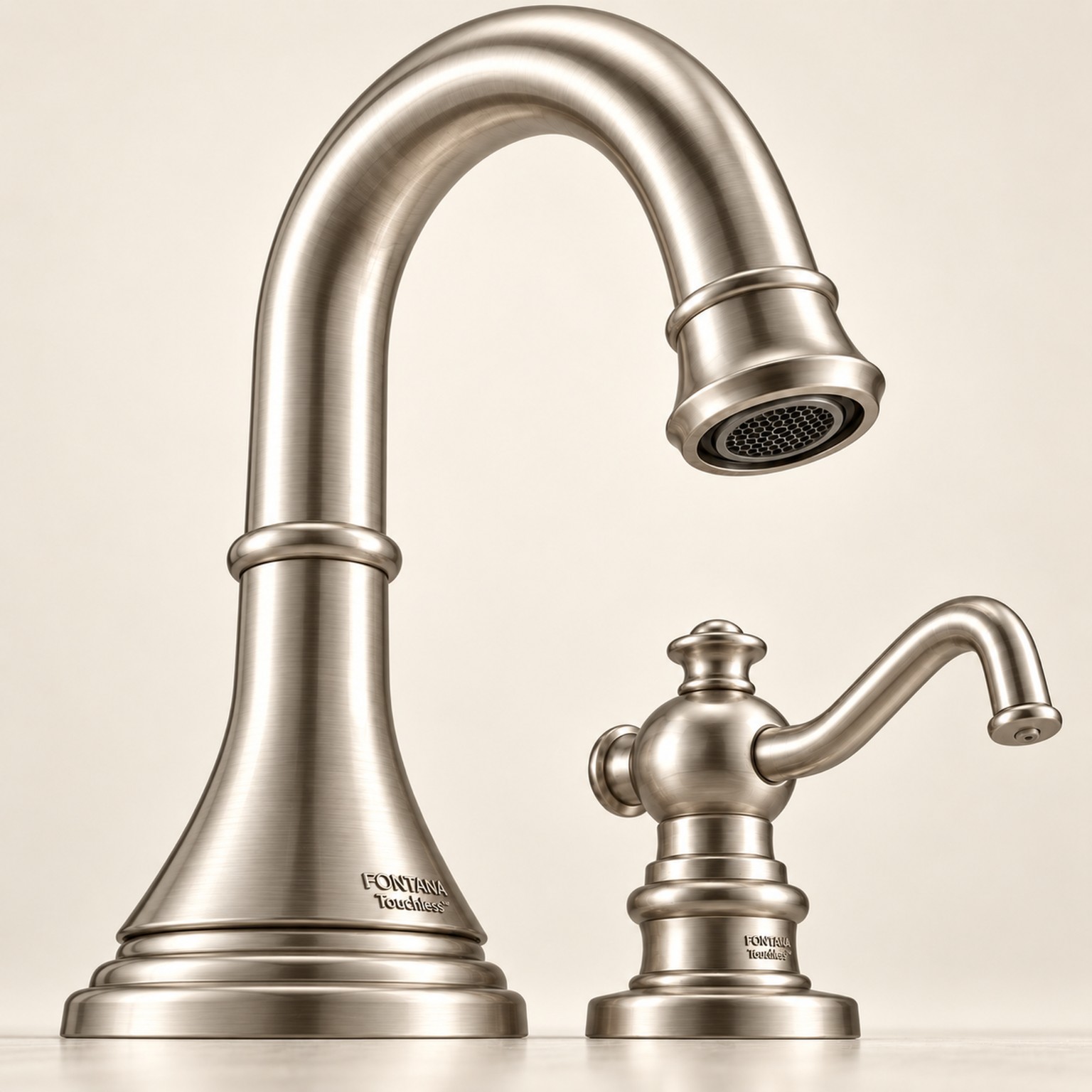
FontanaShowers commercial touchless faucets · Faucet and soap dispenser example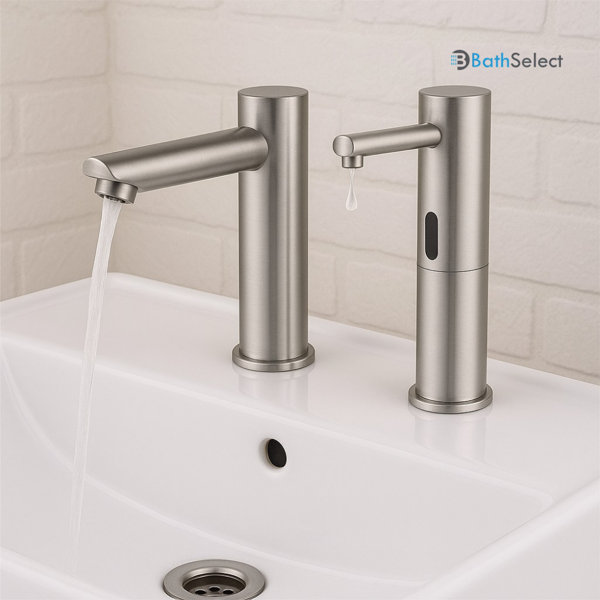
Compare mounting, finish and project requirements
BathSelect’s commercial collection presents deck- and wall-mount options across multiple shapes and finishes. Use the selected product page to confirm its construction, sensor details, power, included components, installation dimensions and warranty terms.
BathSelect commercial sensor faucets · BathSelect automatic sensor faucet optionsThe category pages above may include multiple models. Product specifications do not transfer from one model to another, even within the same product family.

Commercial faucet specification checklist
Use this checklist to compare submittals consistently. Keep a “verified,” “not stated” or “project decision” status beside each line so missing information does not get mistaken for an included feature.
| Specification field | What to record | Why it matters |
|---|---|---|
| Mounting and geometry | Deck / wall mount; hole pattern; spout reach; outlet height; deck thickness; rough-in. | Confirms fit with basin, counter, backing and clearances. |
| Activation and controls | Sensor principle; activation zone documentation; manual controls; temperature adjustment; cleaning mode. | Describes user interaction and field setup. |
| Flow and timing | Flow rate at stated pressure; flow-control part; meter or on-demand cycle; timeout; shutoff behavior. | Supports user experience, water planning and commissioning. |
| Power and components | Battery / AC / self-generating; included controller; transformer; solenoid; mixing valve; supply lines. | Reveals electrical scope and what must be purchased or coordinated separately. |
| Service and durability | Filter access; replacement parts; warranty; service tools; cleaning products; finish care. | Helps facility teams plan uptime and lifecycle maintenance. |
| Compliance documents | Applicable accessibility, plumbing, material, electrical and water-efficiency documentation. | Compliance must be confirmed for the jurisdiction and exact assembly. |
Charts for project planning
The charts below are practical planning examples. The selection weights are a sample project team rubric, not survey results, market-share data or an ArchFaucets ranking.
Example weighting for a commercial project
Adjust the weights with the owner and design team. Healthcare, transport and hospitality projects may prioritize criteria differently.
Make the comparison visible
Use the same project-specific score scale for every candidate and cite the evidence behind each score.
This graph visualizes the example weights only. It does not score or compare brands.
Flow ratings need their test conditions
These are comparison reference points, not a recommendation or a claim that all listed brands offer each rate. Check each exact model’s flow-control part and stated pressure.
Separate flow from total use
Flow rate is only one input to total water use. Activation count, run time, user behavior, flushing functions, leaks and maintenance all affect consumption. Record site conditions before making savings claims.
EPA says the WaterSense label covers eligible private bathroom sink faucets and accessories; public lavatory faucets are not currently eligible product types. Do not label a public faucet “WaterSense certified” unless the exact product and use category are listed by EPA.
EPA Bathroom Faucets guidance →
Installation and commissioning for reliable operation
Plan installation as a sequence of coordinated checks. Follow the exact faucet instructions, because automatic calibration, sensor setup and power-up behavior vary by model.

Coordinate services and access
- Confirm faucet, basin and countertop model numbers.
- Coordinate hot and cold supplies, mixing valve, stops and filtration.
- Show transformer, battery pack or self-generating equipment as applicable.
- Reserve a reachable location for controller and service components.
- Check neighboring fixtures, backsplash, mirror and soap dispenser positions.

Commission the assembled faucet
- Flush the water supply according to the product instructions.
- Perform startup with the sensing area clear when required.
- Set temperature and flow-control components for the project.
- Test intended hand approaches across the planned wash area.
- Check for accidental activation from nearby movement or reflections.
- Repeat the test with final lighting, basin, dispenser and accessories.

Leave the facility team a useful record
Record installed model and options, controller settings, power arrangement, cleaning directions, filter and aerator parts, battery replacement method, warranty contact and observed commissioning results. Keep the submittal and instructions with facility records.
Suggested checks to document
| Check | Record |
|---|---|
| Activation | Target approach, response behavior and repeatability. |
| Shutoff | Response after hands leave and any programmed operating mode. |
| Temperature | Mixing arrangement and measured outlet temperature as project requires. |
| Leak and stream | Connections, drips, aerator condition and basin splash. |
| Service | Access to shutoffs, controller, power, filter and replacement parts. |
Set acceptance criteria from contract documents and the manufacturer’s instructions. This sample is not a universal code test.
Government and accessibility references
Design the entire lavatory space
The Access Board guide covers lavatory and sink access, approach, clearances and related requirements. A touchless sensor does not by itself make an assembly accessible; check reach, basin geometry, controls, knee clearance and protected exposed plumbing.
U.S. Access Board: Lavatories and Sinks →Check controls and clearances
Use the applicable ADA Standards and project jurisdiction when reviewing faucet controls, approach space and lavatory construction. Confirm the assembled fixture and adjacent accessories against the adopted requirements.
2010 ADA Standards for Accessible Design →Use the correct faucet category
EPA identifies eligible WaterSense bathroom faucet categories and notes that public lavatory faucets are not eligible for the WaterSense label. Review its current guidance before making a product certification or savings claim.
EPA Bathroom Faucets → · WaterSense Label →Coordinate faucet placement and sink design
CDC’s healthcare water guidance discusses premise plumbing and intentional sink design choices. For healthcare projects, review the faucet outlet, basin, splash paths and water-management plan with the facility’s infection-prevention and engineering teams.
CDC: Considerations for Reducing Risk from Water →The cited government material does not certify any brand or model. Confirm current local codes, adopted standards, project requirements and the exact fixture package.
Best commercial faucets for 2026: technical FAQs
Which commercial faucet is best for a high-traffic restroom?
There is no universal winner. Compare the exact model’s activation behavior, rated flow, power, service access, mounting geometry, replacement parts and project compatibility. Commission it with the final basin and adjacent fixtures.
Are touchless faucets always more water efficient?
Touchless activation can control when flow begins and stops, but total use depends on flow rate, activation duration, user behavior, programmed cycles and maintenance. Base savings claims on measured project conditions.
Should I choose battery, AC or self-generating power?
Choose based on available electrical service, expected traffic, service policy, controller requirements and model options. Battery systems simplify wiring but require planned replacement; AC requires coordinated power; a self-generating system depends on its specified water-powered mechanism. Verify exact operating requirements.
What flow rate should a commercial restroom faucet have?
Use the project specification and applicable local requirements. Compare rated flow with pressure and flow-control details. A rate displayed for one model or use category should not be applied to another faucet without checking its documentation.
Can I use WaterSense claims for a public restroom faucet?
EPA states public lavatory faucets are not currently eligible for the WaterSense label. Check the current EPA category guidance and avoid calling a product WaterSense-labeled unless that exact product is listed in an eligible category.
What should be included in a faucet submittal?
Include the product data, installation dimensions, sensor and control documentation, flow-control part, power requirements, mixing arrangement, included components, maintenance instructions, warranties and applicable compliance evidence for the exact assembly.