

Touchless Faucet Power Architecture for Architects: Battery, Hardwired AC, Hybrid, Solar & Hydropower
The power source behind a commercial touchless faucet affects electrical rough-in, cabinetry, service access, outage behavior and maintenance labor for the life of the building. Battery operation simplifies many renovations; hardwired AC works well in coordinated new construction; hybrid systems create flexibility; and solar or hydropower platforms can reduce conventional battery dependence.
Five Commercial Power Strategies
No faucet-level line-voltage rough-in, but batteries eventually require technician replacement.
Excellent for new construction when transformers, receptacles and service locations are coordinated early.
Allows one faucet platform to accommodate multiple construction or backup-power conditions.
Harvests ambient light while retaining a stored backup source.
Preserves retrofit simplicity while reducing recurring replacement frequency.
Uses faucet water movement to generate electrical energy for operation.
| Product | Power Strategy | Specification Lesson |
|---|---|---|
| Fontana Automatic Commercial Touchless Faucet | AC / DC / battery | Hybrid deployment flexibility |
| BathSelect Mira Commercial Faucet | Hardwired AC/DC + backup | Retrofit and new-build coordination |
| Sloan SOLIS EAF-275 | Solar + lithium | Ambient-energy harvesting |
| American Standard Selectronic Cast | PWRX long-life battery | Reduced battery-service labor |
| TOTO T24S51 ECOPOWER | Hydropower or AC | Self-generating commercial architecture |
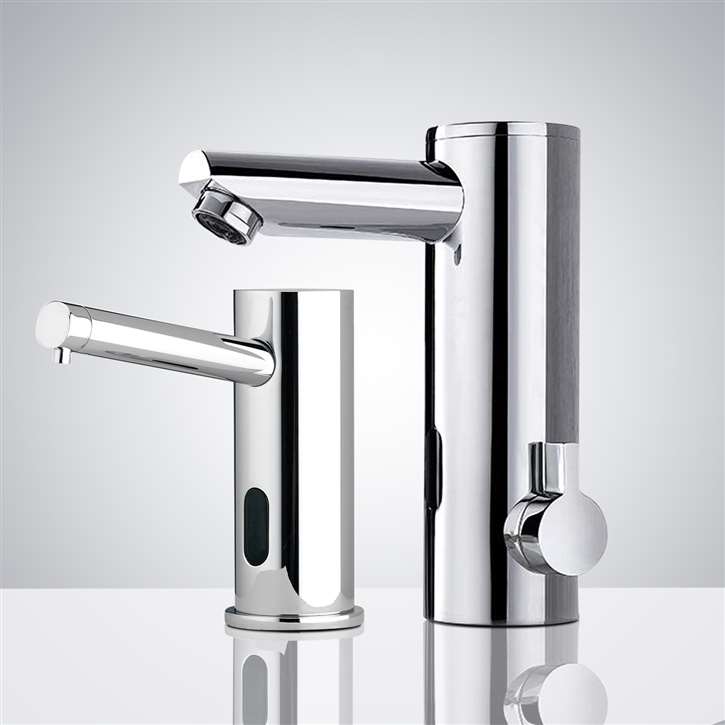
Fontana Touchless Automatic Commercial Motion Sensor Faucet
The Fontana Touchless Automatic Commercial Motion Sensor Faucet demonstrates why hybrid power can simplify a multi-building specification. Fontana currently supports AC/DC operation, hardwired installation and four-AA battery operation within this commercial platform.
One faucet family can accommodate different electrical conditions across a portfolio.
Which power source is installed at each location, and where is its serviceable component?
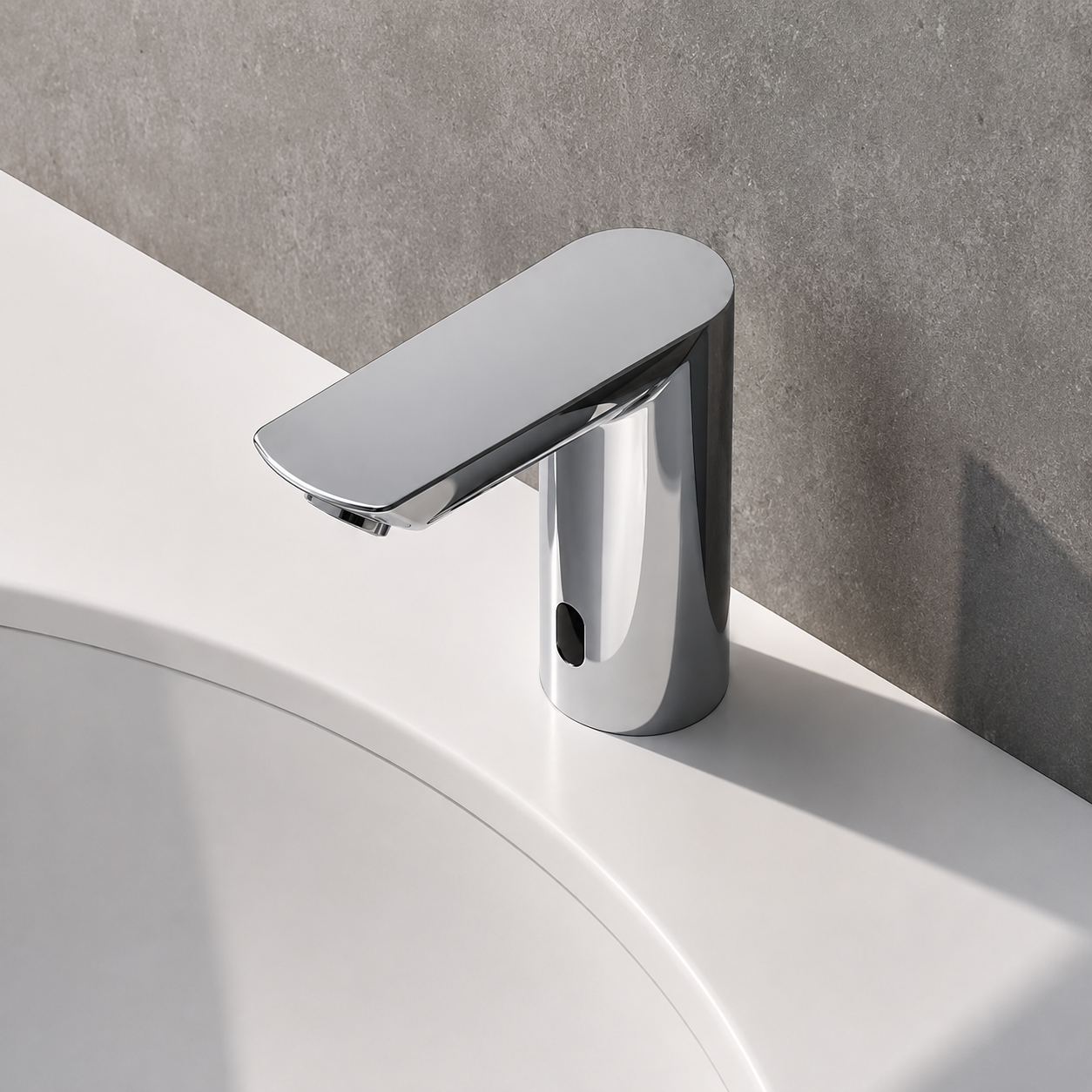
BathSelect™ Mira Commercial Chrome Automatic Hands Free Faucet
BathSelect explicitly identifies the Mira as an AC/DC commercial faucet with hardwired operation and battery backup. It also provides low-battery and solenoid diagnostics plus accessible filtration.
Useful where one project contains both new construction and renovation zones.
Will battery and control components remain accessible after vanity and millwork installation?
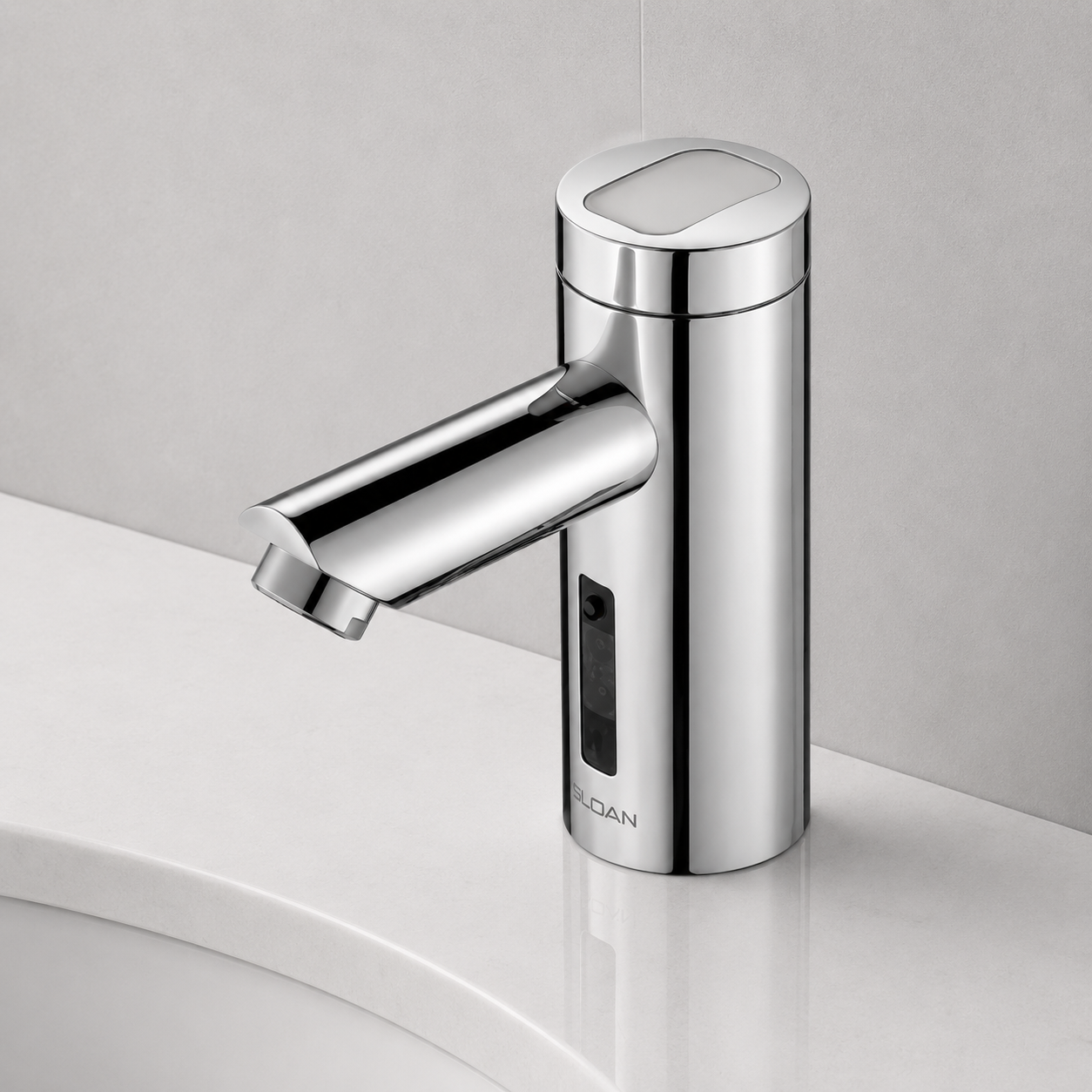
Sloan SOLIS® EAF-275 Solar-Powered Commercial Sensor Faucet
The SOLIS EAF-275 harvests available light while retaining a 6V lithium commercial battery. This reduces dependence on conventional battery replacement without requiring a dedicated hardwired supply at every faucet.
Interesting middle ground between standalone battery power and electrical rough-in.
Are lighting conditions appropriate, and has the lithium backup strategy been documented?
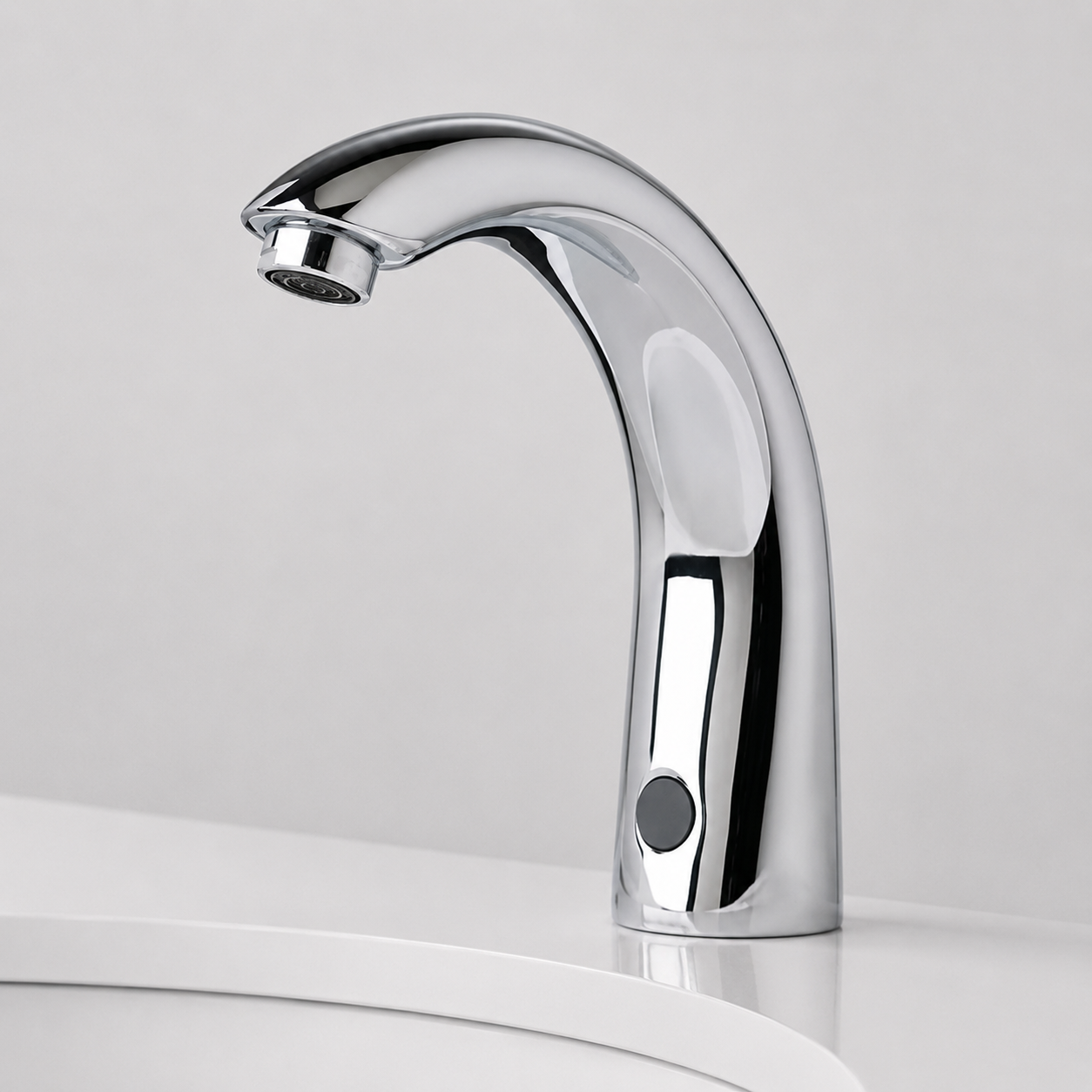
American Standard Selectronic® Cast Touchless Faucet with PWRX®
American Standard attacks the main lifecycle weakness of battery-operated faucets by extending the expected service interval. PWRX is rated for ten-year battery life at the manufacturer’s stated 4,000-use-per-month condition.
Preserves battery-based retrofit simplicity while reducing routine maintenance visits.
What usage assumption supports the battery-life claim, and how will replacement be accessed?
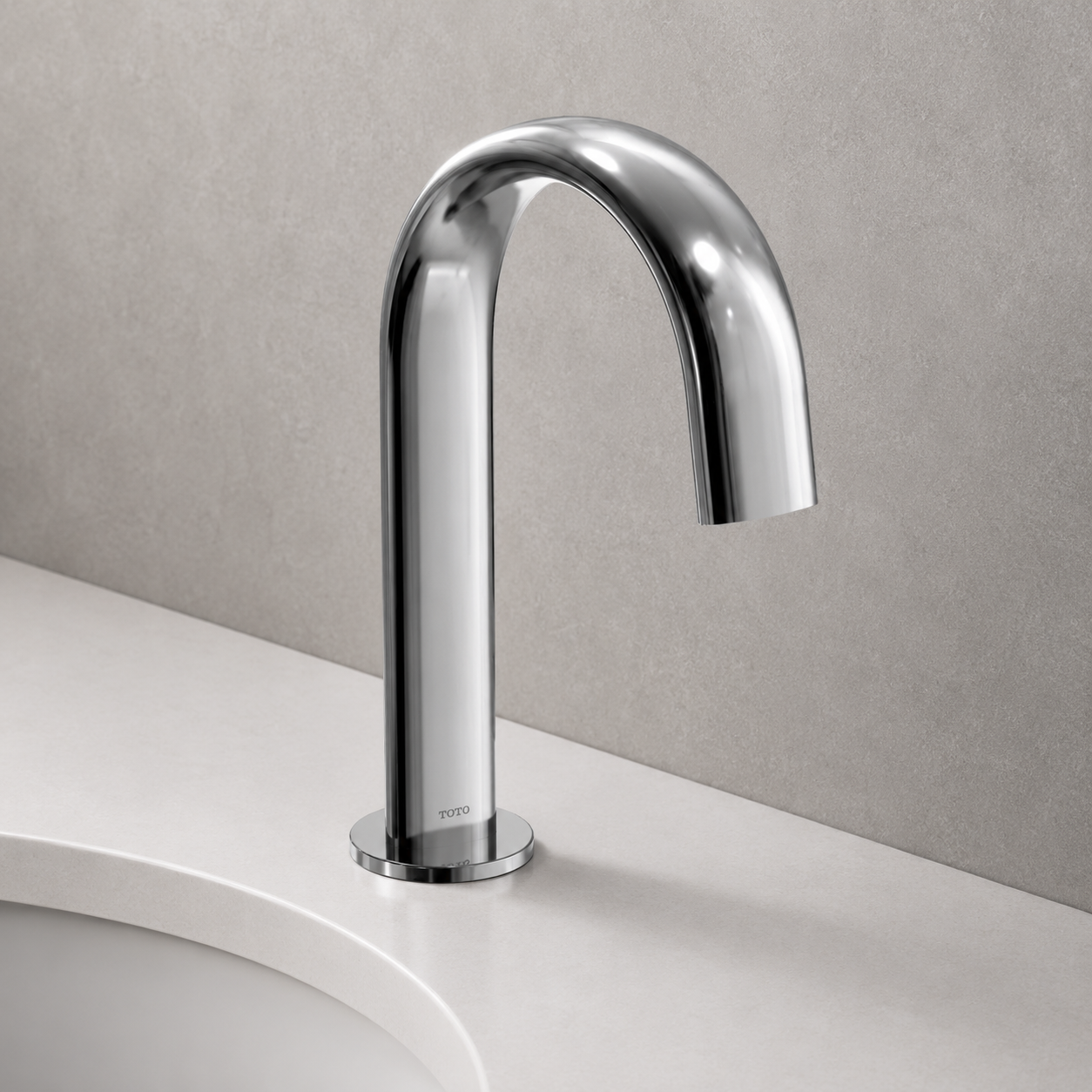
TOTO T24S51 ECOPOWER® Commercial Touchless Faucet
TOTO’s T24S51 series can be specified with either self-generating ECOPOWER hydropower or conventional AC control. Water movement through the faucet generates operating energy in the ECOPOWER configuration.
High-use commercial traffic becomes an energy source rather than purely a maintenance burden.
Which controller—ECOPOWER or AC—is shown in the project submittal and plumbing schedule?
Product-image standard: every case-study image is presented uncropped at 500+ px desktop width and is clickable to the associated manufacturer product or technical specification page.
Power Architecture Must Appear on the Drawings
| Power Type | Drawing / Specification Requirement |
|---|---|
| Battery | Show accessible battery/controller location |
| Hardwired | Coordinate transformer, circuit and connection point |
| Hybrid | Define primary source and backup behavior |
| Solar | Document backup battery and environmental requirements |
| Hydropower | Specify exact generating controller and pressure requirements |
“By Electrical” Is Not Enough
For hardwired faucets, the design team should establish voltage conversion, transformer quantity, location, access, wiring route and whether one transformer serves a single fixture or multiple fixtures.
Battery Cost Is Usually Smaller Than Battery Labor
If battery service requires eight technician minutes, one replacement event across 300 faucets represents roughly 40 labor hours before travel, access and documentation time are included.
That is why long-life battery, hardwired and energy-harvesting systems become increasingly attractive as fixture count rises.
Power Strategy by Project Type
| Existing commercial restroom renovation | Battery / hybrid AC-DC |
| Large new office building | Hardwired / hybrid |
| Mixed-property portfolio | Hybrid AC/DC |
| Bright commercial environment | Solar-assisted deserves review |
| High-activation transportation facility | Hydropower deserves review |
| Retrofit where battery labor is a concern | Long-life battery |
Commercial Faucet Power-System Brands
Touchless Faucet Power FAQ
Should architects specify the faucet power source?
Yes. Power architecture affects electrical scope, service access, procurement and long-term facility operations.
Are battery faucets appropriate for commercial buildings?
Yes. They are especially useful in retrofits, but recurring battery labor should be considered at large fixture counts.
Does hybrid AC/DC mean automatic backup?
Not necessarily. Require the manufacturer to document how the specific configuration changes or transfers between power sources.
Does solar eliminate batteries?
No. Sloan’s SOLIS EAF-275 retains a commercial lithium backup source.
How does ECOPOWER work?
TOTO’s system generates electrical energy from water movement through the faucet and stores it for operation.
What should be shown for a hardwired faucet?
Voltage, transformer or adapter, circuit/interface requirements, connection location and service access should be coordinated.
Professional References
NFPA — National Electrical Code
Electrical-installation framework relevant to hardwired commercial equipment.
American Society of Plumbing Engineers
Commercial plumbing, controls and fixture-coordination resources.
International Code Council
Building and plumbing-code coordination resources.
Whole Building Design Guide
Whole-building systems coordination and maintainability guidance.
U.S. Green Building Council — LEED
Building performance framework relevant to water and energy strategy.
Coordinate Power Before the Faucet Reaches Submittal Review
Battery systems simplify renovation; hardwired systems can reduce recurring service labor in large new buildings; hybrid AC/DC provides portfolio flexibility; solar harvesting can reduce conventional battery dependence; long-life battery systems reduce service frequency; and hydropower can make very high fixture use work in favor of the power system.
For architects and MEP engineers, the correct specification identifies not only the faucet but also its power source, transformer or controller, backup strategy and maintenance access.
Review Fontana Hybrid-Power Commercial Faucet →Independent editorial disclosure: ArchFaucets.com provides independent architecture and specification-oriented analysis. Verify the exact product power architecture, controller, transformer, battery type, backup behavior, electrical requirements and manufacturer submittal before approval.