Commercial Faucet Temperature Control for Architects: Mixing Valves, TMVs & ASSE 1070
Commercial touchless faucet specifications often describe “hot and cold mixing” without defining how outlet temperature is actually controlled. A manual mixer allows temperature adjustment; a thermostatic mixing valve responds to changes in supply conditions to limit outlet temperature. For architects and plumbing engineers, that distinction affects safety, plumbing diagrams, submittal review, commissioning and long-term maintenance.
Three Different Strategies
The building plumbing system supplies water already mixed to the required fixture temperature.
Combines hot and cold water but does not inherently provide thermostatic temperature limiting.
Responds to temperature changes to maintain a controlled mixed-water outlet within its design limits.
Why Point-of-Use Certification Matters
ASSE 1070 addresses water-temperature limiting devices intended for individual plumbing fixtures or groups of fixtures. Where the project requires point-of-use temperature limitation, the selected assembly should document the applicable certification rather than relying on a generic adjustable mixing valve.
The required strategy should be coordinated with the plumbing engineer, adopted plumbing code and authority having jurisdiction.
| Product | Temperature Strategy | Specification Lesson |
|---|---|---|
| Fontana Commercial Temperature Control Sensor Faucet | Integrated temperature control / thermostatic option | All-in-one commercial architecture |
| BathSelect BS10103 | Integrated thermostatic system | Point-of-use commercial temperature control |
| Sloan Optima ETF-410 | Below-deck thermostatic mixer | Separate valve + faucet system |
| Chicago HyTronic TempShield | Integrated ASSE 1070 TMV | Certified faucet-integrated protection |
| Zurn ZG6951-TMV-1 | ASSE 1070 thermostatic valve option | Modular specification approach |
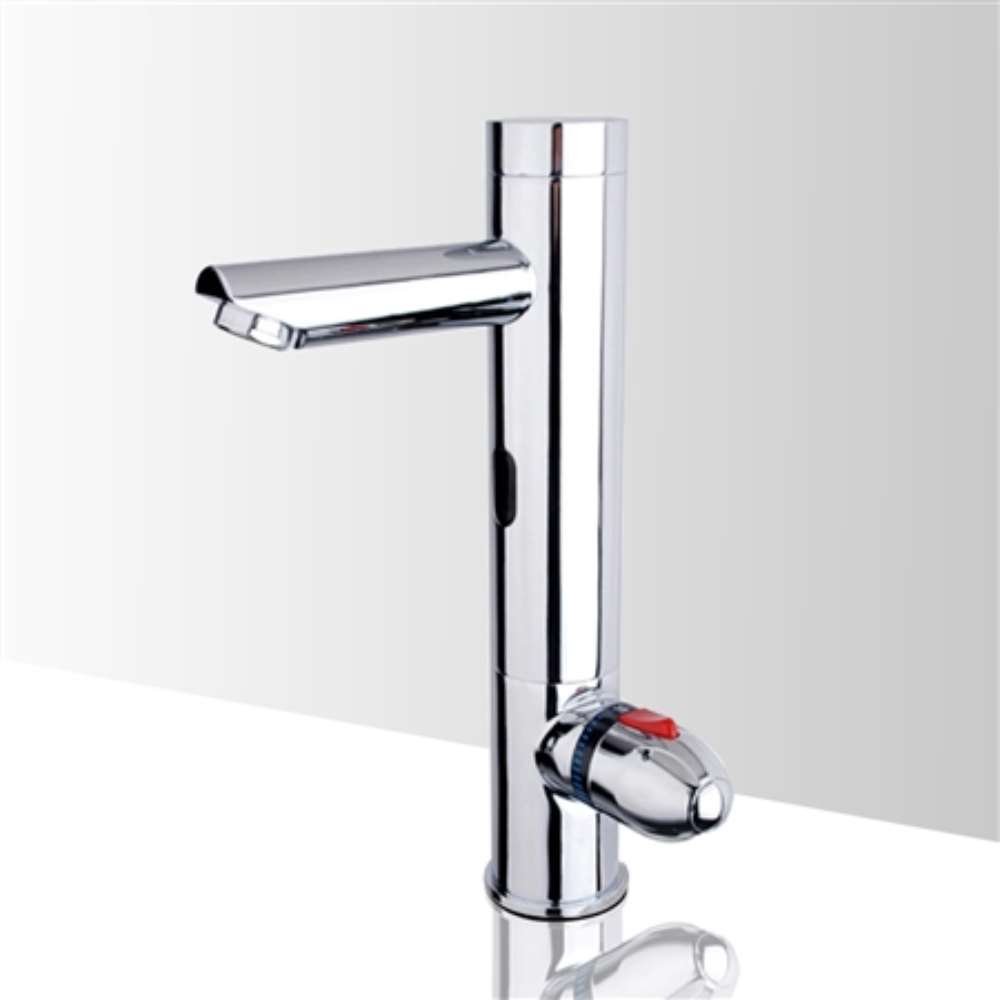
Fontana Chrome Commercial Temperature Control Automatic Sensor Faucet
The Fontana Chrome Commercial Temperature Control Automatic Sensor Faucet integrates touchless operation with point-of-use temperature adjustment architecture rather than treating mixing as an unrelated accessory.
Fontana publishes a solid-brass construction, adjustable infrared sensing, AC/DC power, optional thermostatic mixing, 0.5–1.5 GPM configurable outlets and a 60-second safety timeout.
Consolidates sensing, faucet body and temperature-control options within one commercial platform.
Is the submitted mixer merely adjustable, or is the specified thermostatic device independently certified for the project requirement?
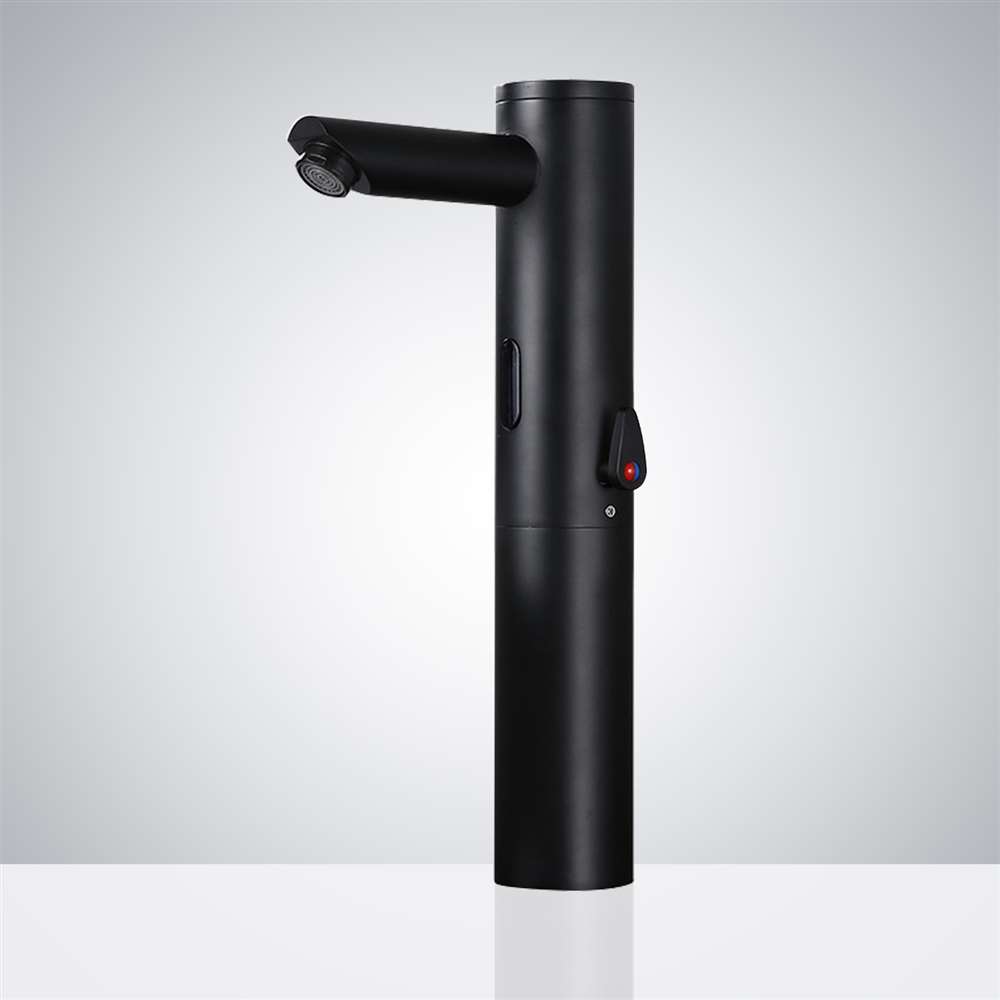
BathSelect™ Matte Black Commercial Thermostatic Sensor Faucet
BathSelect’s BS10103 is explicitly positioned as a commercial thermostatic sensor faucet combining infrared activation with controlled point-of-use temperature delivery.
For architecture teams, the advantage is reduced component fragmentation: the temperature strategy is intentionally designed into the faucet system.
Useful where architects want a cleaner all-in-one temperature-control concept.
Confirm the precise temperature-limiting performance and certification required by the plumbing engineer.
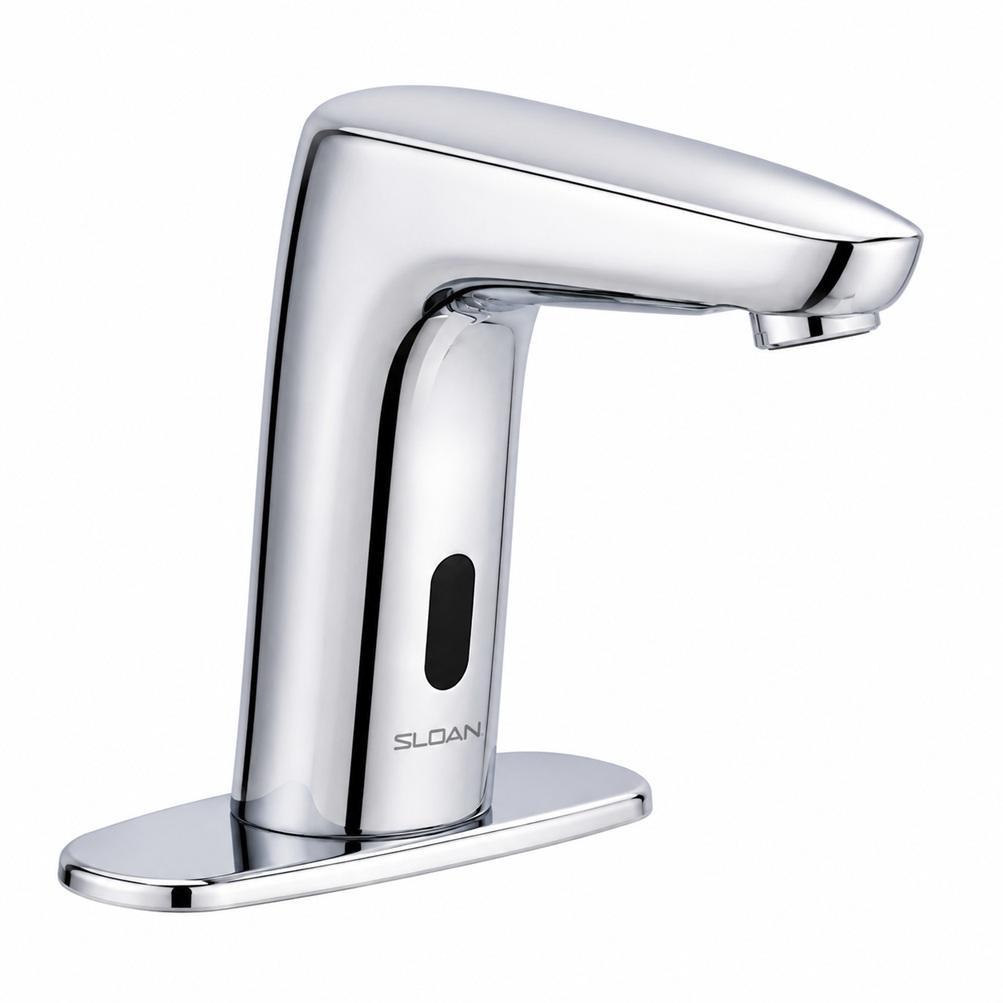
Sloan Optima® ETF-410 Commercial Touchless Faucet with Below-Deck Thermostatic Mixing
This ETF-410 configuration provides a useful contrast to an all-in-one faucet. Sloan specifies a separate below-deck thermostatic mixing valve, allowing the mixing component and faucet to remain identifiable service assemblies.
The current configuration is published at 0.5 GPM with multi-laminar flow, a self-adapting infrared sensor and SC Argus Pro connectivity.
Clearly separates faucet service from below-deck temperature-control service.
Does the vanity provide adequate access to the thermostatic valve, strainers and control equipment?
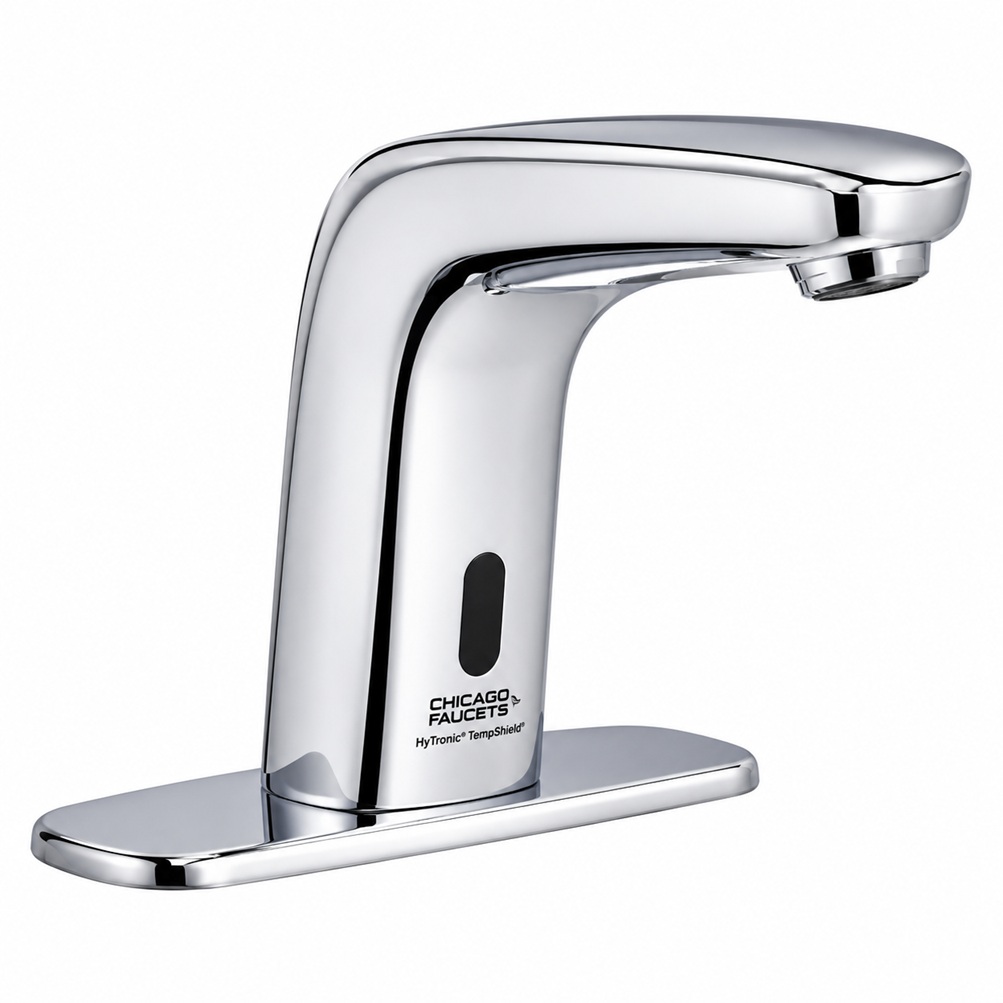
Chicago Faucets HyTronic® TempShield® Touchless Faucet
HyTronic TempShield provides the clearest specification benchmark in this group because Chicago Faucets explicitly integrates an ASSE 1070-certified thermostatic mixing valve into the faucet assembly.
The selected model includes user temperature adjustment, 0.5 GPM non-aerating laminar delivery, Bluetooth controls and a 40-second safety timeout.
Temperature limiting, touchless control and faucet body are specified as one certified assembly.
Does the project require user adjustment or a fixed controlled outlet temperature?
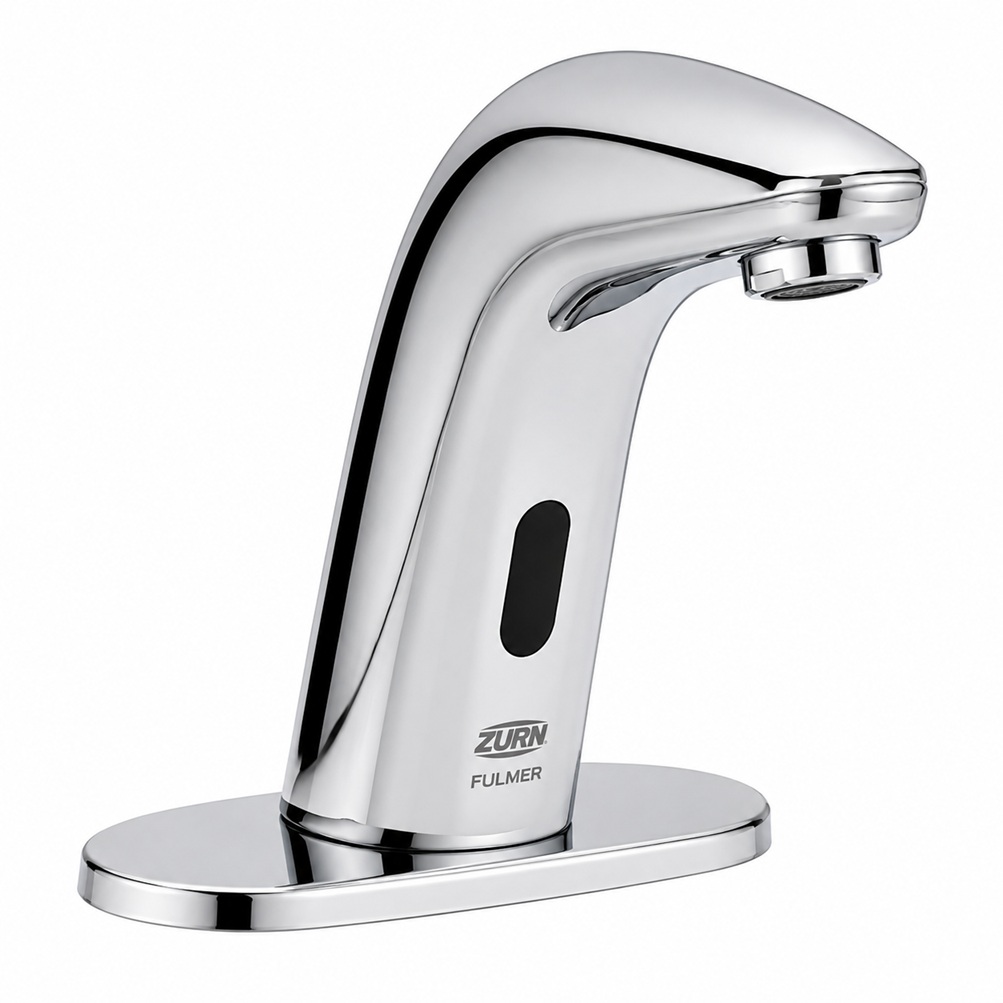
Zurn Fulmer Series® ZG6951 Commercial Sensor Faucet
Zurn takes a modular approach. The ZG6951 can be configured as `ZG6951-TMV-1`, pairing the commercial sensor faucet with a thermostatic mixing valve specifically listed to ASSE 1070.
The platform also uses Zurn’s gear-driven ceramic cartridge, high-efficiency 0.5 GPM flow, and multiple power configurations.
Allows the temperature-control option to be selected as part of the exact faucet suffix.
Does the submitted model number actually contain the required TMV suffix?
Image standard: product imagery is configured for full 500+ px desktop presentation with object-fit:contain. Each image is clickable to the associated manufacturer product or specification page.
Manual Mixing and Thermostatic Limiting Solve Different Problems
| Feature | Manual Mixer | Thermostatic Mixing Valve |
|---|---|---|
| Combines hot and cold water | Yes | Yes |
| User / installer adjustable | Usually | Usually within limits |
| Responds automatically to temperature changes | No | Yes |
| Point-of-use temperature limiting | Not inherently | When properly certified and specified |
| ASSE 1070 certification | Not automatically | Available on certified devices |
Define Where Tempering Happens
Mixed water is generated upstream and distributed to multiple fixtures.
Hot and cold supplies reach the lavatory and are mixed immediately before the faucet outlet.
Thermostatic control is physically incorporated into the faucet assembly.
Thermostatic Valves Need Maintenance Space
Thermostatic mixing valves may contain strainers, checks, cartridges and adjustment mechanisms. These components should remain accessible after countertops, casework and plumbing traps are installed.
Recent point-of-use valve development also shows increasing focus on diagnostics and serviceable strainers, reinforcing why architects should reserve physical access rather than treating the mixer as a concealed permanent component.
What Should Be Verified Before Turnover?
| Hot / cold orientation | Confirm supplies are correctly connected. |
| Outlet temperature | Set and document the approved value. |
| Supply variation | Verify stable operation under realistic conditions. |
| Sensor operation | Confirm normal hands-free activation. |
| Maximum timeout | Verify automatic safety shutoff. |
| Service access | Confirm strainers and cartridge can actually be reached. |
What Architects Should Require
| Exact faucet model | Including TMV/mixer suffix |
| Mixing device | Manufacturer and exact model |
| Certification | ASSE 1070 where required |
| Temperature range | Adjustment and operating limits |
| Supply pressure | Required hot/cold pressure conditions |
| Check valves | Confirm integrated or separate |
| Strainers | Location and service method |
| Installation diagram | Show hot, cold, mixed and power routing |
Commercial Temperature-Control Faucet Brands
Commercial Faucet Temperature-Control FAQ
Is a mixing valve the same as a thermostatic mixing valve?
No. A basic mixer combines hot and cold water; a thermostatic valve actively responds to temperature changes.
What is ASSE 1070 used for?
It applies to water-temperature limiting devices used at individual fixtures or groups of fixtures.
Can tempered water be supplied centrally?
Yes, depending on the building design and applicable requirements, but the plumbing engineer should determine the appropriate strategy.
Does an integrated temperature handle provide scald protection?
Not necessarily. The presence of a handle does not establish thermostatic performance or certification.
Should the TMV be accessible?
Yes. Filters, checks, cartridges and adjustment components may require maintenance.
Should architects verify the exact faucet suffix?
Absolutely. A product family may contain manual-mixing, pre-tempered and certified thermostatic configurations.
Professional References
ASSE International
Standards organization responsible for performance standards including ASSE 1070.
American Society of Plumbing Engineers
Commercial plumbing design, temperature-control and water-system resources.
International Code Council
Model plumbing-code requirements relevant to tempered water and fixture installation.
U.S. DOJ — ADA Standards
Accessibility requirements for commercial lavatories and faucet operation.
ASME A112.18.1 / CSA B125.1
Performance framework for plumbing supply fittings.
Specify the Temperature-Control Function, Not Just “Hot & Cold”
A manual mixing valve, central tempered-water system and ASSE 1070 thermostatic valve are not equivalent solutions. The architect and plumbing engineer should define where hot and cold water are mixed, how maximum outlet temperature is controlled, which device provides that function, and how it will be accessed and commissioned.
Chicago TempShield demonstrates the integrated certified approach; Sloan and Zurn illustrate modular below-deck strategies; while Fontana and BathSelect show how commercial sensing and temperature control can be consolidated into more integrated fixture platforms.
Review Fontana Commercial Temperature Control Faucet →Independent editorial disclosure: ArchFaucets.com provides independent architecture and specification-oriented analysis. Temperature-control requirements vary by code, application and jurisdiction. Verify the exact submitted device, certification, temperature range, flow requirements and current manufacturer technical data before approval.