

Commercial Faucet Flow Rates for Architects: 0.35 vs. 0.5 GPM, Stream Quality & Splash
Commercial faucet flow should be specified as part of the complete lavatory system. A 0.35 GPM outlet can materially reduce water consumption, but handwashing quality also depends on laminar or multi-laminar delivery, pressure compensation, sensor runtime, spout position and basin geometry. This guide compares five commercial platforms and explains what architects should check before approving ultra-low-flow fixtures.
0.35 GPM vs. 0.5 GPM
Aggressive water-reduction strategy for high fixture counts and performance-driven projects.
Widely used public-lavatory baseline balancing conservation with familiar stream volume.
At identical runtime, 0.35 GPM uses 30% less water than 0.5 GPM.
| Product | Flow Strategy | Specification Lesson |
|---|---|---|
| Fontana Brio Commercial Sensor Faucet | 0.35–0.5 GPM platform | Laminar flow + splash coordination |
| BathSelect BS1094-CR | Optional 0.5 GPM | Outlet must be explicitly selected |
| Sloan Optima EBF-85 | 0.35 / 0.5 GPM | Multi-laminar flow flexibility |
| Chicago E-Tronic 80 | 0.35 GPM | Pressure compensation + defined runtime |
| American Standard NextGen | 0.35 GPM | Pressure-compensating multi-laminar delivery |
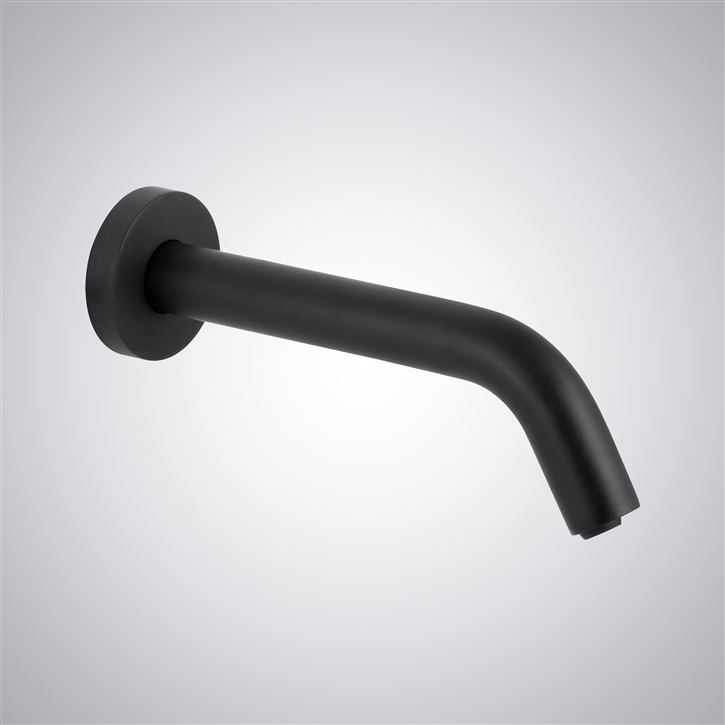
Fontana Brio Wall-Mount Commercial Sensor Faucet
The Fontana Brio Wall-Mount Commercial Sensor Faucet is a useful hydraulic case study because Fontana pairs its commercial low-flow range with regulated laminar delivery intended to support quiet operation and splash control.
Flow, spout projection and wall-mount geometry can be coordinated as one system.
Which exact outlet—0.35 or 0.5 GPM—is included in the submitted fixture?
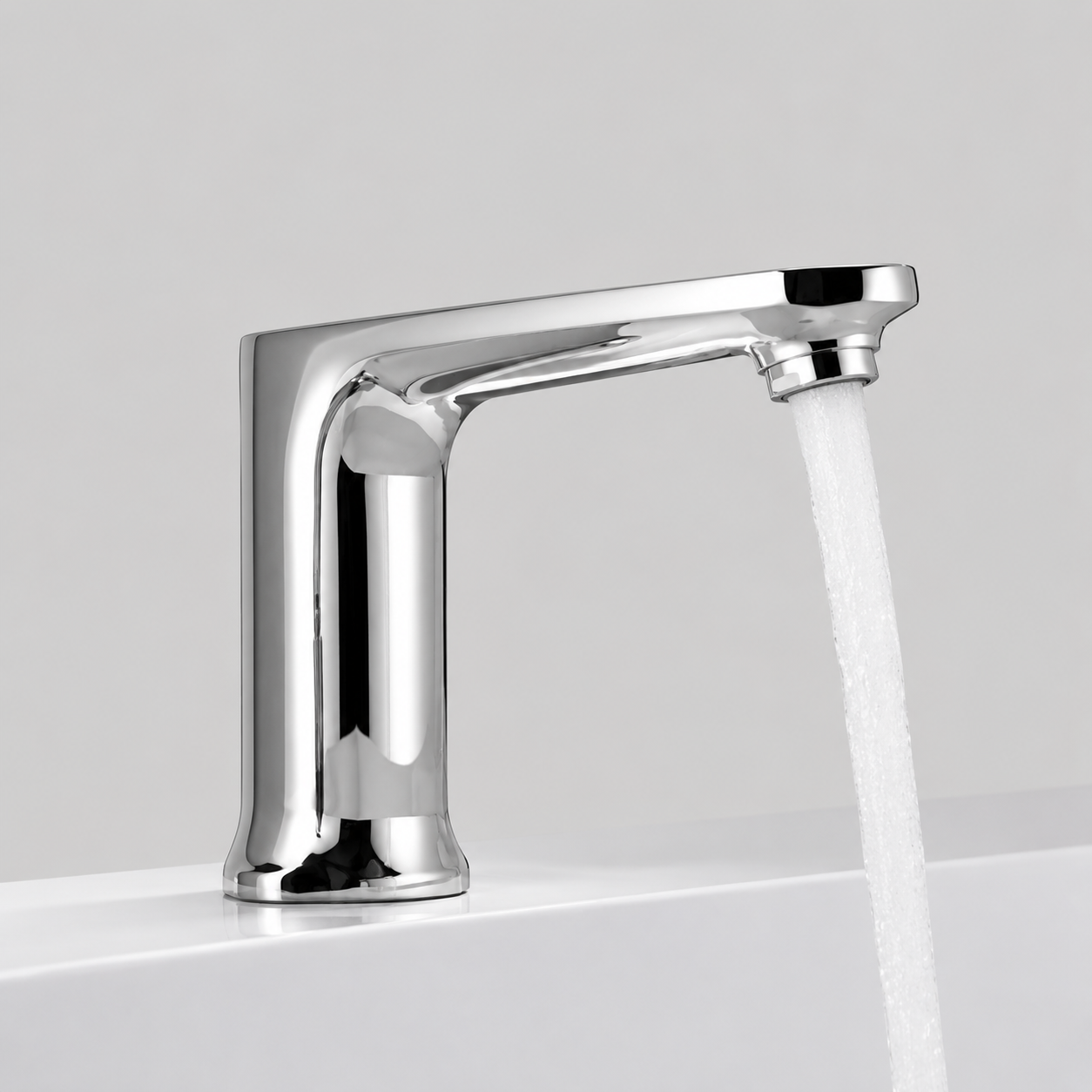
BathSelect™ Chrome Commercial Automatic Touchless Sensor Faucet
BathSelect illustrates why architects should never specify only the faucet body. The same commercial platform is published with multiple outlet choices, including an optional 0.5 GPM configuration.
Strong example of why the approved submittal must identify the actual aerator.
Is the 0.5 GPM outlet written into the purchase description and schedule?
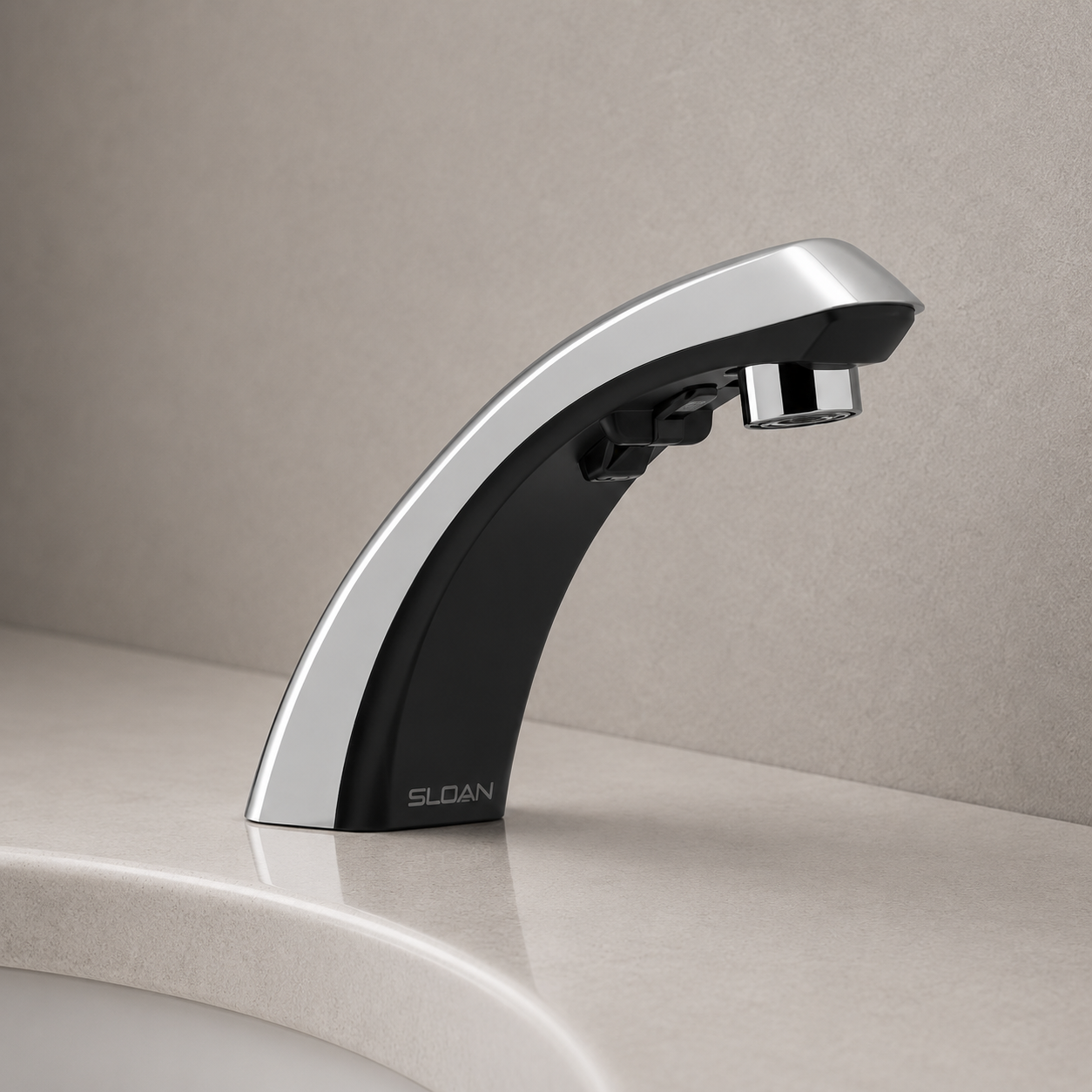
Sloan Optima® EBF-85 Commercial Sensor Faucet
The EBF-85 lets specification teams select between 0.35 and 0.5 GPM while retaining the same commercial faucet family. Multi-laminar and laminar spray options allow outlet behavior to be evaluated separately from the body design.
Allows flow strategy to change without redesigning the entire faucet family.
Which spray type accompanies the selected GPM?
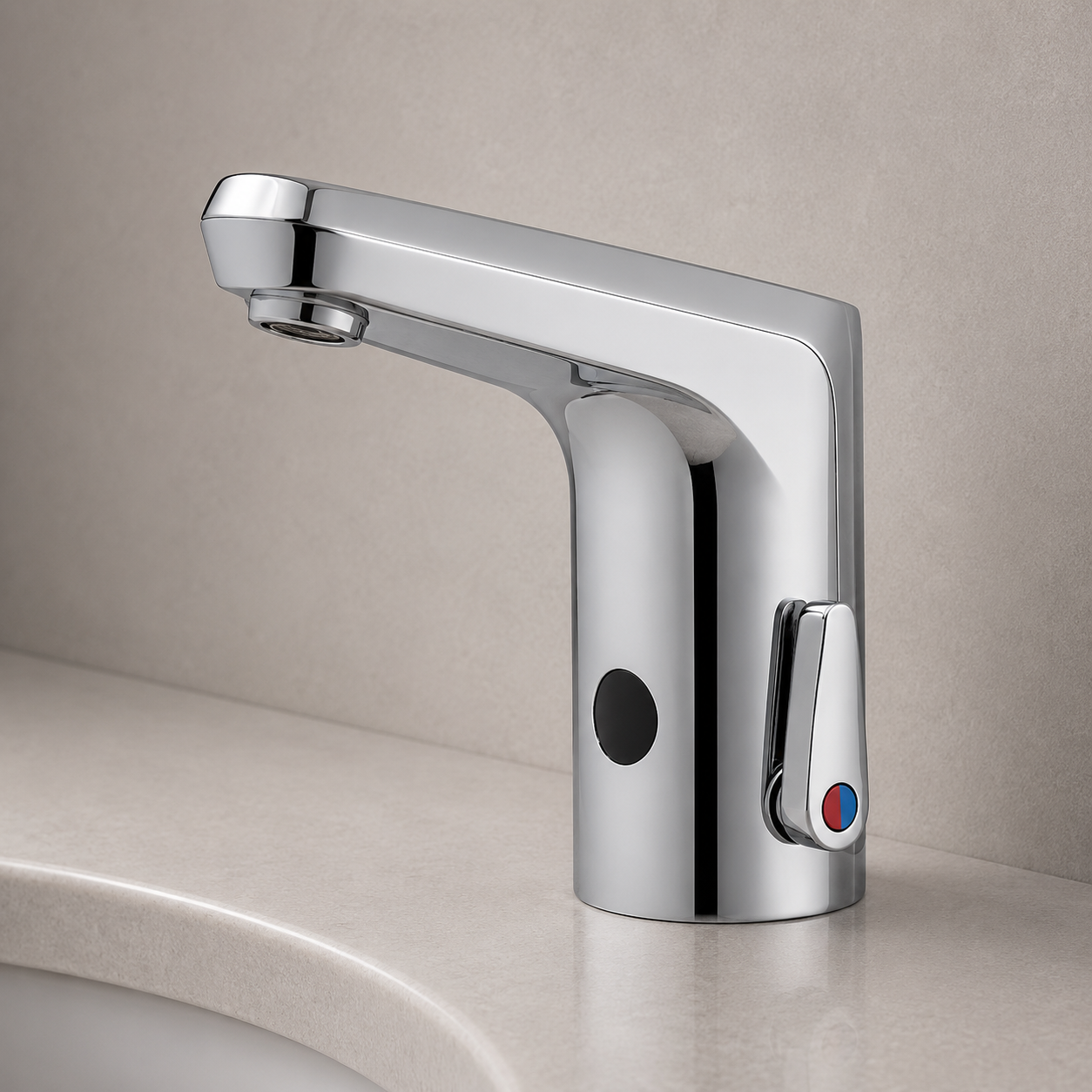
Chicago Faucets E-Tronic® 80 Commercial Touchless Faucet
Chicago’s E-Tronic 80 demonstrates why runtime belongs in the flow discussion. The selected model combines a 0.35 GPM pressure-compensating non-aerating outlet with a defined ten-second hand-presence cycle.
Flow rate and runtime are both clearly documented.
Does the basin mock-up perform acceptably at the actual project pressure?
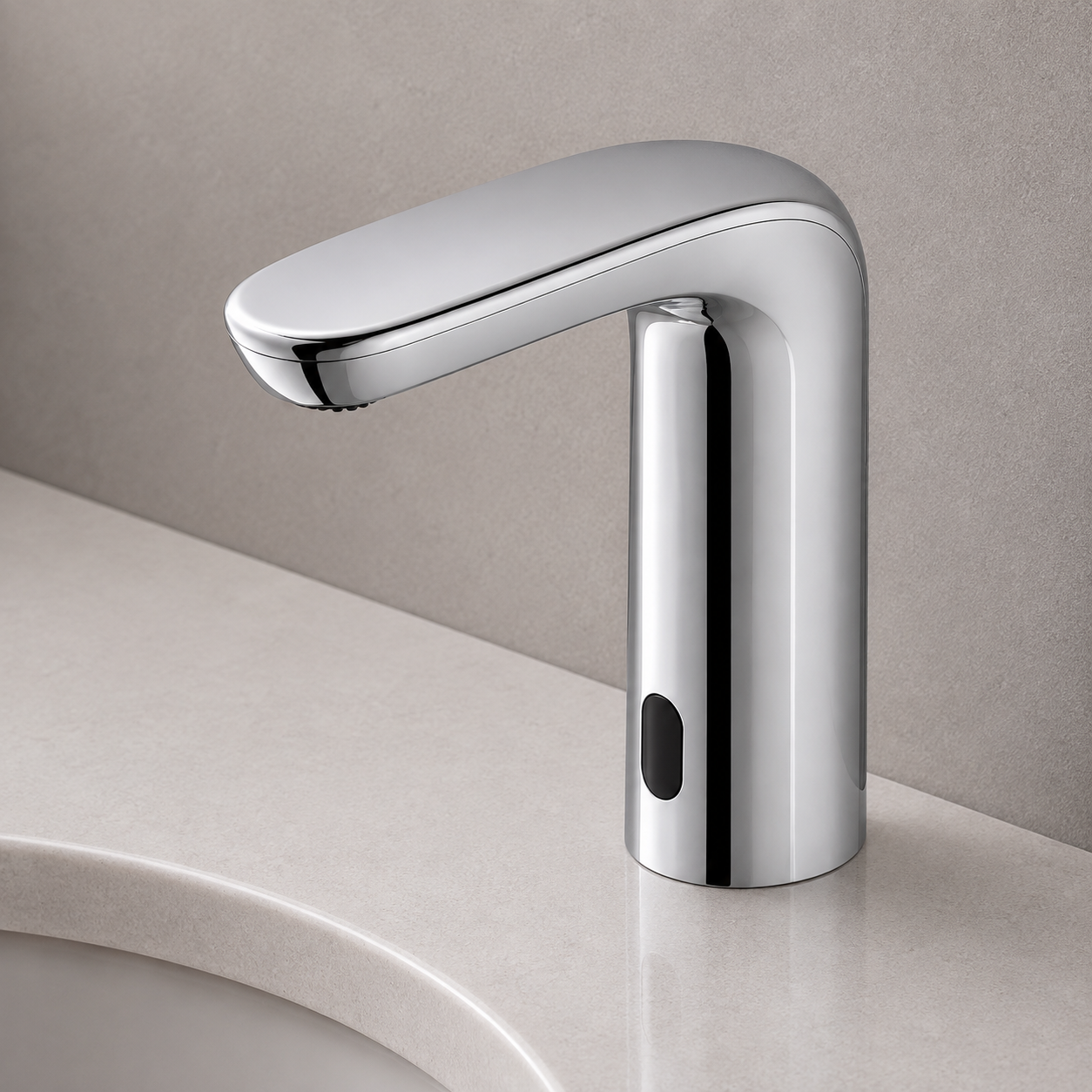
American Standard NextGen® Selectronic® 0.35 GPM Touchless Faucet
NextGen uses a vandal-resistant pressure-compensating multi-laminar outlet to distribute a small water volume across a useful washing zone rather than simply producing a narrow restricted stream.
Demonstrates the importance of outlet engineering at 0.35 GPM.
Has stream coverage been tested with the selected basin?
Product-image standard: images are presented uncropped at 500+ px desktop width and link directly to the associated product page.
What Does the 0.15 GPM Difference Mean?
| Water-On Time | 0.50 GPM | 0.35 GPM |
|---|---|---|
| 10 seconds | 0.083 gal | 0.058 gal |
| 20 seconds | 0.167 gal | 0.117 gal |
| 30 seconds | 0.250 gal | 0.175 gal |
At 1,000 twenty-second activations per day, the theoretical difference is approximately 50 gallons per day, or about 18,250 gallons annually.
Laminar, Multi-Laminar & Aerated Are Not the Same
A laminar outlet produces a clear stream without intentionally mixing air into the water. Multi-laminar outlets divide low flow into multiple controlled streams to improve hand coverage. Aerated outlets intentionally entrain air to increase perceived volume.
At 0.35 GPM, outlet design becomes particularly important because there is less water available to distribute across the handwashing zone.
The Lowest Flow Rate Does Not Automatically Produce the Least Splash
Splash is influenced by outlet height, trajectory, velocity, basin depth, drain position and the surface struck by the stream.
| High spout + shallow basin | Potentially higher splash energy |
| Stream directly over drain | Possible rebound and noise |
| Stream near rear wall | Restricted hand position |
| Controlled laminar stream | Often easier to coordinate predictably |
When Should Architects Consider 0.35 vs. 0.5 GPM?
| General public restroom | 0.5 GPM is a strong starting point |
| Large airport / campus | 0.35 GPM deserves evaluation |
| Aggressive water-reduction target | 0.35 GPM |
| Premium user-experience priority | 0.5 GPM or physical 0.35 GPM mock-up |
| Splash-sensitive shallow basin | Evaluate 0.35 GPM with controlled stream geometry |
Low-Flow Commercial Faucet Brands to Know
Commercial Faucet Flow FAQ
Does 0.35 GPM use 30% less water than 0.5 GPM?
Yes, when both faucets operate for exactly the same duration.
Is 0.35 GPM always better?
No. Water reduction should be balanced against stream coverage, basin geometry and user performance.
Why specify pressure compensation?
It helps maintain more consistent outlet flow as supply pressure varies within the manufacturer’s operating range.
Why does multi-laminar flow matter?
It can distribute limited water across a broader useful handwashing area.
Should architects mock up ultra-low-flow faucets?
For large or highly repeated projects, yes. Test the exact faucet and basin together.
Are public lavatory faucets WaterSense labeled?
Public lavatory faucets are currently outside the EPA WaterSense labeling specification, although EPA identifies 0.5 GPM or less as the efficient public-lavatory criterion.
Professional Sources
U.S. EPA — Bathroom Faucet Efficiency
Public-lavatory water-efficiency guidance and WaterSense eligibility distinctions.
USGBC — LEED
Indoor water-use reduction framework for commercial projects.
American Society of Plumbing Engineers
Commercial plumbing and fixture-engineering resources.
ASME A112.18.1 / CSA B125.1
Plumbing supply-fitting performance framework.
International Code Council
Model plumbing-code resources relevant to commercial lavatories.
Specify GPM, Stream Architecture & Basin Performance Together
0.5 GPM remains a practical public-lavatory baseline, while 0.35 GPM can reduce identical-runtime water use another 30%. But successful ultra-low-flow specification depends on outlet engineering and basin coordination. The architect should therefore approve the exact flow control, stream type, sensor runtime and faucet-to-basin relationship—not merely the faucet body.
Review Fontana Brio Commercial Low-Flow Faucet →Independent editorial disclosure: ArchFaucets.com provides independent architecture and specification-oriented analysis. Verify exact flow-control components, pressure requirements, outlet type, certifications and current manufacturer submittals before approval.